Question
0.1 gm molecule of diatomic gas is isothermally expanded at 293 K to twice its initial volume. After that its adiabatic expansion is done until the final volume becomes four times the initial volume. Find the final temperature of the gas and also calculate the work done for both the expansion ( $R = 8 . 3$ joule $m o l ^{ l } K ^{-1}$, $\gamma=1.4)$
Answer

$n=0.1 gm$ molecule of diatomic gas
In an isothermal :
$V_1=V \text { and } T_1=293 K$
In the begining $\quad V _2=2 V$ and $T _2=293 K$
In adiabatic process
$\begin{array}{rlrl} V _{ i } & =2 V, & T _i & =293 K \\ V _{ f } & =4 V, & T _{ f } & =? \\ \gamma & =1.4 & \end{array}$
For change in adiabatic process:
$\begin{aligned} T _{ i } V _{ i }^{\gamma-1} & = T _{ f } V _{ f }^{\gamma-1} \\ \left(\frac{V_{ i }}{ V _{ f }}\right)^{\gamma-1} & =\frac{ T _{ f }}{ T _{ i }}\end{aligned}$
Putting the value :
$\begin{aligned}\left(\frac{2 V}{4 V}\right)^{1,4-1} & =\frac{T_r}{293} \\\left(\frac{1}{2}\right)^{0.4} & =\frac{T_3}{293}\end{aligned}$
Taking $\log$ both sides
$\log \left(\frac{1}{2}\right)^{0.4}=\log \frac{T_2}{293}$
$\begin{array}{lrl}\Rightarrow & 0.4(\log 1-\log 2) & =\log T _2-\log 293 \\ \Rightarrow & 0.4(0-0.3010) & =\log T _2-2.4669 \\ \Rightarrow & -0.1204+2.4669 & =\log T _2 \\ \Rightarrow & 2.3465 & =\log T _2\end{array}$
$\begin{array}{l}\therefore\quad\quad T _2=\text { Antilog }\{2.3465\} \\\quad\quad\quad T _2=222.1 K \end{array}$
Formula of work done in isothernal process :
$W =2.303 \times nRT \log _{10} \frac{V_2}{V_1}$
Putting the value
$ \begin{aligned} W & =2.303 \times 0.1 \times 8.3 \times 293 \log _{10}\left(\frac{2 V}{V}\right) \\ W & =560.07 \times \log 2 \\ & =560.07 \times 0.3010=168.58 \\ W & =168.58 \text { Joule } \end{aligned} $
Now its adiabatic expansion is done until the final volumne becomes four times the initial volume. Work done is adiabatic process :
$\begin{aligned}\text {Putting the value}\quad W & =\frac{0.1 \times 8.3}{1-1.4}[222.1-293] \\ & =\frac{0.1 \times 8.3 \times 70.9}{0.4}=147.12 \text {Joule} \\ W & =147.12 \text { Joule }\end{aligned}$

Need a full question paper?

Generate a complete, print-ready paper with questions like this in minutes — across 16+ boards, with answer keys.

Start Generating Free

Similar questions

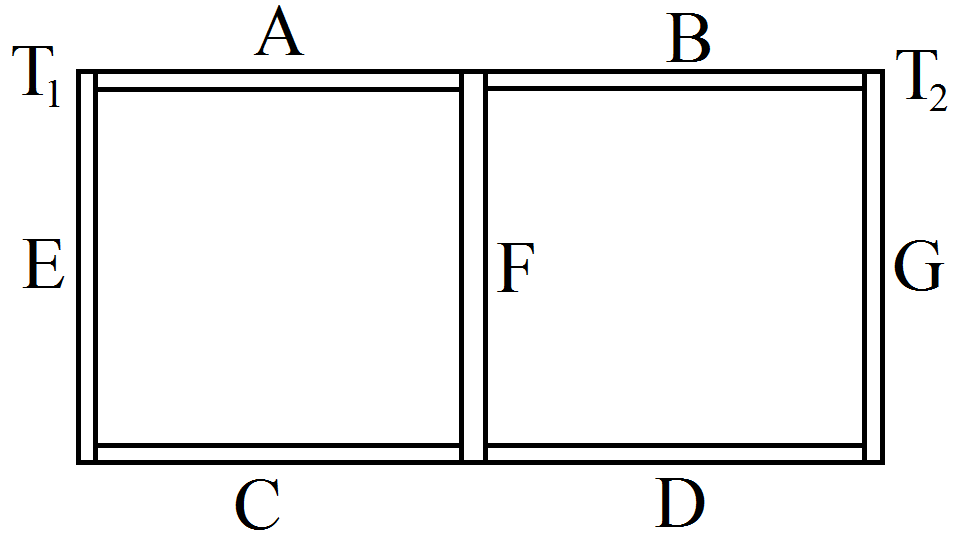
Seven rods $A, B, C, D, E, F$ and $G$ are joined as shown in figure. All the rods have equal cross-sectional area A and length l. The thermal conductivities of the rods are $K_A = K_c = K_0, K_B = K_D = 2K_0, K_E= 3K_0, K_F = 4K_0$, and $K_G = 5K_0$. The rod E is kept at a constant temperature $T_2$ and the rod G is kept at a constant temperature $T_2(T_2 > T_1)$.
  1. Show that the rod F has a uniform temperature $\text{T}=\frac{(\text{T}_1+2\text{T}_2)}{3}.$
  2. Find the rate of heat flowing from the source which maintains the temperature $T_2$.
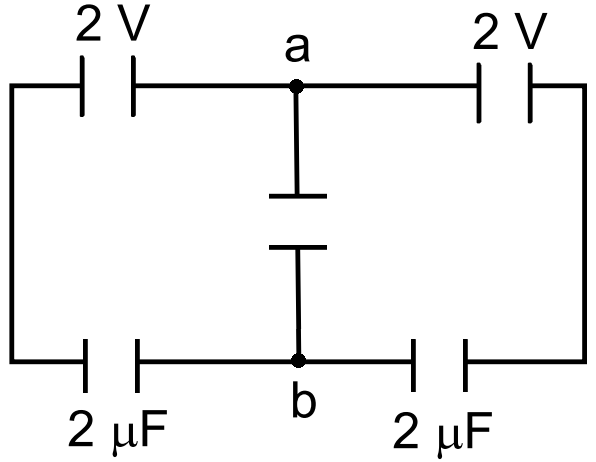
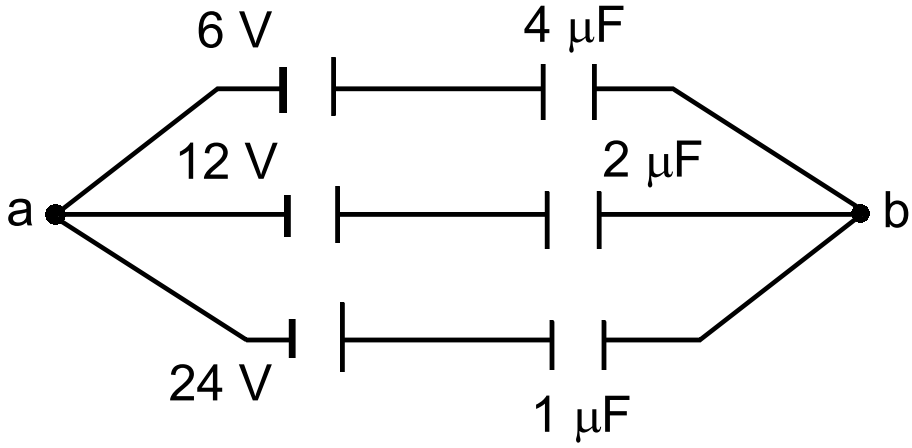
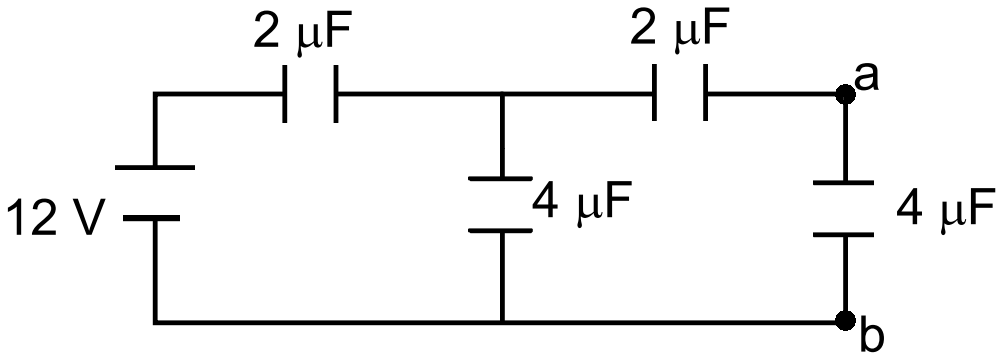
Find the potential difference $V_a - V_b$ between the points a and b shown in each part of the figure.


A pendulum bob of mass $50g$ is suspended from the ceiling of an elevator. Find the tension in the string if the elevator:
  1. Goes up with acceleration $1.2m/s^2$.
  2. Goes up with deceleration $1.2m/s^2$.
  3. Goes up with uniform velocity.
  4. Goes down with acceleration $1.2m/s^2$.
  5. Goes down with deceleration $1.2m/s^2$.
  6. Goes down with uniform velocity.
A pendulum clock gives correct time. What is the error in time per day if the length increases by 0.05%?
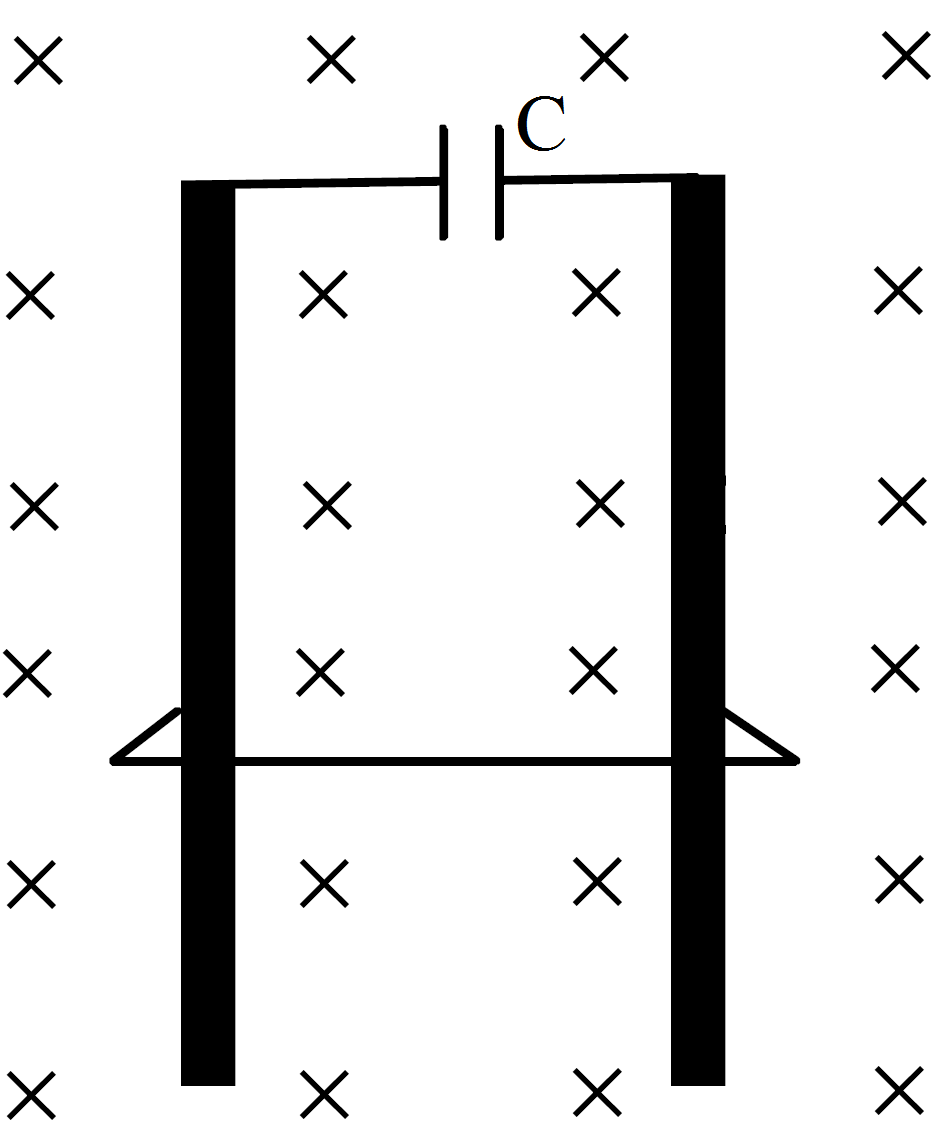
A wire of mass m and length l can slide freely on a pair of smooth, vertical rails (figure). A magnetic field B exists in the region in the direction perpendicular to the plane of the rails. The rails are connected at the top end by a capacitor of capacitance C. Find the acceleration of the wire neglecting any electric resistance.
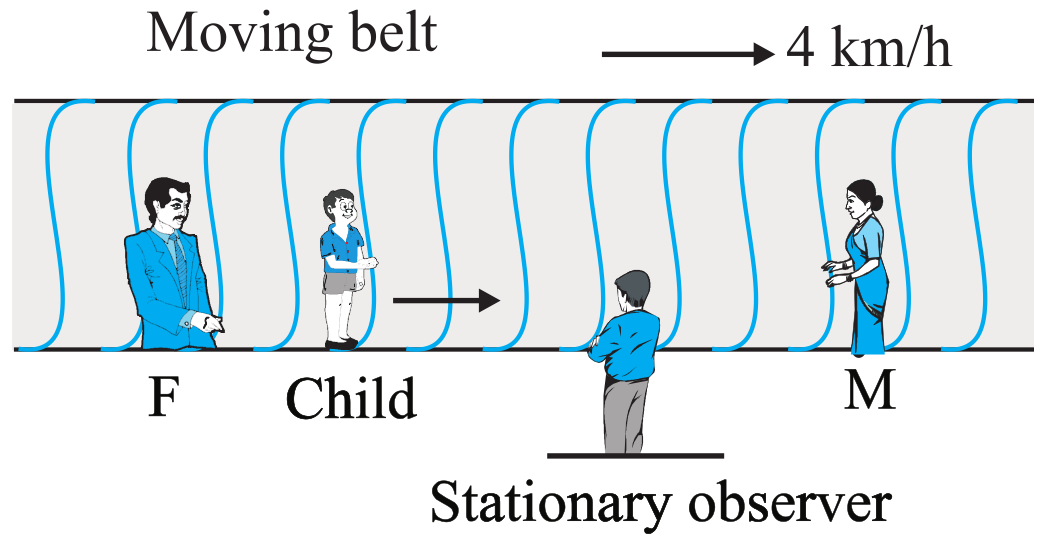
On a long horizontally moving belt a child runs to and fro with a speed $9km h^{–1}$​​​​​​​ (with respect to the belt) between his father and mother located $50$ m apart on the moving belt. The belt moves with a speed of $4km h^{–1}$​​​​​​​. For an observer on a stationary platform outside, what is the
  1. speed of the child running in the direction of motion of the belt?.
  2. speed of the child running opposite to the direction of motion of the belt?
  3. time taken by the child in (a) and (b)?
Which of the answers alter if motion is viewed by one of the parents?
The motion of a particle executing simple harmonic motion is described by the displacement function, $x ( t )= A$ $\cos \left(\omega_t+\omega\right)$.
If the initial $(t=0)$ position of the particle is 1 cm and its initial velocity is $\omega cm / s$, what are its amplitude and initial phase angle? The angular frequency of the particle is $\pi s ^{-1}$. If instead of the cosine function, we choose the sine function to describe the $SHM : x = B \sin (\omega t+a)$, what are the amplitude and initial phase of the particle with the above initial conditions.
Wavelength of two notes in air are $\frac{80}{195}\text{m}$ and $\frac{80}{193}\text{m}.$ Each note produces five beats per second with a third note of a fixed frequency. Calculate the velocity of sound in air.
We would like to prepare a scale whose length does not change with temperature. It is proposed to prepare a unit scale of this type whose length remains, say $10cm$. We can use a bimetallic strip made of brass and iron each of different length whose length (both components) would change in such a way that difference between their lengths remain constant. If $a_{iron} = 1.2 \times 10^{-5}/ K$ and $a_{brass} = 1.8 \times 10^{-5}/ K$, what should we take as length of each strip?
Two trains A and B of length $400m$ each are moving on two parallel tracks with a uniform speed of $72km h^{–1}$ in the same direction, with A ahead of B. The driver of B decides to overtake A and accelerates by $1m s^{–2}$. If after $50s$, the guard of B just brushes past the driver of A, what was the original distance between them?