MCQ
1 tesla is equal to:
- A$10^{-7}$ Gauss
- B$10^{-4}$ Gauss
- ✓$10^{4}$ Gauss
- D$10^{-8}$ Gauss
Generate a complete, print-ready paper with questions like this in minutes — across 16+ boards, with answer keys.
Which of the following is coldest planet
|
(a) Mercury |
(b) Pluto |
(c) Earth |
(d) Venus |
The size of an object as perceived by an eye depends primarily on:
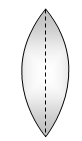
A convex lens has a focal length f. It is cut into two parts along the dotted line as shown in the figure. The focal length of each part will be
|
(a) |
(b) f |
(c) |
(d) 2f |
A potential difference of 2V is applied between the opposite faces of a Ge crystal plate of area 1 cm2 and thickness 0.5 mm. If the concentration of electrons in Ge is 2 × 10¹⁹/m3 and mobilities of electrons and holes are 0.36  and 0.14 respectively, then the current flowing through the plate will be
|
(a) 0.25 A |
(b) 0.45 A |
(c) 0.56 A |
(d) 0.64 A |
The magnetic field at the centre of a circular coil of radius r carrying current I is  . The field at the centre of another coil of radius 2 r carrying same current I is
  . The ratio
  is
is
|
(a) |
(b) 1 |
(c) 2 |
(d) 4 |
In a hydrogen discharge tube it is observed that through a given cross-section 3.13  electrons are moving from right to left and 3.12 protons are moving from left to right. What is the electric current in the discharge tube and what is its direction
|
(a) 1 mA towards right |
(b) 1mA towards left |
|
(c) 2mA towards left |
(d) 2mA towards right |
Electric potential of earth is taken to be zero because earth is a good
|
(a) Insulator |
(b) Conductor |
(c) Semiconductor |
(d) Dielectric |
Electrical conductivity of a semiconductor
|
(a) Decreases with the rise in its temperature |
|
(b) Increases with the rise in its temperature |
|
(c) Does not change with the rise in its temperature |
|
(d) First increases and then decreases with the rise in its temperature |


