Question
1. The river flows on. but sluggishly. Its surface is calm and smooth. It turns a bend at a clump of bamboo, gently passes a grove of coconut, and now drifts along with scarcely a murmur. It is wide, too. The engineers had needed unspeakable amounts of concrete and rupees to build a. bridge across and when that went into disrepair with age and neglect, they had needed even more to build another.

2. A white flock of river terns appears. The terns energetically flap their pointed wings but mill around in an effort to go slow with the flow. They swoop and pick off the surface of the river small silvery fish, floating strangely immobile on their side. It is easy work, for the fish are already dead. Dozens of dead fish follow, sprinkled and sparkling on the river, killed by poison or by the shock of a dynamite blast upriver. Some feed the terns, others drift here and there and below the culverts and into the nearby fields.

3. The waters had travelled far to get here. Blown by winds from across the ocean, meeting the great escarpment of the Western Ghats, rising as vapours and clouds, and bringing wafting mists and torrential rains, they had drenched the slopes of the mountains a hundred miles away. Not all the rain had travelled to the ocean, though much had arisen from the forest itself, ascending through millions of roots and stems and transpiring through billions of leaves and leaflets. The forests pump hundreds of thousands of litres of water into the air, and the air returns some of it, falling as rain condensing as dew.

4. Some water flows overland, much sinks in, sponged by the leaf litter and soil. Below the surface, the water travels through pipes and aquifers far and wide, recharging ground waters, emerging as springs, and draining into streams feeding the wide river.

5. The clear waters from the forest join other waters; waters that gather the dust and carry the soil from the road-scars and the mine-wounds on the hill slopes. Waters deadened by passage through dams and reservoirs, through stagnant pools and ponds with hyacinth and algae. Waters carrying earth from furrowed and exposed soils under alien plantations of acacia and eucalyptus and from forests whose litter-blankets are harvested to enrich the nearby fields with nutriment. Waters course in with the wastes of villages, towns, and cities, the effluents of factories and the oil and fuel spilled from lorries washed on the banks.

6. The river passes a rice mill. The mill faces away from the river, with a neat garden in front and a mound of waste dumped at the back, on the banks.

7. The story of the river seems so familiar. The river gives us water for irrigation, drinking, washing, bathing, navigation, and power. It provides us fish and fertile plains, reeds and recreation. But, does the river really give to us all this or do we just take it? And what do we give back, if anything?

17.1. On the basis of your reading of the passage, answer the following questions in 30–40 words each:

(a) What is the course that a river takes?

(b) What are terns? What do they pick from the river that is strange?

(c) The river is a combination of different waters. What are these?

(d) The writer says at the end ‘whether the river gives us or we take it’. What is the difference between the two?

17.2. On the basis of your reading of the passage, answer of the following:

(a) In para 5, the synonym of ‘motionless’ is .................................. .

(i) dirtily

(ii) moving

(iii) stagnant

(iv) muddy

(b) In para 5, the antonym of ‘deplete’ is .................................. .

(i) carry

(ii) spilled

(iii) gather

(iv) enrich

(c) The strange thing in case of the water birds, terns is that they catch only those fish which are alive.(True/False)

(d) The river not only gives us water for irrigation, drinking, bathing, power, etc. but also provides us .................................. .
Answer

17.1 (a) River flows on its own slowly, bends here and there, passes across trees and groves and then widens on to the plains.

(b) Terns are water birds which come in flocks to the river. Their food is the fish. They swoop over the river and catch the fish. The strange thing in this case is that these fishes are dead.

(c) There is the water that comes from the mountain clear and pure, goes into the forests, around trees and then there is the rain water. To this gets added water that comes as effluent from factories, waste from villages and towns and then this becomes impure.

(d) When somebody gives something to us we will take it with respect, gratitude and reverence. But ‘Man’ believes in taking, we take water as we need it for everything but never show respect to it.

17.2 (a) (iii) (b) (iv) (c) False (d) fish and fertile plains, reeds and recreation

Need a full question paper?

Generate a complete, print-ready paper with questions like this in minutes — across 16+ boards, with answer keys.

Start Generating Free

Similar questions

1. Holiday plans ensure promises and perils; hopes and hypes; excitement and disappointments; good news and not-so good news. The not-so good news is that not everyone can plan a vacation to Arctic Alps or to the Amazon to observe the diverse wildlife there for obvious reasons like lack of resources or failure to obtain the necessary sanction for leave. The good news is that there is so much to eye, experience and enjoy right where you live — amidst the hustle and bustle of the city. For some, vacation is all about circus, beach, malls, movies, shopping, reading, and catching up on sleep. But for nature enthusiasts this is the time to make the best of wildlife spotting in the city.

2. The wildlife diversity and cities have always been treated as an oxymoron. In highly congested and thickly populated cities with myriad skyscrapers, flyovers, malls, heritage buildings and magnificent edifices, it’s incredibly amazing to see wildlife abound in their own secretive niches. The untamed birds, insects, mammals, reptiles, amphibians and of course the untended plants are all over.

3. Summer vacations render an awesome reprieve from stressful work schedule and also bestow time to enjoy pleasant surprises over a cup of morning coffee in your own neighbourhood — birds bustly engaged in nesting, squirrels relishing mangoes, spotted owlets peeping out in stupor from tree holes and butterflies hovering over the peacock flower.

4. This is the season to look out for the fiery blossoms of Indian Laburnum and Copper Pods. Indian Laburnum otherwise known as the golden shower tree produces gorgeous pendulous inflorescence and is a greatly refreshing sight to behold when the city is actually reeling under heat wave. Copper pods produce dense clusters of crinkled yellow flowers which are highly relished by the rose-ringed parakeets.

5. Birds to look out for in home gardens and in the neighbourhood are magpie robins, tree pies, golden orioles, wagtails, hoopoes, sunbirds, sparrows, tailor birds, barbets, kingfishers, woodpeckers, babblers, warblers, bee-eaters, bulbuls, shrikes, shikras, koels, pipits, parakeets, rollers and sometimes even the rare paradise flycatchers and pitta. Each bird has a distinct call and it is easy to trace their presence to their sound, which is otherwise not too easy.

Attempt the following questions on the basis of the passage you have read:
(a) An ‘oxymoron’ here refers to .................................. .
(i)oxygen (ii)skyscrapers
(iii)wildlife in congested cities (iv)flyovers


(b) For nature enthusiasts, vacation is the time to .................................. .

(i)look for wildlife around (ii)go for movies
(iii)catch up on sleep (iv)go to mall
(c) One feels stressed in summer vacation because one needs time to look for wildlife around the city.(True/False)
(d) We find magpie robins and tailor birds around our houses.(True/False)
(e) Birds can be distinguished because every bird has .................................. .
(f) People plan a vacation to the Amazon or Arctic Alps to observe .................................. .
(g) Summer is the season to look out for the fiery blossoms of .................................. and .................................. .
(h) Find the word from the passage which means the same as “easy to see or understand”. (para 1)
1. There was a time when human interference was minimum, the number of wild animals was quite high and there was no problem of their protection or conservation.
2. Due to the irrational use of natural and biotic resources of the Earth in the past, most of the wildlife has been destroyed beyond retrieval. According to an estimate, in India about 200 species of wild animals and birds have become extinct and another 2500 are on the verge of extinction. Some of them are black buck, chinkara, wolf, swamp deer, nilgai, Indian gazelle, antelope, tiger, rhinoceros, gir lion, crocodile, flamingo, pelican, bustard, white crane, grey heron, mountain quail, etc.
3. In India, the Government and NGOs are taking keen interest in protection of wildlife. The Wildlife Protection Act, 1972, has several provisions for the conservation of wildlife. As many as 165 game sanctuaries and 21 national parks have been deployed to protect the natural habitat and wild animals. Apart from this, Wildlife Conservation Week is also celebrated from 1st to 7th October every year. But still there is a long way to go in this direction.
4. Preservation of wildlife does not mean a blanket protection to all faunal and floral species; rather it implies a proper, judicious control over the multiplication of plants and animals which interact together to provide a proper environment to man whose very existence is in peril today.
5. It is our urgent duty to protect the natural splendour of ecosystems and to evolve a system of coexistence with every living creature upon the Earth.
Image
Based on your understanding of the passage, answer the questions given below:
I. Infer one reason for the following, based on the information in the passage. The number of wild animals was quite high and there was no problem of their protection or conservation. 
II. Select the appropriate options to fill in the blanks.
Most of the wildlife has been________ beyond________ due to the irrational use of natural resources on the Earth.
I. destroyed
II. retrieval
III. desertion
IV. build
V. revived
a. I and II$\quad$b. II and III$\quad$c. III and IV$\quad$ d. IV and V
III. Complete the following analogy correctly with a word/phrase from the passage.
Flowers: Garden::________: Sanctuaries
(Clue: Just like flowers are in a garden, similarly________ are in the sanctuaries.)
IV. Select the correct option to complete the sentence.
Judicious control over the multiplication of plants and animals which provide
a. natural splendour of ecosystem
b. proper environment to man
c. blanket protection
d. happy and comfortable living
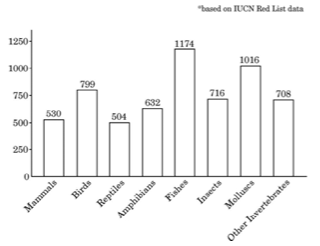
V. According to the graph, which is the most vulnerable animal species and the least vulnerable from the graph.
I. Birds
II. Insects
III. Fishes
IV. Reptiles
V. Insects
VI. Mammals
VII. Molluses
a. I and II$\quad$ b. III and IV$\quad$ c. V and VI$\quad$d. VI and VI
VI. Fill in the blanks by selecting the correct option.
The Wildlife Protection Policy has several provisions for________ of wildlife.
a. conservation$\quad$b. safety$\quad$ c. habitation$\quad$ d. well being
VII. List any two examples of Government and NGOs trying to protect the wildlife.
VIII. List one reason why the Government makes certain recommendations for protection of wild animals.
Hyderabad The city of nizams

1. Golconda Fort

In the 16th century, when Golconda was the capital of the Qutb Shahi Kingdom, it is believed that a shepherd boy came across an idol on the hill. It was then that the Kakatiya dynasty’s ruler built this fort. The fort is 120 m high. After it was captured by Aurangazeb, the Mughal emperor, the fort fell into ruins.

The beautiful ruins of the fort have a story to tell. They make you wonder how the fort may have looked in its days of glory and grandeur. The fort also hosts a sound and light show every day, and the history of this fort is narrated in such an interesting manner that even a child can understand and enjoy it.

The climb to the fort is a tedious one and unless you are physically fit, you should avoid the climb and relax in the gardens below. The view from the top is breathtaking and should suffice as a counter-incentive to laziness.

2. CHARMINAR

The next place to visit is the Charminar. The literal meaning of this monument is ‘four minarate’. There is a mosque on the second floor. It is said that when the state was engulfed by the plague, Sultan Muhammad Quli Qutb Shah, the fifth ruler of the Qutb Shahi dynasty, prayed to end the plague and promised to build a mosque in the very place where he was praying. Thus, Charminar came into being!

The walk from the bottom to the top of the monument is a little spooky, owing to the narrowness of the pathway and the steepness of the steps. Once you reach the top after successfully negotiating the tiers of balconies, the view of the crowds bustling below will surely lift your spirits.

Make sure you visit the nearby Laad Bazaar, where there are rows of shops selling the famous Hyderabadi glass bangles and lac bangles.

3. SALAR JUNG MUSEUM

The Salar Jung Museum is the third largest museum in the country and boasts of owning the biggest one- man collection of antiques in the world. A visit to the Salar Jung Museum is a must, even if you are not a fan of antique stuff. You can view the Nizam’s collection of textiles, arms, metalware, ivory carvings, Indian bronzes and carpets.

The main attraction is definitely the Musical Clock, made by Cook and Kelvy of England. Inside the clock is a timekeeper. Every hour, he comes out and beats a gong as many times as the time indicates. Another attraction at the museum is the Veiled Rebecca, an amazing sculpture made by the Italian sculptor, Giovanni Maria Benzoni.

Attempt the following questions on the basis of the passage you have read:

(a) Golconda was the capital of the Qutab Shahi kingdom in the .................................. .

(i) 15th century

(ii) 16th century

(iii) 17th century

(iv) 14th century

(b) The main attraction in the Salar Jung Museum is .................................. .

(i) metalware

(ii) collection of carpets

(iii) musical clock

(iv) ivory carvings

(c) Veiled Rebecca is kept in the Golconda fort.(True/False)

(d) Laad Bazaar famous for its glass and lac bangles is near Charminar.(True/False)

(e) .................................. ruler decided to build a fort on the hill.

(f) The Mughul ruler .................................. attacked and captured the fort which led to its ruin.

(g) ‘Four minarates’ is the meaning of the word .................................. .

(h) Find the word from the passage which means the same as “the quality of being great”. (para 1)

1. Science and technology not only dominate the psyche of humanity but also the whole biosphere. How does science influence civilisation and how is it related to human happiness?

2. The original, cosmic evolution of the biosphere was one that promoted, supported, nourished, sustained and enhanced life. Life went on adding to the evolution with newer species and ecosystems, even more beautiful and vibrant than the ones before. Our biosphere accommodated a pleasant weather cycle and climate system to support these newer species, keeping everything in dynamic equilibrium.

3. Now the biosphere is overburdened and ailing. Some of our ecosystems have already collapsed, while others are at death’s door. Ever increasing pollution coupled with over-exploitation of natural resources and greenhouse gas emissions is driving several species towards extinction. This is not a phenomenon that has occurred by itself, and neither has it been caused by, human beings alone. But it definitely has been spurred by so-called advances in technology.

4. In this millennium, we no longer live in a, biosphere — we are inhabitants of a technosphere. A technosphere is an impaired biosphere that has no affinity with values of life nor with sustainability and evolution of life. Although technology has empowered civilisation, it has also reduced it to being a mere tool of science and technology. And when the whole civilisation turns technocratic, science and technology are bound to dominate, causing life to shrink. The intensifying climate crisis is but a symptom of the biosphere’s illness and life’s gradual collapse.

5. We’ve reached a point where we are intolerant of anything remotely “unscientific” in our contemporary world. Scientists look for alternatives, but even these solutions are sought in the same domain that has caused these problems. In short, we are stewing in a soup of our own making.

6. So, what would be meaningful for the welfare of humans? Naturally, something that would enhance life, serve to integrate ecosystems and cleanse our environment. Enhancement of life includes betterment of human life and vice versa. If life shrinks, we cannot blossom.

7. Science and technology by themselves are neutral; it is the way we use them that has either a positive or negative impact on our lives and environment. And when we use science in a manner that increases unsustainability and unhappiness in our lives, how can we rely blindly on science for our happiness?

7.1. On the basis of your reading of the passage, answer the following questions.
(a) How did the biosphere evolve over a period of time?
(b) How has this equilibrium got disturbed now?
(c) What is the difference between biosphere and technosphere?
(d) Man needs to use ‘science and technology’ in a sensible manner. Explain.

7.2. On the basis of your reading of the passage, answer of the following:

(a) In para 3, the synonym of ‘disappeared’ is .................................. .
(i) disintegrated
(ii) settle
(iii) ailing
(iv) collapsed

(b) In para 5, the antonym of ‘nearly’ is .................................. .
(i) sought
(ii) remotely
(iii) stewing
(iv) domain

(c) A biosphere that has been destroyed by the advancement of technology is called an ecosystem. (True/False)

(d) Today many of the ecosystems have collapsed due to increasing .................................. .

1. Diabetes is a metabolism abnormality that affects the way your body uses blood sugar (glucose), your main source of energy. To understand diabetes, you have to start from the beginning - with food. Your body converts a portion of the food you eat and digest into glucose. Glucose is then absorbed into your bloodstream, where it can enter the individual cells of tissue throughout your body to be used as energy. Before your cells will let glucose in, however, they need the help of insulin.

2. Insulin is a hormone produced by your pancreas - a gland located just behind your stomach. Normally, insulin acts like a master key, unlocking the doors of your cells and allowing glucose inside. To simply maintain this process, such as at night when you’re asleep, the pancreas releases a low level of insulin on a constant basis. When necessary, such as after a meal, your pancreas increases insulin supply to meet demand.

3. After you eat a meal or a snack, your pancreas releases more insulin to make sure the extra glucose in your bloodstream can enter your cells. If you have more glucose than you need, your body can remove the excess from your blood and store it in your liver and muscles or convert it to fat. Then, when you run low on fuel, your body can release this stored energy back into your bloodstream, where insulin is waiting to usher it into your cells.

4. If you have diabetes, this whole process goes awry. Instead of entering cells throughout your body, excess glucose builds up in your bloodstream and some of it may eventually be excreted in your urine. This can happen when your pancreas doesn’t produce enough insulin (Type 1 diabetes), when your cells have become resistant to the effects of insulin (Type 2 diabetes) or, more commonly, when both of these problems occur.

Attempt the following questions on the basis of the passage you have read:

(a) Diabetes is a .................................. .

(i) nervous disorder

(ii) metabolic disorder

(iii) throat disorder

(iv) physical disorder

(b) If your body does not produce sufficient insulin you have .................................. .

(i) type 2 diabetes

(ii) jaundice

(iii) type 1 diabetes

(iv) iron deficiency

(c) Diabetes is related to the sugar intake of your food.(True/False)

(d) Secretions of pancreas decrease during the night.(True/False)

(e) Glucose from food gets absorbed in our .................................. .

(f) Pancreas produces the hormone .................................. .

(g) Find the word from the passage which means the same as “change from one form to another”. (para 1)

(h) Find the word from the passage which means the same as “regular”. (para 2)

1. Necessity is indeed the mother of invention. When areas in and around Leh began to experience water shortages, life didn't grind to a halt. Why? Because a retired civil engineer in the Jammu and Kashmir Government came up with the idea of artificial glaciers.
2. Ladakh, a cold desert at an altitude of 3,000-3,500 meters above sea level, has a low average annual rainfall rate of 50 mm . Glaciers have always been the only source of water. Agriculture is completely dependent on glacier melt, unlike the rest of river/monsoon-fed India. But over the years, with increasing effects of climate change, rainfall and snowfall patterns have been changing, resulting in severe shortage and drought situations. Given the extreme winter conditions, the window for farming is usually limited to one harvest season.
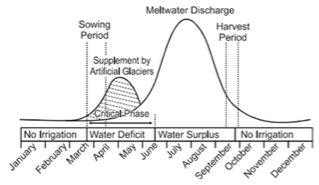
3. It is located between the natural glacier above and the village below. The one closer to the village and lowest in altitude melts first, providing water during April-May, the crucial sowing season. Further, layers of ice above melt with the increasing temperature, thus ensuring continuous supply to the fields.
Therefore, farmers have been able to manage two crops instead of one. It costs about 1,50,000 and above to create a glacier.
4. Fondly called the glacier man, he has designed over 15 artificial glaciers in and around Leh since 1987. In recognition of his pioneering effort, he was conferred the Padma Shri by The President of India.
5. There are a few basic steps followed while creating an artificial glacier. River or stream water at high altitude is diverted to a shaded area of the hill, facing north, where the winter sun is blocked by a ridge or a mountain range. At the start of winter i.e., in November, the diverted water is made to flow on sloping hills facing distribution channels. Stone embankments are built at regular intervals which impede the flow of water, making shallow pools which freeze, forming a cascade of ice along the slope. Ice formation continues for 3-4 months resulting in a large accumulation of ice which is referred to as an 'artificial glacier'.
Image

Based on your understanding of the extract, answer the questions below:
I. Infer one reason for the following, based on information in paragraph 1.
Areas in and around Leh began to experience water shortage but life didn't grind to a halt.
II. Select from the passage the appropriate option to fill in the blanks:
Agriculture is completely dependent on ________ unlike the rest of river/monsoon-fed India.
a. rainfall pattern
b. climate change
c. glaciers melt
d. extreme winter conditions
III. Write any two steps followed while creating the glaciers.
IV. List two reason why artificial glaciers seem the best option.
V. Complete the following analogy correctly with a word/phrase from paragraph 3:
icing: cake:: layers: ________
VI. Select the correct option to complete the following sentence: At the start of winter the diverted water is made to flow ________.
a. on sloping hills facing distribution channels.
b. on high altitude.
c. on ice-cold water level.
d. on mountain range.
VII. Fill in the blank by selecting from the passage the correct option:
The ________ have been the only source of water in areas in and around Ladakh.
a. glaciers$\quad$b. rivers$\quad$c. streams$\quad$d. water springs
VIII. The word 'located' in paragraph 3 means ___________.
1. The Canadian Rocky Mountains or the Canadian Rockies are breathtakingly beautiful mountains and a precious ecosystem with a wealth of wildlife, lush forests including a large variety of flora, ice-capped peaks, and among the most picturesque landscapes you will see in the world. Glaciers, waterfalls, lakes, limestone caves, canyons and fossils of marine animals are part of this splendid landscape.

2. The Canadian Rocky Mountain Parks are a UNESCO World Heritage site. According to the UNESCO, this province has outstanding physical features — “Classic illustrations of glacial geological processes – including ice fields, remnant valley glaciers, canyons and exceptional examples of erosion and deposition – are found throughout the area. The Burgess Shale Cambrian and nearby Precambrian sites contain important information about the earth’s evolution.”

3. For all these reasons, these mountains are also great for activities like hiking, fishing, trekking, mountaineering, skiing, camping, and sightseeing. This presents a challenge to the authorities because these beautiful mountains and valuable ecosystem could likely be a target for commercial and economic exploitation.

4. So, how is this challenge being met? The Rockies are divided into many national parks. This means these are protected areas with many controls in place regarding what can be done within the area – whether by commercial organisations, other groups or the private visitor. This World Heritage label also implies many responsibilities for protection and special care.

5. For example, there is the Canadian Rocky Mountain Parks World Heritage Site where four national parks are part of this site – Banff, which is the most popular and visited; Jasper; Kootenay: and Yoho. Besides, there are three British Columbia Provincial Parks — Hamber Provincial Park, the Mount Assiniboine Provincial Park and Mount Robson Provincial Park. These parks are known for their scenic splendour and together receive millions of visitors annually.

6. The idea is to encourage tourism and allow visitors to enjoy the spectacular Rockies but to ensure that it is done in harmony with the environment. Many hotels exhort their guests to help them in being environment-friendly by asking them not to waste water or electricity. Some of them provide guestroom amenity containers which are biodegradable. At some resorts you will see environmental reminder tips in the rooms.

7. There is a strong civic consciousness ingrained within the citizens so that the environment is preserved.

Attempt the following questions on the basis of the passage you have read:

(a) ........................ get attracted to these Rockies.

(i)The people who love hiking, fishing, trekking, etc.

(ii)The people who want to be eco-friendly

(iii)The environmentalists

(iv)All of the above

(b) The number of parks the Rockies are divided into are .................................. .

(i)three(ii)four

(iii)two(iv)five

(c) Very few visitors like to visit these parks as rules are not in place.(True/False)

(d) The National Park status has helped preserve the ecosystem.(True/False)

(e) The Canadian Rockies have a precious ecosystem with a wealth of .................................. .

(f) These Rockies are also world .................................. sites.

(g) Amenity containers are provided to the guests in the guestroom that are .................................. .

(h) Find the word from the passage which means the same as “excellent”. (para 1)

(1) A thorough study conducted across several villages of north-west India unveiled fascinating insights into the mural* landscape. It revealed that a significant majority, comprising around 80%, of these vibrant artworks are meticulously crafted by the villagers themselves. Approximately 15% of the murals stem from collaborative endeavours between villagers and local or visiting artists.
(2) Surprisingly, a small fraction, about 5%, of the murals are the result of sponsored initiatives, often commissioned by governmental or non-governmental organisations. These murals convey social messages ranging from education and environmental conservation to public health awareness.
(3) Among the locally crafted murals, nearly 55% depict scenes from mythology and folklore, celebrating the rich cultural heritage of the region. About 26% of these murals showcase daily life in the villages, capturing moments of joy, struggle, and victory. The remaining 19% feature abstract or contemporary themes, reflecting evolving artistic expressions in rural settings.
(4) Further analysis reveals that among the locally crafted murals, nearly 63% are found on the walls of community centres, temples, and other public spaces. Around 27% adorn the exterior walls of residential houses. The remaining 10% are scattered across schools, health centres, and other institutional buildings, serving as educational tools and sources of inspiration for the younger generation.
(5) To delve deeper, comparisons across various parameters such as demographic patterns, subject matter, techniques, community engagement, and impact are crucial. Analysing these facets not only provides a comprehensive understanding of mural creation in northwest Indian villages but also unveils avenues for cultural preservation, community development, and creative expression.
a large painting or artwork that is typically created directly on a wall or ceiling
Answer the following questions, based on the passage above
I. What does the use of the phrase 'fascinating insights' by the writer, in paragraph 1, tell us about their feelings?
A. The writer is expressing surprise.
B. The writer is conveying boredom and frustration.
C.The writer is indicating interest and enthusiasm.
D. The writer is showing disappointment.
II. Select the option that is true for the assertion and reason given below.
Assertion : The murals in northwest Indian villages are meticulously crafted.
Reason : The murals are the result of collaborative endeavours.
A. Both the assertion and reason are true, and the reason is the correct explanation of the assertion.
B. Both the assertion and reason are true, but the reason is not the correct explanation of the assertion.
C. The assertion is true, but the reason is false.
D. The assertion is false, but the reason is true.
III. Identify the word that indicates that the writer anticipated a higher percentage of sponsored initiative murals?
IV. How do the murals in northwest Indian villages contribute to community engagement and awareness?
V. Read the given prompt and select the correct option in the brackets to fill in the blank.
In Hari's village, a mural depicting sustainable farming practices is showcased on the Panchayat office wall.
The percentage of mural type that this would be counted in is. (26% / 19% / 55%)
VI. What does the highest percentage of different mural themes suggest about the artistic preferences and cultural priorities in northwest Indian villages?
VII. Complete the sentence suitably.
The significant presence of murals on the exterior walls of residential houses highlight.
VIII. Complete the following with a suitable reason.
The most likely reason the writer believes that a mural can serve as an 'educational tool' is because it can
IX. In the context of the last paragraph, describe the significance of comparing various parameters such as demographic patterns, subject matter, techniques, community engagement, and impact in understanding the mural landscape in northwest Indian villages.
1. Both water and energy are integral parts of the human body. By weight about 60% of an adult’s human body is water and dehydration is one of the biggest single killers of children in the modern world. Life without water is unthinkable.

2. The human body needs its daily intake of food to meet its energy requirements, which according to the Food and Agriculture Organisation of the United Nations is about 1,800 kcal per day. Life without energy is equally unthinkable.

3. The energy that we take in through food again depends, amongst other things, on water for agriculture and often that water is pumped with electrical or other forms of energy. The interdependence of energy and water is evident.

4. The world at large seeks both water and energy security. The Worldwatch Institute estimates that about 1.1 billion people (one-fifth of the world population) live in areas of physical water scarcity and another 1.6 billion are facing economic water shortage (when existing water sources cannot be used because of a lack of investment in water-related infrastructure). We will probably have a world population of 9 billion by 2050 and this will put further stress on the water sourcing and supply systems. Here again the connection between energy and water is evident: globally about 70% of water consumption is for the agricultural sector. No water, no food, no energy.

5. Actions needed on the water front include reduction in water usage for agriculture (pump efficiencies, drip irrigation instead of flood irrigation, change in crop patterns), recycling of water, extensive rainwater harvesting programmes, stoppage of run-offs and water pollution.

6. We need to remind ourselves that the fossil-based energy that we rely on so much for almost everything we do is stored solar energy. And while the sun took over 150 million years to store its energy in the form of fossil fuels, we are busy discharging that huge solar battery in a matter of a few hundred years.

Attempt the following questions on the basis of the passage you have read:

(a) By weight, an adult human body contains about .................................. water.

(i)60% (ii)65%

(iii)70% (iv)75%

(b) The interdependence of ............................ is evident.

(i)energy and food(ii)food and water

(iii)energy and light(iv)energy and water

(c) By 2050, the increase in population will put stress on water and supply system.(True/False)

(d) Human beings are utilizing the fossil fuel very fast.(True/False)

(e) Not many children die of dehydration in today’s age and time.(True/False)

(f) Fuel found under the ground such as coal is called .................................. fuel.

(g) We get .................................. from food.

(h) Find the word from the passage which means the same as “clear/easily seen”. (para 3)

1. “Music expresses that which cannot be put into words and that which cannot remain silent,” said the French poet Victor Hugo. Early on Saturday morning, 20 participants of the Times Passion Sufi Poetry and Music Appreciation Trail embarked on a journey into this ineffable nature of Sufi music through the streets of the capital.

2. The weekend passion trail started with a heritage walk at the Bada Batashewala Mahal and then moved on to the chilla of Hazrat Nizamuddin Auliya, where the iconic saint is said to have lived for around 65 years. The walk was filled with facts on the historical significance of these places.

3. Serendipitously, the day, January 30, was also the final day of celebrations of the 712th urs of Hazrat Nizamuddin Auliya. On the occasion, the trail participants visited the Nizamuddin Auliya dargah, where they offered a chadar, participated in the prayers of fadia ceremony and listened to qawwali renditions.

4. The trail was led by Dhruv Sangari, a well-known Sufi singer who began training in classical music at the age of seven. Having developed an interest in Sufism, he also trained under the late Ustad Nusrat Fateh Ali Khan Saheb and has been performing professionally since 2001 with his troupe Rooh.

5. The heritage walk was followed by a session on Sufi poetry and music, where Sangari introduced the participants to the message of peace and love that Sufism delivers. Sufism is a mystical dimension that focuses on purification of oneself. This aspect is felt strongly in Sufi music too. The famous Persian poet and Sufi master, Jalal ad-Din Muhammad Rumi, once said, “I want to sing like the birds sing, not worrying about who hears or what they think.”

6. Sangari’s session also featured revelatory anecdotes from the lives of Sufi saints like Baba Bulleshah, and their links to the origin of popular Sufi poetry. “This was my first heritage walk and Sufi trail in Delhi and I was completely hooked. Dhruv made all the difference,” said Renuka Mahajan, a participant.

7. The passion trail culminated with a musical rendition by Sangari and his troupe where they performed popular Sufi songs like ‘Chhap Tilak Sab Chheen’ and ‘Dama Dam Mast Kalandar’.

8. “I was moved to witness in the eyes of the participants the joy of having felt something profound,” said the trail architect himself.

On the basis of your reading of the passage, choose the correct option for any ten of the following questions.

(a) At Nizamuddin Auliya’s dargah, the trail participants offered .................................. .

(i) flowers

(ii) clothes

(iii) chaddar

(iv) eatables

(b) The person who spoke on the Sufism and the message of peace and love at the meet is .................... .

(i) Dhruv Sangari

(ii) Ustad Nusrat Fateh Ali Khan

(iii) Renuka Mahajan

(iv) Rumi

(c) Who trained Sangari?

(i) Ustad Nusrat Fateh Ali Khan

(ii) Victor Hugo

(iii) Hazrat Nizamuddin

(iv) None of the above

(d) Which one of the following statements is true?

1. Victor Hugo was a French Poet.

2. Victor Hugo was an American Poet.

3. Victor Hugo was a sufi Poet.

4. None of the above.

(i) option 2 only

(ii) option 1 only

(iii) option 3 only

(iv) option 4 only

(e) Which one of the following statement (s) is true?

(i) Dhruv Sangari began training in classical music at the age of ten.

(ii) Dhruv Sangari began training in classical music at the age of seven.

(iii) Dhruv Sangari began training in classical music at the age of eleven.

(iv) None of the above.

(f) Who is Jalal ad-Din Muhammad Rumi?

(i) A Persian poet and Sufi master.

(ii) A French Poet.

(iii) An American Poet.

(iv) None of the above.

(g) On the occasion, which one of the following activities was not undertaken by the trail participants?

(i) Visit to the Nizamuddin Auliya dargah.

(ii) Offering a chadar on dargah.

(iii) Participation in the prayers of fadia ceremony. (iv) Qawwali competition.

(h) Which one of the following did not feature in Sangari’s session?

(i) Revelatory anecdotes from the lives of Sufi saints like Baba Bulleshah.

(ii) Anecdotes of the link of Baba Bulleshah to the sufi poetry.

(iii) Musical rendition by Sangari.

(iv) Release of a collection of book on history of Sufism.

(i) The heritage walk was followed by …………………………….. .

(i) a session on Sufi poetry

(ii) sufi music

(iii) a musical rendition by Sangari

(iv) all of the above

(J) According to the passage, what is ‘Sufism’?

(i) Sufism is a mystical dimension that focuses on purification of oneself.

(ii) It is a religion.

(iii) It is the name of famous musical band.

(iv) None of the above.

(k) Find the word from para 6 which means the same as ‘making people aware of something’.

(i) revelatory

(ii) serendipitously

(iii) renditions

(iv) mystical

(l) Find the word from para 1 which means the same as ‘too great to be expressed in words’.

(i) ineffable

(ii) anecdotes

(iii) culminated

(iv) profound