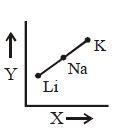
- ABlue colour intensity decreases during electrolysis
- BBlue colour intensity remains constant if $Cu-$ electrode used.
- ✓$pH$ of solution is $8$ after electrolysis
- DAt anode $O_2$ gas liberated during electrolysis
Hence, the $C u S O_{4}$ is acidic in nature and it's $p H$ is thus less than $7$ always.
The incorrect statement is $p H$ of solution after electrolysis is $8$.
Generate a complete, print-ready paper with questions like this in minutes — across 16+ boards, with answer keys.
(image)
($1$) The compound $R$ is
(image)
($2$) The compound $T$ is
($A$) glycine
($B$) alanine
($C$) valine
($D$) serine
Given the answer question ($1$) and ($2$) 

Assertion $(A) :$ $I - Cl$ is more reactive than $I _{2}$.
Reason $(R):$ $I - Cl$ bond is weaker than $I-I$ bond.
In the light of the above statements, choose the most appropriate answer from the options given below:
$k =\left(6.5 \times 10^{12} \,s ^{-1}\right) e ^{-26000 K / T }$
is followed for the decomposition of compound $A$. The activation energy for the reaction is $.....\,kJ$ $mol ^{-1}$. [nearest integer]
(Given: $R =8.314 \,J\, K ^{-1}\, mol ^{-1}$ )
$\begin{array}{*{20}{c}}{ - OAc}\\{\rm{I}}\end{array}$$\begin{array}{*{20}{c}}{ - OMe}\\{{\rm{II}}}\end{array}$$\begin{array}{*{20}{c}}{ - OS{O_2}Me}\\{{\rm{III}}}\end{array}$$\begin{array}{*{20}{c}}{ - OS{O_2}C{F_3}}\\{{\rm{IV}}}\end{array}$
The order of leaving group ability is