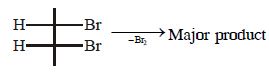
MCQ
$\,$
  • A

  • B


  • D

Answer

Correct option: C.

c

Need a full question paper?

Generate a complete, print-ready paper with questions like this in minutes — across 16+ boards, with answer keys.

Start Generating Free

Similar questions

Liquid $'M\ ’$ and liquid $'N\ ’$ form an ideal solution. The vapour pressures of pure liquids $'M\ ’$ and $'N\ ’$ are $450$ and $700\,\ce{mm\ Hg,}$ respectively at the same temperature. Then correct statement is$: ( x_M =$ mole fraction of $'M\ ’$ in solution $;x_N =$ mole fraction of $'N\ ’$ in solution$; y_M =$ mole fraction of $'M\ ’$ in vapour phase; $y_N =$ mole fraction of $'M\ ’$ in vapour phase$)$
Which of the following element has maximum density
Which of the following point never be same for $IP$ and $EA$
phenol $\xrightarrow[\Delta ]{{{H^ \oplus }}}X\,\xrightarrow[{(2)\,\,{H_2}O/Zn}]{{(1)\,\,{O_3}}}Y\,;$ $Y$ is
Consider the data given below for hypothetical reaction $A \to X$

$Time  (sec)$                     Rate $(mol\,  L^{-1} sec.^{-1})$

$0$                                      $1.60 \times 10^{-2}$

$10$                                    $1.60 \times 10^{-2}$

$20$                                    $1.60 \times 10^{-2}$

$30$                                    $1.60 \times 10^{-2}$

From the above data, the order of reaction is

Identify the correct statement regarding entropy
Which one of the following statements for $D.I.$ Mendeleeff, is incorrect?
Henry Moseley studied characteristic X-ray spectra of elements. The graph which represents his observation correctly is: (Given $v =$ frequency of $X$-ray emitted; $Z =$ atomic number)
Match each of the diatomic molecules in Column $I$ with its property $/$ properties in Column $II$.
Column $I$ Column $II$
$(A)$ $\mathrm{B}_2$ $(p)$ Paramagnetic
$(B)$ $\mathrm{N}_2$ $(q)$ Undergoes oxidation
$(C)$ $\mathrm{O}_2^{-}$ $(r)$ Undergoes reduction
$(D)$ $\mathrm{O}_2$ $(s)$ Bond order $\geq 2$
  $(t)$ Mixing of   $'\mathrm{s}\ '$ and $'\mathrm{p}\ '$ orbitals
The order of the magnitude of first ionisation potentials of $Be, B, N$ and $O$ is