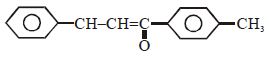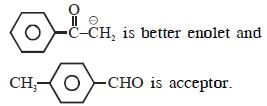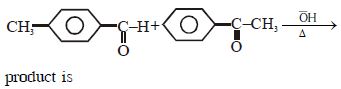
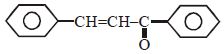
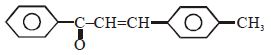
MCQ
$ $
  • A


  • C

  • D

Answer

Correct option: B.

b

Need a full question paper?

Generate a complete, print-ready paper with questions like this in minutes — across 16+ boards, with answer keys.

Start Generating Free

Similar questions

Fusion of $MnO _2$ with $KOH$ in presence of $O _2$ produces a salt $W$. Alkaline solution of $W$ upon eletrolytic oxidation yields another salt $X$. The manganese containing ions present in $W$ and $X$, respectively, are $Y$ and $Z$. Correct statement($s$) is (are)

$(1)$ $Y$ is diamagnetic in nature while $Z$ is paramagnetic

$(2)$ Both $Y$ and $Z$ are coloured and have tetrahedral shape

$(3)$ In both $Y$ and $Z , \pi$-bonding occurs between $p$-orbitals of oxygen and $d$-orbitals of manganese.

$(4)$ In aqueous acidic solution, $Y$ undergoes disproportionation reaction to give $Z$ and $MnO _2$.

$C{H_3}COCl\mathop {\xrightarrow{{2H}}}\limits_{Pd/BaS{O_4}} C{H_3}CHO + HCl;$

The above reaction is called

At higher altitudes the boiling point of water lowers because
$1\,\,M$ of $10 \,ml$ ${H_2}S{O_4}$  will completely neutralise


In order to complete the reaction $1 - {\text{Pentyne}}\xrightarrow{{\text{a}}}4 - {\text{Octyne}}\xrightarrow{{\text{b}}}cis{\text{ 4 Octene}}$ $a$ and $b$ will be

$(1)$ $NaN{H_2};\mathop {C{H_3}}\limits^{{\text{a}}\,\,\,\,\,\,\,} C{H_2}Br$:${H_2},{\text{ }}\mathop {{\text{(one mole)}}}\limits^{\text{b}} {\text{ }}Pd{\text{ or }}Ni$

$(2)$ $NaN{H_2};C{H_3}C{H_2}C{H_2}Br$:${H_2}{\text{ (two moles) }}Pd{\text{ or }}Ni$

$(3)$ $NaN{H_2};C{H_3}C{H_2}C{H_2}Br$:${H_2},{\text{ (one mole) }}Pd{\text{ or }}Ni$

$(4)$ $NaN{H_2};C{H_3}C{H_2}C{H_2}Br$:$B{H_3},{H_2}{O_2},O{H^ - }$

Which of the following conformers for ethylene glycol is most stable ?
A liquid mixture contain $10\  moles$ of $A$  $(P_A^0= 200\ mm\  Hg)$ and $10\  moles$ of $B$  $( P_B^0 = 100\ mm\ Hg )$. The vapour pressure over liquid mixture is $160\  mm\  Hg$. Which is correct statement ?
If a reaction has the experimental rate expression rate $= K [A]^2[B]$, if the concentration of $A$ is doubled and the concentration of $B$ is halved, the what happens to the reaction rate
In the reaction $2A + B \to {A_2}B$, if the concentration of $A$ is doubled and of $B$ is halved, then the rate of the reaction will
Arrange the following Cobalt complexes in the order of increasing Crystal Field Stabilization Energy $(CFSE)$ value.

Complexes : $\left[\mathrm{CoF}_{6}\right]^{3-},\left[\mathrm{Co}\left(\mathrm{H}_{2} \mathrm{O}\right)_{6}\right]^{2+},\left[\mathrm{Co}\left(\mathrm{NH}_{3}\right)_{6}\right]^{3+}$ and $\left[\mathrm{Co}(\mathrm{en})_{3}\right]^{3+}$

$\quad\quad\quad\quad\quad\quad A\quad\quad\quad\quad \quad B\quad\quad\quad\quad\quad\quad C\quad\quad\quad\quad\quad\quad D$

Choose the correct option: