MCQ
 Image
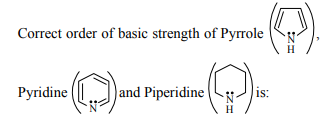
  • Piperidine > Pyridine > Pyrrole
  • B
    Pyrrole > Pyridine > Piperidine
  • C
    Pyridine > Piperidine > Pyrrole
  • D
    Pyrrole > Piperidine >Pyridine

Answer

Correct option: A.
Piperidine > Pyridine > Pyrrole
(A)
Order of basic strength is
$N \left( sp ^3\right.$, localized lone pair $)> N \left( sp ^2\right.$, localized lone pair $)> N \left( sp ^2\right.$, delocalized lone pair, aromatic $)$
$\therefore$ Piperidine $>$ Pyridine $>$ Pyrrole

Need a full question paper?

Generate a complete, print-ready paper with questions like this in minutes — across 16+ boards, with answer keys.

Start Generating Free

Similar questions

Which of the following ligands is expected to bidentate
The $pH$ at which $\mathrm{Mg}(\mathrm{OH})_2\left[\mathrm{~K}_{\mathrm{sp}}=1 \times 10^{-11}\right]$ begins to precipitate from a solution containing $0.10 \ \mathrm{M}$ $\mathrm{Mg}^{2+}$ ions is_____
Which of the following reactions end in finite time
Match List $I$ with List $II$ :

LIST $I$

(Compound /

Species)

LIST $II$

(Shape / Geometry)

$A$ $\mathrm{SF}_4$ $I$ Tetrahedral
$B$ $\mathrm{BrF}_3$ $II$ Pyramidal
$C$ $\mathrm{BrO}_3^{-}$ $III$ See saw
$D$ $\mathrm{NH}_4^{+}$ $IV$ Bent $T$-shape

Choose the correct answer from the options given below :

The least number of oxyacids are formed by
Hydrogen behaves as oxidising agent when it reacts with
$[Figure]$ $\mathop {\xrightarrow{{(i)\,CHC{l_3} + KOH}}}\limits_{(ii)\,C{H_2}{I_2} + NaOH} [X]$

here $‘X’$ is :

An organic compound has been found to possess the Empirical formula $C{H_2}O$ and molecular weight $90$. The molecular formula of it is $(C = 12,\,\,H = 1,\,{\rm{and}}\,\,O = 16)$
The geometry of $XeOF_4$ by $VSEPR$ theory is
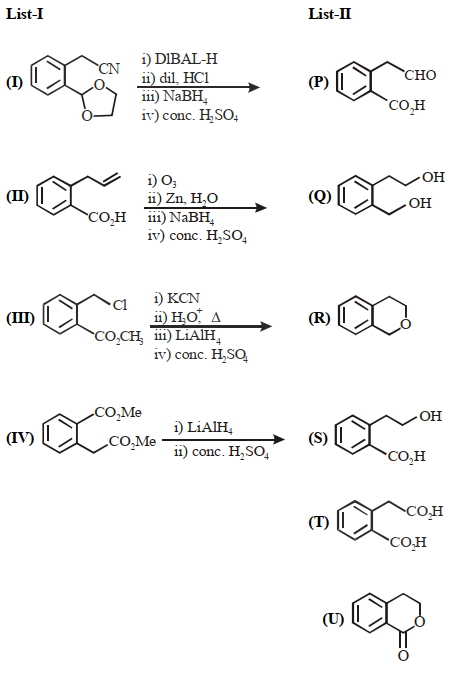
Answer the following by appropriately matching the lists based on the information given in the paragraph $List-I$ includess starting materials and reagents of selected chemical reactions. $List-II$ gives structures of compounds that may be formed as intermediate products and/or final products from the reactions of $List-I$

($1$) Which of the following options has correct combination considering $List-I$ and $List-II$?

$(1) (III), (S), (R)$ $(2) (IV), (Q), (R)$ $(3) (III), (T), (U)$ $(4) (IV), (Q), (U)$

($2$) Which of the following options has correct combination considering $List-I$ and $List-II$?

$(1) (I), (Q), (T), (U)$ $(2) (II), (P), (S), (U)$ $(3) (II), (P), (S), (T)$ $(4) (I), (S), (Q), (R)$

Give the answer quetion ($1$) and ($2$)