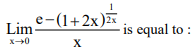
MCQ
 Image
  • A
    e
  • B
    $\frac{-2}{ e }$
  • C
    0
  • D
    $e-e^2$

Answer

$\operatorname{Lim}_{x \rightarrow 0} \frac{e-e^{\frac{1}{2 x} \ln (1+2 x)}}{x}$
$=\operatorname{Lim}_{x \rightarrow 0}(-e) \frac{\left(e^{\frac{\ln (1+2 x)}{2 x}-1}-1\right)}{x}$
$=\operatorname{Lim}_{x \rightarrow 0}(-e) \frac{\ln (1+2 x)-2 x}{2 x^2}$
$=(-e) \times(-1) \frac{4}{2 \times 2}=e$

Need a full question paper?

Generate a complete, print-ready paper with questions like this in minutes — across 16+ boards, with answer keys.

Start Generating Free

Similar questions

The solution of the equation $\frac{{dy}}{{dx}} = \frac{y}{x}\left( {\log \frac{y}{x} + 1} \right)$ is
The equation of the parabola with focus $(a, b)$ and directrix $\frac{x}{a} + \frac{y}{b} = 1$ is given by
Let $f: R \rightarrow R$ be given by $f(x)=(x-1)(x-2)(x-5)$. Define $F(x)=\int_0^x f(t) d t, x>0$. Then which of the following options is/are correct?

$(1)$ F has a local minimum at $x=1$

$(2)$ $F$ has a local maximum at $x=2$

$(3)$ $F ( x ) \neq 0$ for all $x \in(0,5)$

$(4)$ F has two local maxima and one local minimum in $(0, \infty)$

Let ${A_0}{A_1}{A_2}{A_3}{A_4}{A_5}$ be a regular hexagon inscribed in a circle of unit radius. Then the product of the lengths of the line segments ${A_0}{A_1},\,\,{A_0}{A_2}$ and ${A_0}{A_4}$ is
Cube root of $217$ is
If $A = \{x : x$ is a multiple of $4\}$ and $B = \{x : x$ is a multiple of $6\}$ then $A \cap B$ consists of all multiples of
Let $f(x)=\frac{2^{x+2}+16}{2^{2 x+1}+2^{x+4}+32}$. Then the value of $8\left(\mathrm{f}\left(\frac{1}{15}\right)+\mathrm{f}\left(\frac{2}{15}\right)+\ldots+\mathrm{f}\left(\frac{59}{15}\right)\right)$ is equal to
The sum of all integral values of $\mathrm{k}(\mathrm{k} \neq 0$ ) for which the equation $\frac{2}{x-1}-\frac{1}{x-2}=\frac{2}{k}$ in $x$ has no real roots, is ..... .
A line $4x + y = 1$ passes through the point $A(2,\; - \;7)$ meets the line $BC$ whose equation is $3x - 4y + 1 = 0$ at the point $B$. The equation to the line $AC$ so that $AB = AC$, is
If $G $ and  $G' $ be the centroids of the triangles $ABC $ and $A'B'C'$ respectively, then $\overrightarrow {AA} ' + \overrightarrow {BB'} + \overrightarrow {CC} ' = $