MCQ
$16 \sin \left(20^{\circ}\right) \sin \left(40^{\circ}\right) \sin \left(80^{\circ}\right)$ is equal to 
  • A
    $\sqrt{3}$
  • $2 \sqrt{3}$
  • C
    $3$
  • D
    $4 \sqrt{3}$

Answer

Correct option: B.
$2 \sqrt{3}$
b
$16 \sin 20^{\circ} \sin 40^{\circ} \sin 80^{\circ}$

$=16 \sin 40^{\circ} \sin 20^{\circ} \sin 80^{\circ}$

$=4(4 \sin (60-20) \sin (20) \sin (60+20))$

$=4 \times \sin \left(3 \times 20^{\circ}\right)$

${[\because \sin 3 \theta=4 \sin (60-\theta) \times \sin \theta \times \sin (60+\theta)]}$

$=4 \times \sin 60^{\circ}$

$=4 \times \frac{\sqrt{3}}{2}=2 \sqrt{3}$

Need a full question paper?

Generate a complete, print-ready paper with questions like this in minutes — across 16+ boards, with answer keys.
Start Generating Free

Similar questions

Using the principal values of the inverse trigonometric functions the sum of the maximum and the minimum values of $16\left(\left(\sec ^{-1} x\right)^2+\left(\operatorname{cosec}^{-1} x\right)^2\right)$ is :
The position of a moving car at time $t$ is given by $f(t)=a t^{2}+b t+c, t>0,$ where $a, b$ and $c$ are real numbers greater than $1 .$ Then the average speed of the car over the time interval $\left[ t _{1}, t _{2}\right]$ is attained at the point
If $f (x) = \frac{{{{\log }_{\sin |x|}}{{\cos }^3}x}}{{{{\log }_{\sin |3x|}}{{\cos }^3}\left( {\frac{x}{2}} \right)}}for |x| <\frac{\pi }{3} x \ne 0= 4$ for $x = 0$then, the number of points of discontinuity of f in $\left( { - \frac{\pi }{3},\,\frac{\pi }{3}} \right)$ is
The curve for which the intercept cut off by any tangent on $y-$ axis is proportional to the square of the ordinate of the point of tangency is (where $c_1$ and $c_2$ are arbitrary constants)
Let $\mathrm{y}=\mathrm{y}(\mathrm{x})$ be the solution of the differential equation $\frac{d y}{d x}=2(y+2 \sin x-5) x-2 \cos x$ such that $\mathrm{y}(0)=7$. Then $\mathrm{y}(\pi)$ is equal to :
Rolle's theorem is true for the function $f(x) = {x^2} - 4 $ in the interval
Let $X$ be a family of sets and $R$ be a relation on $X$ defined by $‘A$ is disjoint from $B’$. Then $R$ is
The triangle formed by the points $(0, 7, 10), (-1, 6, 6), (-4, 9, 6)$ is
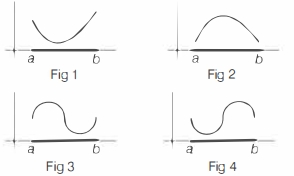
The following figure shows the graph of a differentiable function $y=f(x)$ on the interval $[a, b]$ (not containing $0$ ).  $FIGURE$  Let $g(x)=\frac{f(x)}{x}$. Which of the following is a possible graph of $y=g(x) ?$
Corner points of the feasible region determined by the system of linear constraints are $(0,3), (1,1)$ and $(3,0) .$ Let $Z=p x+q y,$ where $p, q\,>\,0 .$ Condition on $p$ and $q,$ so that the maximum of $Z$ occurs at $(3,0)$ and $(1,1)$ is $.....$