MCQ
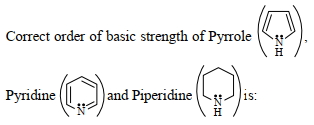
- ✓Piperidine $>$ Pyridine $>$ Pyrrole
- BPyrrole $>$ Pyridine $>$ Piperidine
- CPyridine $>$ Piperidine $>$ Pyrrole
- DPyrrole $>$ Piperidine $>$ Pyridine
$\mathrm{N}\left(\mathrm{sp}^3\right.$, localized lone pair $)>\mathrm{N}\left(\mathrm{sp}^2\right.$, localized lone
pair $)>\mathrm{N}\left(\mathrm{sp}^2\right.$, delocalized lone pair, aromatic)
$\therefore$ Piperidine $>$ Pyridine $>$ Pyrrole
Generate a complete, print-ready paper with questions like this in minutes — across 16+ boards, with answer keys.
$NH_2-CH_2-CH_2-NH_2 +$ $\begin{array}{*{20}{c}}
{COO{C_2}{H_5}} \\
{|\,\,\,\,\,\,\,\,\,\,\,\,\,\,\,\,\,\,\,\,\,\,\,\,\,} \\
{COO{C_2}{H_5}}
\end{array}$ $\xrightarrow{{Pyridne}}$ $[X]$
$[X]$ will be :

Statement $I :$ In $CuSO _{4} .5 H _{2} O , Cu - O$ bonds are present.
Statement $II :$ In $CuSO _{4} .5 H _{2} O$, ligands coordinating with $Cu$ $(II)$ ion are $O$-and $S$-based ligands.
In the light of the above statements, choose the correct answer from the options given below