MCQ
$ $

  • B

  • C

  • D

Answer

Correct option: A.

a
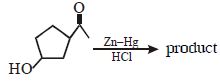
$Zn-Hg/HCl$ can reduce all functional group.

Need a full question paper?

Generate a complete, print-ready paper with questions like this in minutes — across 16+ boards, with answer keys.
Start Generating Free

Similar questions

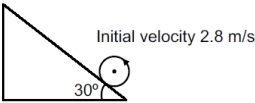
A sphere pure rolls on a rough inclined plane with initial velocity $2.8 \,m / s$. Find the maximum distance on the inclined plane. (in $m$)
An electric dipole is placed in an electric field generated by a point charge
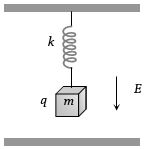
Time period of a block suspended from the upper plate of a parallel plate capacitor by a spring of stiffness $k$ is $T$. When block is uncharged. If a charge $q$ is given to the block them, the new time period of oscillation will be
A uniform rod of density $\rho $ is placed in a wide tank containing a liquid of density ${\rho _0}({\rho _0} > \rho )$. The depth of liquid in the tank is half the length of the rod. The rod is in equilibrium, with its lower end resting on the bottom of the tank. In this position the rod makes an angle $\theta $ with the horizontal
Which of the following is the most precise device for measuring length 
The de$-$Broglie wavelength of electron in $3^{\text {rd }}$ orbit of $He ^{+1}$ ion is approximately (in $A^{\circ}$)
A plane electromagnetic wave of frequency $28 \,MHz$ travels in free space along the positive $x$-direction. At a particular point in space and time, electric field is $9.3 \,V / m$ along positive $y$-direction. The magnetic field (in $T$ ) at that point is
The voltage gain of a triode depends upon
A free neutron decays into a proton but a free proton does not decay into neutron. This is because
A Hydrogen-like atom has atomic number $Z$. Photons emitted in the electronic transitions from level $n=4$ to level $n=3$ in these atoms are used to perform photoelectric effect experiment on a target metal. The maximum kinetic energy of the photoelectrons generated is $1.95 \mathrm{eV}$. If the photoelectric threshold wavelength for the target metal is $310 \mathrm{~nm}$, the value of $Z$ is. . . . . . .[Given: $h c=1240 \mathrm{eV}-\mathrm{nm}$ and $R h c=13.6 \mathrm{eV}$, where $R$ is the Rydberg constant, $h$ is the Planck's constant and $c$ is the speed of light in vacuum]