Question
Image

Answer

Get the step-by-step solution for this question inside the Vidyadip app.

Get the answer in the app

Need a full question paper?

Generate a complete, print-ready paper with questions like this in minutes — across 16+ boards, with answer keys.

Start Generating Free

Similar questions

How will you distinguish between the following pairs of compounds:
Chloroform and carbon tetrachloride.
  1. The cell in which the following reaction occurs:
$2 Fe^{3+} (aq) + 2 I^- (aq) \longrightarrow 2 Fe^{2+}(aq) + I2 (s)$

has $\text{E}^0_{\text{cell}}$ = 0·236 V at 298 K. Calculate the standard Gibbs energy of the cell reaction. (Given : $1 F = 96,500 C mol^{-1}$)
  1. How many electrons flow through a metallic wire if a current of 0·5 A is passed for 2 hours? (Given : $1 F = 96,500 C mol^{-1}$)
Explain the nomenclature of phenols by giving examples.
Write down the reactions taking place in different zones in the blast furnace during the extraction of iron.
Illustrate how copper and zinc give different products on reaction with $HNO_3.$
The reaction between $A$ and $B$ is first order with respect to $A$ and zero order with respect to $B$. Fill in the blanks in the following table:
Experiment $[A]/mol\ L^{-1}$ $[B]/mol\ L^{-1}$ Initial rate$/mol\ L^{-1}\ min^{-1}$
$I$ $0.1$ $0.1$ $2.0 \times 10^{-2}$
$II$ $-$ $0.2$ $4.0 \times 10^{-2}$
$III$ $0.4$ $0.4$ $-$
$IV$ $-$ $0.2$ $2.0 \times 10^{-2}$
The rate of a particular reaction triples when temperature changes from $50°C$ to $100°C$. Calculate the activation energy of the reaction.[log $3 = 0.4771; R = 8.314 JK^{-1} mol^{-1}$].
  1. What is the role of Sulphur in the vulcanization of rubber?
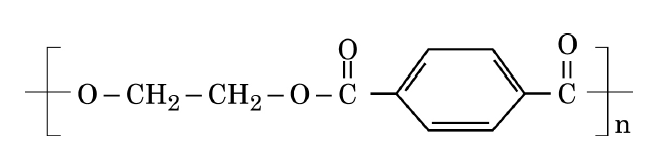
  2. Identify the monomers in the following polymer:
  1. Arrange the following polymers in the increasing order of their intermolecular forces:
Terylene, Polythene, Neoprene.
Complte the following reaction :
$CH _3 COOH \frac{\text { (i) } X _2 R e d P }{\text { (iii) } H _2 O }$
Write one difference in each of the following:
  1. Multimolecular colloid and Associated colloid.
  2. Coagulation and Peptization.
  3. Homogeneous catalysis and Heterogeneous catalysis.