Question

1A current flows through an infinitely long straight wire. The magnetic field produced at a point 1 metres away from it is

(a)  2   

(b)  

(c)  2 

(d) 2π  

Answer

(c)  2 

Need a full question paper?

Generate a complete, print-ready paper with questions like this in minutes — across 16+ boards, with answer keys.

Start Generating Free

Similar questions

When ultraviolet rays fall on the surface of metal, photoelectric effect does not occur but the following will casue :
For $n$-type Germanium impurity dopped in Germanium is :
The angle between the plane of vibration and plane of polarisation is :

A 36 W galvanometer is shunted by resistance of 4W. The percentage of the total current, which passes through the galvanometer is

(a) 8 %

(b) 9 %

(c) 10 %

(d) 91 %

 If the wavelength of electromagnetic radiation is doubled, what will happen to the energy of photons?
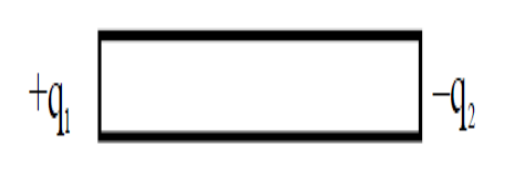
A thin insulator rod is placed between two unlike point charges +q1​ and q2​. For this situation tick the correct alternative (s):

In a streamline flow:
  1. The speed of a particle always remains same.
  2. The velocity of a particle always remains same.
  3. The kinetic energies of all the particles arriving at a given point are the same.
  4. The momenta of all the particles arriving at a given point are the same.
Two point charges 2 C and -6 C attract each other with a force of 12 N. A negative charge of 2 C is added to each of the above charges, now the force between them is:

The distance between charges 5 ×   and -2.7   is 0.2 m. The distance at which a third charge should be placed in order that it will not experience any force along the line joining the two charges is

(a) 0.44 m

(b) 0.65 m

(c) 0.556 m

(d) 0.350 m

If m1 and m2 are the refractive indices of the materials of core and cladding of an optical fibre, then the loss of light due to its leakage can be minimised by having

(a) m1 > m2

(b) m1 < m2

(c) m1 = m2

(d) None of these