MCQ
$(1+\tan\theta+\sec\theta)(1+\cot\theta-\text{cosec }\theta)=$
  • A
    0
  • B
    1
  • 2
  • D
    -1

Answer

Correct option: C.
2
$(1+\tan\theta+\sec\theta)(1+\cot\theta-\text{cosec }\theta)$
$=1+\cot\theta-\text{cosec }\theta+\tan\theta+\cot\theta\tan\theta$
$=-\tan\theta\text{ cosec }\theta+\sec\theta+\sec\theta\cot\theta-\sec\theta\text{ cosec }\theta$
$=1+\frac{\cos\theta}{\sin\theta}-\frac{1}{\sin\theta}+\frac{\sin\theta}{\cos\theta}+1-\frac{\sin\theta}{\cos\theta}\times\frac{1}{\sin\theta}$
$=\frac{1}{\cos\theta}+\frac{1}{\cos\theta}\times\frac{\cos\theta}{\sin\theta}-\frac{1}{\cos\theta}\times\frac{1}{\sin\theta}$
$=2+\frac{\cos\theta}{\sin\theta}+\frac{\sin\theta}{\cos\theta}-\frac{1}{\sin\theta}-\frac{1}{\cos\theta}$
$=\frac{1}{\cos\theta}+\frac{1}{\sin\theta}-\frac{1}{\sin\theta\cos\theta}$
$=2+\frac{\sin\theta}{\cos\theta}+\frac{\cos\theta}{\sin\theta}-\frac{1}{\sin\theta\cos\theta}$
$=2+\frac{\sin^2\theta+\cos^2\theta}{\sin\theta\cos\theta}-\frac{1}{\sin\theta\cos\theta}$
$=2+\frac{1}{\sin\theta\cos\theta}-\frac{1}{\sin\theta\cos\theta}=2$

Need a full question paper?

Generate a complete, print-ready paper with questions like this in minutes — across 16+ boards, with answer keys.
Start Generating Free

Similar questions

If one root the equation $2x^2+ kx + 4 = 0$ is $2$, then the other root is :
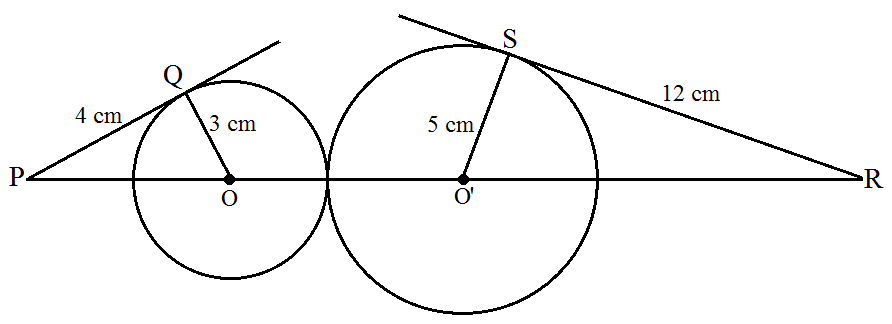
In the figure, $PR =$
Directions : In the following questions, the Assertions $(A)$ and Reason $(s) \ (R)$ have been put forward. Read both the statements carefully and choose the correct alternative from the following :
Assertion : Degree of a zero polynomial is not defined.
Reason : Degree of a non $-$ zero constant polynomial is $0$
A circus artist is climbing a long rope, which is tightly stretched and tied from the top of a vertical pole to the ground. The ratio of the height of the pole to the length of the string is $ 1 : \sqrt2.$ The angle made by the rope with the ground level is :
If in two triangles $\text{DEF}$ and $\text{PQR}, \angle D=\angle Q$ and $\angle R=\angle E,$ then which of the following is not true?
The areas of two similar triangles $\triangle\text{ABC}$ and $\triangle\text{DEF}$ are 1$44 \ cm^2$ and $81 \ cm^2$ respectively. If the longest side of larger $\triangle\text{ABC}$ be 36\ cm, then the longest side of the smaller triangle $\triangle\text{DEF}$ is:
In the given data if $n = 230, l = 40, cf = 76, h = 10, f = 65,$ then its median is :
In a $\triangle\text{ABC},$ point $D$ is on side $AB$ and point $E$ is on side $AC,$ such that $\text{BCED}$ is a trapezium. If $DE : BC = 3 : 5,$ then $\text{Area}(\triangle\text{ADE}):\text{Area}(\Box\text{BCED})=$
If $\triangle\text{ABC} \sim \triangle\text{DEF}$ such that $AB = 1.2\ cm$ and $DE = 1.4\ cm,$ the ratio of the areas of $\triangle\text{ABC}$ and $\triangle\text{DEF}$ is :
$AP$ and $AQ$ are tangents drawn from a point $A$ to a circle with centre $O$ and radius $9\ cm.$ If $OA = 15\ cm,$ then $AP + AQ =$