Question
Image

Answer

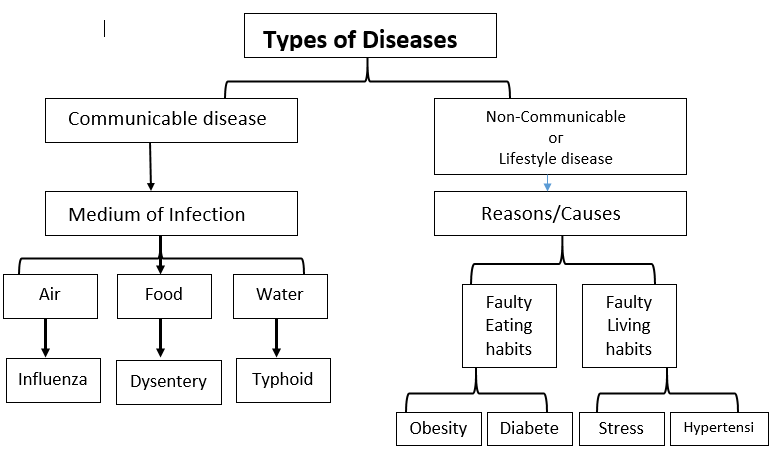
Types of Diseases


Diseases are of two types. They can be communicable diseases or non-communicable ones. The non-communicable diseases are also called lifestyle diseases. For communicable diseases, the medium of infection can be either air (e.g. Influenza), food (e.g. dysentery) or water (e.g. typhoid). In the case of non-communicable diseases, there are two reasons for their spread. The first is faulty eating habits and the second is faulty living habits. Faulty eating habits lead to obesity and diabetes, while faulty living habits lead to stress and hypertension. People must be made aware of all this to be able to take care and lead a healthy life.

Need a full question paper?

Generate a complete, print-ready paper with questions like this in minutes — across 16+ boards, with answer keys.

Start Generating Free

Similar questions

Here is some information about the gulmohar and banyan trees. Write the information in tabular form:

             The gulmohar tree is of medium size. It has a modest height. It has compound leaves that have a feathery appearance. They are bright green in colour. Its flowers are bright orange, red and yellow. However, It bears no fruits. It has leguminous roots that have nitrogen-fixing properties. The banyan tree, on the other hand, is large and tall. Its leaves too are largel They are glossy green in colour and elliptical in shape. The banyan tree has no flowers, but it does bear the fig fruit. The banyan tree is specially noticeable for its aerial roots.

Read the following information and complete the table given below it:

                Chandrayaan-2, India's second mission to the Moon will, for the first time, unravel secrets around the Moon's South Pole. Chandrayaan-2 is a three-part spacecraft an orbiter, a lander and a rover. The lander is named Vikram after Vikram Sarabhai. the founder of the Indian space programme. The rover is named Pragyan, meaning 'wisdom'.

                Chandrayaan-2 was launched on 22 July atop ISRO's GSLV Mk-III at 2:43 p.m. from the Satish Dhawan Space Centre at Sriharikota. Performing as expected, the rocket released Chandrayaan-2 In a highly elliptic orbit around Earth about 17 minutes later. In fact, it was released 6,000 km higher than planned. The solar arrays on Chandrayaan-2 developed smoothly as the probe began its journey.
TableInformation
(1) Name of the Mission  
(2) Date of Launch  
(3) Centre of Launch 
(4) Name of the Rover 
(5) Founder of Indian Space Programme 
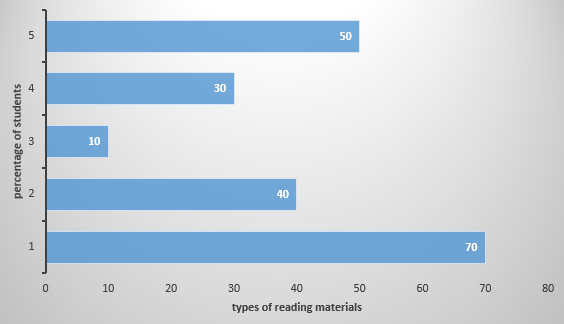
Observe the following bar-graph, which shows the results of a survey of the reading habits of the students studying in schools. Write a paragraph and suggest a suitable title:
Image

Observe the flow chart of process of cheese and other dairy products from milk and write a paragraph on it. Suggest a suitable title:

1. Crop Production for cow feed
2. Milk Production Cows give milk
3. Transporta- tion to dairy plant
4. Processing Cheese and dairy
5. Final trans- portation to consumers' home
6. Retail
7. Transporta- tion to stores
8. Packaging
Read the following information and complete the table given below. Give a suitable title:
           Turties and tortoises are closely related. They are both reptiles from the same family (Testudines or Chelonia). The main difference between the two is that turtle is the name given to water- dwellers and tortoise is the name given to land-dwellers. They are easily identified by the presence of a shell, from which their head and limbs protrude.
          Turtles are found in Africa and America. Its shell is lighter and more streamlined than that of a tortoise. To enable swimming. It has webbed feet with long claws. Turtles are omnivores, eating both vegetation and meat. Their lifespan is shorter than that of the tortoise with an average of 20-40 years and a maximum of 86 years.
          Tortoises are found mainly in Asia and Africa, but also in America. It has a rounder, bumpier, heavier shell than a turtle. Its bent legs are short and sturdy. Tortoises are usually herbivores, but some eat meat. Their lifespan is longer than that of the turtle with an average of 80-150 years and a maximum of 188 years.
FeaturesTurtlesTortoises
(1) HABITAT  
(2) PLACES FOUND IN  
(3) SHELL  
(4) LIFESPAN  

Image

Read the following information and prepare a pie diagram for the same:

Annual Water Usage in Maharashtra

              Water is life. It is a universal solvent and an important resource. The annual usage of water differs in various sectors of Maharashtra. The major occupation of Maharashtra being agriculture, the maximum amount of available water is used for irrigation, that is 86%. The distant following place 7% is contributed by the domestic sector, which includes drinking, washing, cooking, etc. There is a close competition of other sectors with 6% usage of water. One of the key factors which plays an important role in the development of a nation is the industrial sector. The consumption of water by the industrial sector is very negligible, which is 1%.
            We know the energy sector plays a vital role in the development of a nation. In this sector, the use of water is almost nil. If we try to observe its place in the chart we realise that it holds 0% usage and is yet to open its account.

Read the following information. Transfer it into a flow tree diagram and suggest a suitable title:
           The tulsi plant is a close relative of culinary basil. It is differentiated by its medicinal properties and some physical characteristics. There are three main types of tulsi plants:
           Rama Tulsi (also known as Green Leaf Tulsi) - A green tulsi with light purple flowers and an aromatic, clove-like scent, thanks to its chemical component of eugenol, which is the main aroma in cloves and has a mellow flavour.
           Krishna Tulsi (also known as Shyama Tulsi or Purple Leaf Tulsi) - A purple plant with a clove-like aroma and peppery flavour.
           Vana Tulsi (or Wild Leaf Tulsi) - A bright, light green tulsi plant that grows wild and is indigenous to many areas of Asia and North/East Africa, it has a more lemony aroma and flavour.

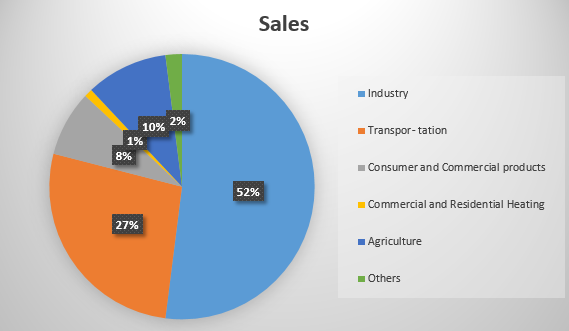
Study the following pie-diagram and write a paragraph based on the information given in it:

Sources of Emissions of Air Pollutants
Image