MCQ
$^{22}$Ne nucleus, after absorbing energy, decays into two $\alpha-$particles and an unknown nucleus. The unknown nucleus is:
  • A
    Nitrogen
  • Carbon
  • C
    Boron
  • D
    Oxygen

Answer

Correct option: B.
Carbon

$^{22}$Ne decays
$\alpha$ particle $= He^{2+}$
Mass No $= 4$
$p = 2, n = 2$
So, New mass no. $= 22 − 8 = 14$
Atomic No. $= 10 − 4 = 6$
So, the new element is ${6^C}^{14}$

Need a full question paper?

Generate a complete, print-ready paper with questions like this in minutes — across 16+ boards, with answer keys.
Start Generating Free

Similar questions

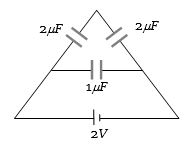
The charge on any one of the $2\,\mu \,F$ capacitors and $1\,\mu \,F$ capacitor will be given respectively (in $\mu \,C$) as
The self inductance of a choke coil is $10\, mH$. When it is connected with a $10\,V$ $dc$ source, then the loss of power is $20\, watt$. When it is connected with $10\, volt$ $ac$ source, then loss of power is $10\, watt.$ The frequency of $ac$ source will be......$Hz$
The maximum efficiency of a full wave rectifier is .........
In a hypothetical system a particle of mass $m$ and charge $-3q$ is moving around a very heavy particle having charge $q$. Assuming Bohr’s model to be true to this system, the orbital velocity of mass $m$ when it is nearest to heavy particle is
An electron makes a transition from orbit $n = 4$ to the orbit $n = 2$ of a hydrogen atom. The wave number of the emitted radiations ($R =$ Rydberg's constant) will be
 A potentiometer circuit has been set up for finding the internal resistance of a given cell. The main battery, used across the potentiometer wire, has an emf of $2.0\,V$ and a negligible internal resistance. The potentiometer wire itself is $4\,m$ long. When the resistance $R,$ connected across the given cell, has values of  $(i)$ infinity $(ii)$ $9.5\,\Omega$ the balancing lengths on the potentiometer wire are found to be $3\,m$ and $2.85\,m,$ respectively. The value of internal resistance of the cell is ............... $\Omega$
Which of the following is not reversible
At a distance of 10 cm from a long straight wire carrying current, the magnetic field is 0.04 T. At the distance of 40 cm, the magnetic field will be
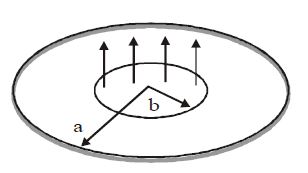
A line charge ( $\lambda $ per unit length) is in the form of circular wheel of radius $'a'$ and moment of inertia is $I$ , initial at rest. It is free to rotate in a horizontal plane. There is a coaxial magnetic field $B = {B_0}\hat k$ extending upto a radius $b(b < a)$ . If the magnetic field is switched off, the angular velocity $'\omega '$ of the wheel is given by
The electric field in a region is directed outward and is proportional to the distance $r$ from the origin. Taking the electric potential at the origin to be zero,