MCQ
${{(27)}^{1/3}}=$
  • A
     3
  • B
     $3,\,\,3i,\,3{{i}^{2}}$
  •  $3,\,3\omega ,\,3{{\omega }^{2}}$
  • D
     None of these

Answer

Correct option: C.
 $3,\,3\omega ,\,3{{\omega }^{2}}$
C

Need a full question paper?

Generate a complete, print-ready paper with questions like this in minutes — across 16+ boards, with answer keys.

Start Generating Free

Similar questions

If the three vertices of a rectangle taken in order are the points $(2, -2)$, $(8, 4)$ and $(5, 7)$. The coordinates of the fourth vertex is
For all $n \in N, 3^{2n} + 7$ is divisible by:
The mean deviation of the data 3, 10, 10, 4, 7, 10, 5 from the mean is:
Three concentric circles of which the biggest is $x^2 + y^2 = 1$, have their radii in $A.P.$ If the line $y = x + 1$ cuts all the circles in real and distinct points. The interval in which the common difference of the $A.P.$ will lie is
The value of the limit

$\lim _{x \rightarrow \frac{\pi}{2}} \frac{4 \sqrt{2}(\sin 3 x+\sin x)}{\left(2 \sin 2 x \sin \frac{3 x}{2}+\cos \frac{5 x}{2}\right)-\left(\sqrt{2}+\sqrt{2} \cos 2 x+\cos \frac{3 x}{2}\right)}$ is. . . . . . 

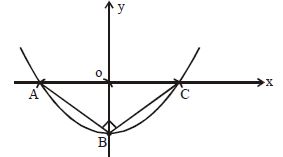
If graph of $y = ax^2 + bx + c$ as follows

$\Delta ABC$ is right angled osceles triangle with hypotenuse $AC = 4\sqrt 2\ units$ then minimum value of $ax^2 + bx + c$ is
If the sum of the first $11$ terms of the series ${\left( {1\frac{4}{7}} \right)^2} + {\left( {1\frac{5}{7}} \right)^2} + {\left( {1\frac{6}{7}} \right)^2} + {2^2} + {\left( {2\frac{1}{7}} \right)^2} + ......$ is $\frac{{11}}{7}\lambda $ then $\lambda $ is equal to
The sum of the squares deviations for $10$ observations taken from their mean $50$ is $250.$ The coefficient of variation is:
Let $a_1, a_2, a_3 \ldots a_n$ be $n$ positive consecutive terms of an arithmetic progression. If $d > 0$ is its common difference, then $\lim _{n \rightarrow \infty} \sqrt{\frac{d}{n}}\left(\frac{1}{\sqrt{a_1}+\sqrt{a_2}}+\frac{1}{\sqrt{a_2}+\sqrt{a_3}}+\ldots \ldots .+\frac{1}{\sqrt{a_{n-1}}+\sqrt{a_n}}\right)$
A quadratic polynomial $ y = f (x)$  with absolute term  $3$  neither touches nor intersects the abscissa axis and is symmetric about the line $x = 1$ . The coefficient of the leading term of the polynomial is unity. A point $A(x_1, y_1)$  with abscissa $x_1 = 1$  and a point $B(x_2, y_2) $ with ordinate $y_2 = 11 $ are given in a cartisian rectangular system of co-ordinates $OXY $ in the first quadrant on the curve $y = f (x)$  where $ 'O'$  is the origin. The area bounded by the curve $y = f(x)$ and a line $y = 3$ is