Question
Generate a complete, print-ready paper with questions like this in minutes — across 16+ boards, with answer keys.
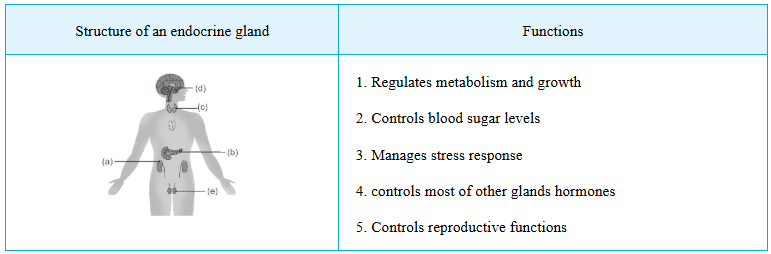
| List-I | List-II |
| (i) Stress hormone | (a) Cortisol |
| (ii) Emergency hormone | (b) Adrenaline |
| (iii) Binding hormone | (c) Oxytocin |
| (iv) Master gland | (d) Pituitary |
| Column I | Column II |
| (i) Chloroplasts | (a) Raw materials |
| (ii) Oxygen and Hydrogen | (b) Raw materials |
| (iii) Carbon dioxide and water | (c) Photolysis |
| (iv) Cells in the leaf | (d) Light reaction |
| (e) Glucose + oxygen |
| Column I | Column II |
| (i) Cytokinins | (a) Acts as an anti-transpirant |
| (ii) 2, 4-D and 2,4,5-T | (b) Gibbane ring structure |
| (iii) Ethylene | (c) Used in tissue culture |
| (iv) Abscisic acid | (d) Eradication of weeds |
| (e) Promotes transverse growth |
| Column I | Column II |
| (i) Offspring | (a) Law of segregation |
| (ii) Phenotype | (b) External appearance |
| (iii) Purity of gametes | (c) Progeny produced due to reproduction |
| (iv) Unit factor | (d) Only one character |
| (e) Gene |
| COLUMN A | COLUMN B |
| (i) The excretory organs | (a)Lungs |
| (ii) Excrete CO2 | (b)Bowman's capsule |
| (iii) Outer dark part of kidney | (c)End part of nephron |
| (iv) A thin walled cup | (d)Kidneys |
| (e)Cortex |
| Column I | Column II |
| (viii) Blood pressure | (a) Allows blood flow from right auricle to right ventricle. |
| (ix) Tricuspid valve | (b) Cardiac cycle. |
| (x) Bicuspid valve | (c) Largest vein |
| (xi) Contraction and relaxation of heart | (d) Sphygmomanometer |
| (e) Allows blood flow from left auricle to left ventricle. |
| Column A | Column B |
| (i) Genetics | (A) Chromosomes similar in size and shape. |
| (ii) Autosomes | (B) The alternative forms of genes. |
| (iii) Recessive genes | (C) Study of laws of inheritance of characters. |
| (iv) Allele | (D) A gene that can express only when in a similar pair. |
| (E) Chromosomes other than the pair of sex chromosomes. |
| Column I | Column II |
| (i) Acrosome | (a) Oestrogen |
| (ii) Ovulation | (b) Male gamete |
| (iii) Sperm | (c) Stoppage of menstrual cycle |
| (iv) Menopause | (d) Spermatozoa |
| (e) Testosterone |
| Column I | Column II |
| (i) Grana | (a) Producers |
| (ii) Autotrophs | (b) Decomposers |
| (iii) By-products of photosynthesis | (c) Work rooms |
| (iv) Bacteria and fungi | (d) Glucose + oxygen |
| (e) Light reaction |
| I | II |
| (i) Karyokinesis | (a) Resting phase |
| (ii) Mitosis | (b) Reductional division |
| (iii) Interphase | (c) Division of cytoplasm |
| (iv) Cytokinesis | (d) Division of nucleus |
| (e) Somatic cell division |