Question
$3(x + 2) - 2(x - 1) = 7$

Answer

$3(x + 2) - 2(x - 1) = 7$ On expanding the brackets,
we get $3x + 3 × 2 - 2 × x + 2 × 1 = 7 3x + 6 - 2x + 2 = 7 3x - 2x + 6 + 2 = 7 x + 8 = 7$
Subtracting $8$ from both sides,
we get $x + 8 - 8 = 7 - 8 x = -1$
Verification: Substituting $x = -1$ in $L.H.S.,$
we get $L.H.S. = 3(x + 2) - 2(x - 1) = 3(-1 + 2) - 2(-1 -1) = (3 × 1) - (2 × -2) = 3 + 4 = 7$, and
$R.H.S. = 7 L.H.S. = R.H.S.$
Hence, verified.

Need a full question paper?

Generate a complete, print-ready paper with questions like this in minutes — across 16+ boards, with answer keys.

Start Generating Free

Similar questions

From the sum of $x^2+3 y^2-6 x y, 2 x^2-y^2+8 x y, y^2+8$ and $x^2-3 x y$ subtract $-3 x^2+4 y^2-x y+x-y+3$.
The length of a rectangular field is twice its breadth. If the perimeter of the field is 228 metres, find the dimensions of the field.
The radius of one circular field is $5\ m$ and that of the other is $13\ m$. Find the radius of the circular field whose area is the difference of the areas of first and second field.
Fill in the blanks.
ShapeCentre of RotationOrder of RotationAngle of Rotation
Square
Rectangle
Rhombus
Equilateral triangle
Regular hexagon
Circle
Semi-circle
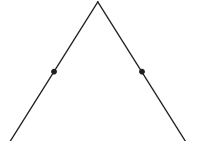
Use support lines in the given figure to construct a pointed arch. Make different arches by changing the radius of the arcs.
Image
Romesh borrowed $Rs. 2000 $ at $2\%$ per annum and $Rs. 1000$ at $5\%$ per annum. He cleared his debt after $2$ years by giving $Rs. 2800$ and a watch. What is the cost of the watch?
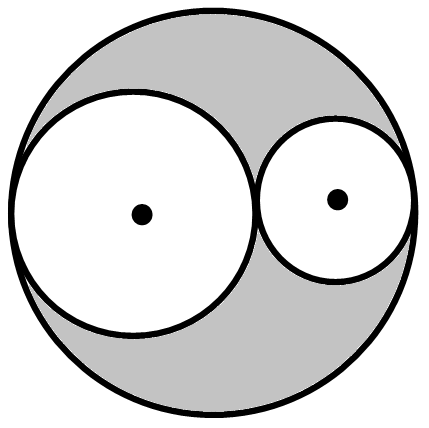
In the given figure, a circle of diameter $21\ cm$ is given. Inside this circle, two circles with diameters $\frac{2}{3}$ and $\frac{1}{3}$ of the diameter of the big circle have been drawn, as shown in the given figure. Find the area of the shaded region.
Convert each part of the ratio to percentage
(i) 3 : 1
(ii) 2 : 3 : 5
(iii) 1 : 4
(iv) 1 : 2 : 5
A wire is in the shape of a rectangle. Its length is $40\ cm$ and breadth is $22\ cm$. If the same wire is bent in the shape of a square, what will be the measure of each side? Also, find which side encloses more area?
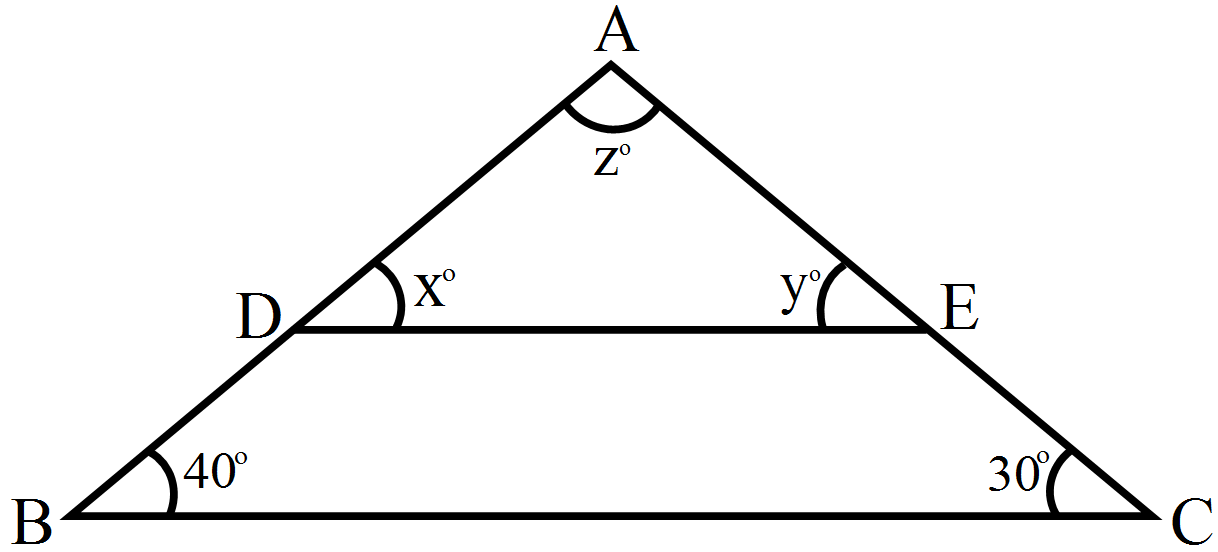
Find $x, y, z$ (whichever is required) from the figure given below: