MCQ
$4$ kilometres are equal to:
  • $4,00,000$ metre.
  • B
    $40,000$ metre.
  • C
    $4,00p$ metre.
  • D
    $400$ metre.

Answer

Correct option: A.
$4,00,000$ metre.
$1\ km = 1000m, 4\ km = 4000\ m$

Need a full question paper?

Generate a complete, print-ready paper with questions like this in minutes — across 16+ boards, with answer keys.
Start Generating Free

Similar questions

The Sun is __________
Water vapours enter the air (or atmosphere) by which of the following processes?
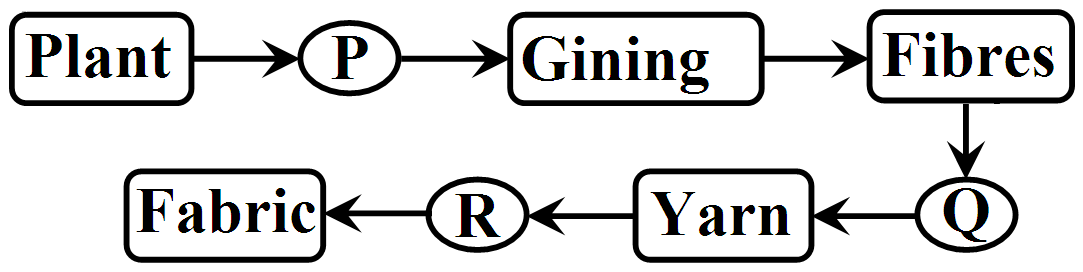
The flow chart given below shows the production of cotton fabric.

What could $P, Q$ and $R$ be?
The weight of dried residue obtained by heating $100\ ml$ of a saturated solution of salt was found to be $7g.$ It shows that the solubility of salt in water is $($in $g/ 100\ ml).$
Directions: Read the passage $(s)$ given be low and answer the questions that follow. Passage The process of making yam from fibres is called spinning. In spinning, fibre from a mass of cotton or wool are drawn out and twisted. This brings the fibres together to form a yam. To make fabric, we have to first convert the cotton fibres into yarns by which of the following process?
An animal lives on land and in water. It has a tail and the body is covered with scales. This animal is :
When Amrita was asked to pick up a few articles from a collection, she picked up the following:
Wooden scale.
Glass test tube.
Paper basket.
Which of the following articles is she most likely to pick up the next?
Which of the following gases in air helps burning?
Which joint allows movement in all directions?
Direction: Read the passages given below and answer the questions that follow. Passage If you look at a leaf carefully you can easily see some lines on the leaf. These lines are called veins. In some cases you can see a thick vein in the middle of the leaf. This vein is called midrib. The design made by veins is called the leaf venation. Parallel venation can be seen in: