Question
$5(2 - 3x) - 17(2x - 5) = 16$

Answer

$5(2 - 3x) - 17(2x - 5) = 16$
On expanding the brackets, we get $(5 \times 2) - (5 \times 3x) - (17 \times 2x) + (17 \times 5) $
$= 16 10 - 15x - 34x + 85 $
$= 16 10 + 85 - 34x - 15x $
$= 16 95 - 49x $
$= 16$
Subtracting 95 from both sides, we get $-49x + 95 - 95 = 16 - 95 -49x = -79$
Dividing both sides by $-49,$
we get $\frac{-49\text{x}}{49}=\frac{-79}{-49}$ $\text{x}=\frac{79}{49}$
Verification: Substituting $\text{x}=\frac{79}{49}$ in $L.H.S.,$
we get $=5\Big(2-3\times\frac{79}{49}\Big)-17\Big(2\times\frac{79}{49}-5\Big)$
$=(5\times2)-\Big(5\times3\times\frac{79}{49}\Big)-\Big(17\times2\times\frac{79}{49}\Big)+(17\times5)$
$=10-\frac{1185}{49}-\frac{2686}{49}+85$
$=\frac{490-1185-2686+4165}{49}=\frac{784}{49}=16=\text{R.H.S.}$
$\text{L.H.S.}=\text{R.H.S.}$
Hence, verified.

Need a full question paper?

Generate a complete, print-ready paper with questions like this in minutes — across 16+ boards, with answer keys.

Start Generating Free

Similar questions

Solve the following equations. Check your result in case. $6(3x + 2) - 5(6x - 1) = 3(x - 8) - 5(7x - 6) + 9x$
Estimate and then measure the objects listed in the following table. Draw a double bar graph based on the data. How accurate were your estimates? Find the average difference between the estimated and measured values.
ObjectEstimate (in cm)Measure (in cm)Positive Difference
Length of a pen
Length of an eraser
Length of your plam
Length of your geometry box
Length of your math notebook
Evaluate: $\frac{-16}{9}+\frac{-5}{12}+\frac{7}{18}$
In $\triangle\text{DEF},  \angle\text{D} = 60^\circ , \angle\text{E} = 70^\circ $ and the bisectors of $\angle\text{E}$ and $\angle\text{F}$ meet at $O$. Find $(i) \ \angle\text{F}  \ (ii) \ \angle\text{EOF}.$
Designing a Healthy Diet
When you design your healthy diet, you want to make sure that you meet the dietary requirements to help you grow into a healthy adult. As you plan your menu, follow the following guidelines.
$1.$ Calculate your ideal weight as per your height from the table given at the end of this question.
$2.$ An active child should eat around $55.11$ calories for each kilogram desired weight.
$3. \ 55\%$ of calories should come from carbohydrates. There are $4$ calories in each gram of carbohydrates.
$4. \ 15\%$ of your calories should come from proteins. There are $4$ calories in each gram of proteins.
$5. \ 30\%$ of your calories may come from fats. There are $9$ calories in each gram of fats.
Following is an example to design your own healthy diet.
Example:
$1.$ Ideal weight $= 40\ kg.$
$2.$ The number of calories needed $= 40 \times 55.11 = 2204.4$
$3.$ Calories that should come from carbohydrates
$= 2204.4 \times 0.55 = 1212.42$ calories.
Therefore, required quantity of carbohydrates
$=\frac{1212.40}{4}=303.105\text{g}=300\text{g.}$
$4.$ Calories that should come from proteins
$= 2204.4 \times 0.15 = 330.66$ calories.
Therefore, required quantity of protein
$=\frac{330.66}{4}\text{g}=82.66\text{g}.$
$5.$ Calories that may come from fat $= 2204.4 \times 0.3$
$= 661.3$ calories.
Therefore, required quantity of fat
$=\frac{661.3}{9}\text{g}=73.47\text{g.}$
$1.$ Your ideal desired weight is $.......... kg.$
$2.$ The quantity of calories you need to eat is $........g$
$3.$ The quantity of protein needed is $.........g.$
$4.$ The quantity of fat required is $.........g.$
$5.$ The quantity of carbohydrates required is $.........g.$
 
 
Ideal Height and Weight Proportion


Men
 
 
Women
 
Height
 
Weight
Height
 
Weight
Feet
$cm$
Kilograms
Feet
$cm$
Kilograms
$5’$
$152$
$48$
$4’7”$
$140$
$34$
$5’1”$
$155$
$51$
$4’8”$
$142$
$36$
$5’2”$
$157$
$54$
$4’9”$
$145$
$39$
$5’3”$
$160$
$56$
$4’1”$
$147$
$41$
$5’4”$
$163$
$59$
$4’11”$
$150$
$43$
$5’5”$
$165$
$62$
$5’$
$152$
$45$
$5’6”$
$168$
$65$
$5’1”$
$155$
$48$
$5’7”$
$170$
$67$
$5’2”$
$157$
$50$
$5’8”$
$173$
$70$
$5’3”$
$160$
$52$
$5’9”$
$175$
$73$
$5’4”$
$163$
$55$
$5’10”$
$178$
$75$
$5’5”$
$165$
$57$
$5’11”$
$180$
$78$
$5’6”$
$168$
$59$
$6’$
$1834$
$81$
$5’7”$
$170$
$61$
$6’1”$
$185$
$84$
$5’8”4$
$173$
$64$
$6’2”$
$188$
$86$
$5’9”$
$175$
$66$
$6’3”$
$191$
$89$
$5’10”$
$178$
$68$
$6’4”$
$193$
$92$
$5’11”$
$180$
$70$
A sugar bag contains 30 kg of sugar. After consuming $\frac{2}{3}$ of it , how much sugar is left in the bag?
Construct a $\triangle\text{PQR}$ in which $QR = 6\ cm, PQ = 4.4\ cm$ and $PR = 5.3\ cm.$ Draw the bisector of $\angle\text{P.}$
Following data gives total marks (out of $600$) obtained by six children of a particular class.
Students:
Ajay
Bali
Dipti
Faiyaz
Gotika
Hari
Marks Obtained:
$450$
$500$
$300$
$360$
$400$
$540$
Represent the data by a bar graph.
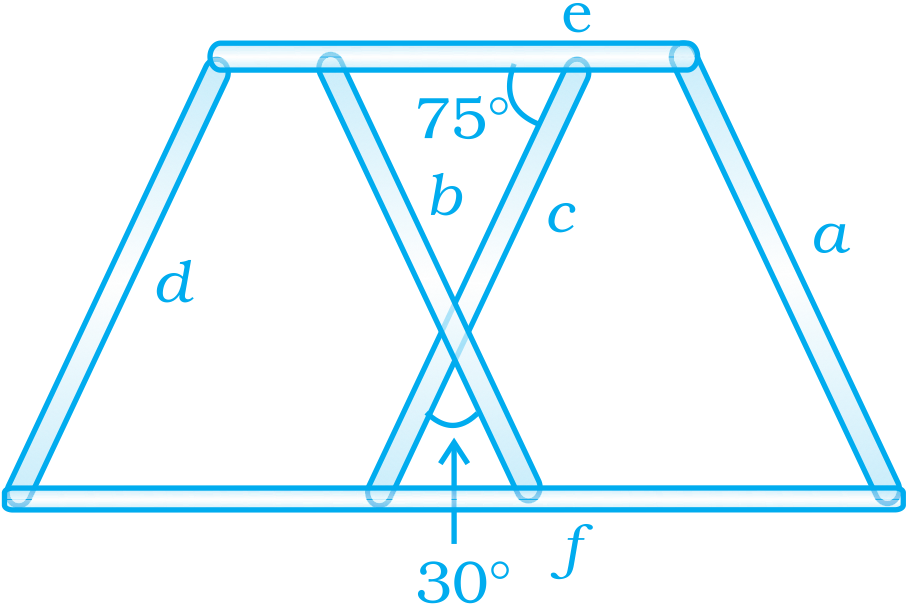
Iron rods $a, b, c, d, e$ and $f$ are making a design in a bridge as shown in $Fig.$ in which $a \| b, c \| d, e \| f.$ Find the marked angles between.
$i. b$ and $c$
$ii. d$ and $e$
$iii. d$ and $f$
$iv. c$ and $f$
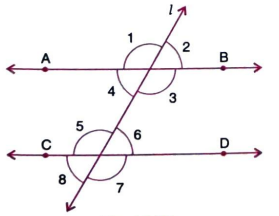
In Fig. $A B \| C D$ and $\angle 1$ and $\angle 2$ are in the ratio 3: 2. Determine all angles from 1 to 8.
Image