Question
6(1 - 4x) + 7(2 + 5x) = 53

Answer

6(1 - 4x) + 7(2 + 5x) = 53
On expanding the brackets, we get (6 × 1) - (6 × 4x) + (7 × 2) + (7 × 5x) = 53
6 - 24x + 14 + 35x = 53
6 + 14 + 35x - 24x = 53
20 + 11x = 53
Subtracting 20 from both sides, we get 20 + 11x - 20 = 53 - 20
11x = 33
Dividing both sides by 11, we get
$\frac{\text{11x}}{11}=\frac{33}{11}$
$\text{x}=3$
Verification:
Substituting x = 3 in L.H.S., we get
= 6(1 - 4 × 3) + 7(2 + 5 × 3)
= 6(1 - 12) + 7(2 + 15)
= 6(-11) + 7(17)
= -66 + 119
= 53 = R.H.S.
L.H.S. = R.H.S.
Hence, verified.

Need a full question paper?

Generate a complete, print-ready paper with questions like this in minutes — across 16+ boards, with answer keys.

Start Generating Free

Similar questions

Draw $\triangle\text{ABC}$ in which AB = 5.5cm. BC = 6cm and CA = 7cm. Also, draw perpendicular bisector of side BC.
The following table shows the favourite sports of 250 students of a school. Represent the data by a bar graph.
Sports Cricket Football Tennis Badminton Swimming
No. of students 75 35 50 25 65
The following table shows the weight of 12 players:
Weight (in kg) 48 50 52 54 58
Number of players 4 3 2 2 1
Find the median and mean weights.
Using empirical formula, calculate its mode.
Draw triangle with the measures given. In ∆MAT, l(MA) = 5.2 cm, m∠A = 80°, l(AT) = 6 cm.
Draw triangle with the measures given. In ∆ABC, l(AC) = 7.5 cm, m∠ABC = 90°, l(BC) = 5.5cm.
Find the missing value of p for the following distribution whose mean is 12.58
x:
5 8
10
12
p 20 25
f:
2
5
8
22 7 4 2
Arrange the following fractions in ascending order:
$\frac{4}{6},\frac{3}{8},\frac{6}{12},\frac{5}{16}$
Students should take examples of their own and practice construction of triangles.
i. In ∆PQR, l(PQ) = 5 cm, l(QR) = 6.8 cm, l(PR) = 5.5 cm.
ii. In ∆XYZ, l(XY) = 5.7 cm, m∠Y = 120°, l(YZ) = 7 cm.
iii. In ∆RST, l(ST) = 6.7 cm, m∠S = 60°, m∠T = 40°.
iv. In ∆UVW, m∠U = 90°, l(UV) = 5 cm, l(VW) = 6 cm.
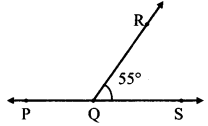
Observe the adjacent figure and answer the following questions :
Image


  1. Write the names of the angles in the figure alongside.
  2. What type of a pair of angles is it?
  3. Which arms of the angles are not the common arms?
  4. m∠PQR = __.
  5. m∠RQS = __.
Find the products given below and case verify the result for a = 1, b = 2 and c = 3.
$\Big(\frac{4}{9} \text{abc}^3\Big)\times \Big(\frac{-27}{5} \text{a}^3 \text{b}^2\Big)\times(-8 \text{b}^3 \text{c})$