MCQ
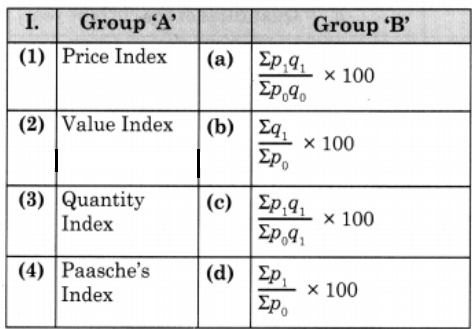
- A(1) – d, (2) – c, (3) – a, (4) – b
- ✓(1) – d, (2) – a, (3) – b, (4) – c
- C(1) – b, (2) – c, (3) – d, (4) – a
- D(1) – c, (2) – d, (3) – a, (4) – b
Generate a complete, print-ready paper with questions like this in minutes — across 16+ boards, with answer keys.
| Group ‘A’ | Group ‘B’ |
| (1) Contraction in demand | (a) Less is demanded at a same price |
| (2) Decrease in demand | (b) Complementary goods |
| (3) Demand curve | (c) Substitute goods |
| (4) Tea and Coffee | (d) Less is demanded at a higher price |
| (e) Slopes downwards from left to right |
| Group ‘A’ | Group ‘B’ |
| 1. Very short period | (a) More than 5 years |
| 2. Short period | (b) Less than 1 year |
| 3. Long period | (c)Few days or weeks |
| 4. Very long period | (d) Upto 5 years |
| Group ‘A’ | Group ‘B’ |
| (1) Demand | (a) A new demand curve |
| (2) Variation in Demand | (b) Same demand curve |
| (3) Extension of demand | (c) Ability and willingness to pay |
| (4) Increase in demand | (d) Change in price alone |
| (e) Distribution of income |
| Group ‘A’ | Group ‘B’ |
| Expenditure Method | Inventory method |
| GDP | C + I + G + (X-M) + (R-P) |
| National income | Micro economic concept |
| Unpaid services | Services of housewife |
| Group A | Group B |
| 1. Perfect Competition | (a) Product Differentiation |
| 2. Monopoly | (b) Uniform Price |
| 3. Monopolistic Competition | (c) Few Sellers |
| 4. Oligopoly | (d) Single Seller |
| Group ‘A’ | Group ‘B’ |
| Three sector economy | Households, business firms, foreign sector |
| National income | Money value of final goods and services |
| Output method | Income method |
| NNP | GDP – Depreciation |
| Group ‘A’ | Group ‘B’ |
| 1. Ordinal measurement | (a)Maximum TU |
| 2. Principles of Economics | (b) $M U_X>P_X$ |
| 3. Point of satiety | (c) Prof. Alfred Marshall |
| 4. Consumer’s equilibrium | (d) Grading of utility |
| (e) $M U_X>P_X$ |
| Group ‘A’ | Group ‘B’ |
| (1) National Income | (a) Rent, wages, interest, etc. |
| (2) Factor Pricing | (b) Mikros |
| (3) Micro | (c) Study of aggregate |
| (4) Slicing method | (d) Makros |
| (e)Splits the whole economy |
| Group ‘A’ | Group ‘B’ |
| 1. Individual supply | Potential supply |
| 2. Determinants of law of supply | Infrastructural facilities |
| 3. Assumption of the law of supply | Change in government policy |
| Group ‘A’ | Group ‘B’ |
| (1) Factor of Production | (a) Other things being equal |
| (2) Ceteris Paribus | (b) Land |
| (3) Price theory | (c) Micro economics |
| (4) Lumping method | (d) Profit |
| (e)Whole economy |