Question
Get the step-by-step solution for this question inside the Vidyadip app.
Get the answer in the appGenerate a complete, print-ready paper with questions like this in minutes — across 16+ boards, with answer keys.
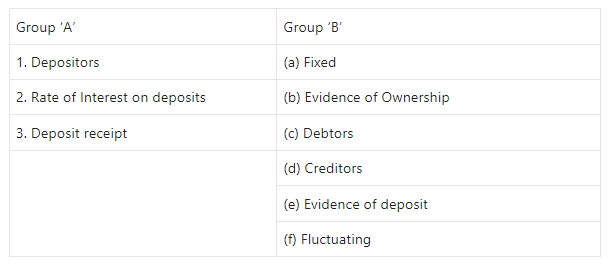
| Group ‘A’ | Group ‘B’ |
| 1. Deposit maturity | (a) Letter of renewal |
| 2. Accuracy | (b) Investment up to ₹ 25000 |
| 3. Deposit receipt | (c) 21 days |
| 4. Small depositors | (d) Precaution |
| 5. Renewal of deposit | (e) 36 months |
| (f) Creditors |
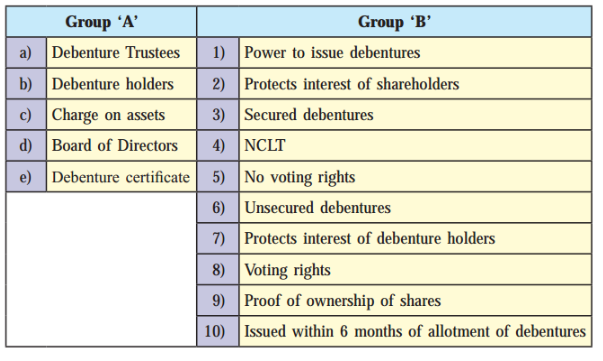
| Group ‘A’ | Group ‘B’ |
| (1) Courtesy | (a) Wrong Publicity |
| (2) Prompt Response | (b) True and Real Facts |
| (3) Transparency | (c) Politeness |
| (4) Conciseness | (d) Up to date information |
| (5) Precise Information | (e) Reply without delay |
| (6) Secretary | (f) Irrelevant Information |
| (7) Goodwill | (g) Hide Information |
| (h) Confidential Officer | |
| (i) False and incorrect Information | |
| (j) Rude and harsh wording | |
| (k) Brief and to the point | |
| (l) Delay in replying | |
| (m) Good image of the company | |
| (n) Disclose Secrets |
| Group ‘A’ | Group ‘B’ |
| (1) Debenture holder | (a) Owners of the company |
| (2) Retained profit | (b) Capitalisation of profit |
| (3) Public deposit | (c) Savings account holder |
| (4) Overdraft facility | (d) Creditor of the company |
| (5) Equity shares | (e) Maximum 3 years |
| (f) Maximum 5 years | |
| (g) Current account holder | |
| (h) Ploughing back of profit | |
| (i) Permanent capital | |
| (j) Temporary capital |
| Group ‘A’ | Group ‘B’ |
| (1) Money Market | (a) Most common method to meet credit needs |
| (2) Commercial bills | (b) Primary Market |
| (3) Repo rate | (c) Interest |
| (4) Gilt-edged market | (d) Government securities market |
| (5) Secondary market | (e) Official bank rate |
| (f) Treasury bills | |
| (g) Financial market | |
| (h) Short term funds are borrowed and lent | |
| (i) Stock exchange | |
| (j) Fewer applications than expected |
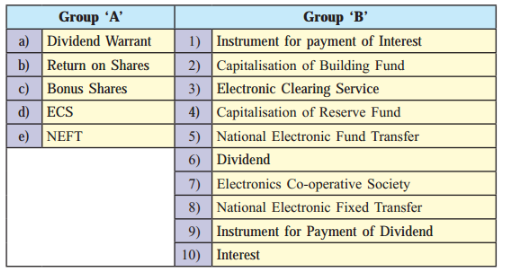
| Group ‘A’ | Group ‘B’ |
| (1) Dematerialization | (a) State of being interchangeable |
| (2) Rematerialisation | (b) Register with Depository |
| (3) Fungibility | (c) Demat Request Form |
| (4) Issuer | (d) Transferor informs DP |
| (5) Sale of Shares | (e) Transferee intimates the DP |
| (6) Purchase of Shares | (f) Remat Request Form |
| (g) Broker |
| Group ‘A’ | Group ‘B’ |
| (1) Trust Deed | (a) Owner |
| (2) Debenture Certificate | (b) Deed for debenture holders |
| (3) Secured Debenture | (c) Charge on company’s assets |
| (4) Redemption by annual installment | (d) Creditors of the company |
| (5) Debenture holders | (e) Signature of two directors |
| (f) Two coupons | |
| (g) Deed for depositors | |
| (h) No charge on the company’s assets | |
| (i) CARE | |
| (j) Credit rating |
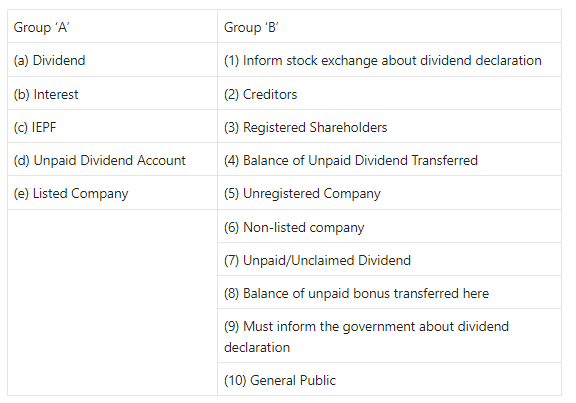
| Group ‘A’ | Group ‘B’ |
| (1) Secretary | (a) Registered Document |
| (2) Electronic Mode | (b) Fluctuating rate of dividend |
| (3) Share Certificate | (c) Correspondence with members |
| (4) Reply Letter | (d) Dividend Warrant |
| (5) Bon as Share | (e) Payment of Dividend |
| (f) Existing Equity Shareholder | |
| (g) Bearer Document | |
| (h) Low rate of dividend | |
| (i) Fluctuations in the market | |
| (j) Correspondence with Bank |