MCQ
A $0.10\, kg$ block oscillates back and forth along a horizontal surface. Its displacement from the origin is given by: $x = (10\,cm)\cos [(10\,rad/s)\,t + \pi /2\,rad]$. What is the maximum acceleration experienced by the block
  • $10\,\,m/{s^2}$
  • B
    $10\,\pi \,m/{s^2}$
  • C
    $\frac{{10\pi }}{2}\,m/{s^2}$
  • D
    $\frac{{10\pi }}{3}\,m/{s^2}$

Answer

Correct option: A.
$10\,\,m/{s^2}$
a
(a) $a = 10 \times {10^{ - 2}}m$ and $\omega = 10\;rad/sec$
${A_{\max }} = {\omega ^2}a = 10 \times {10^{ - 2}} \times {10^2} = 10\;m/{\sec ^2}$

Need a full question paper?

Generate a complete, print-ready paper with questions like this in minutes — across 16+ boards, with answer keys.

Start Generating Free

Similar questions

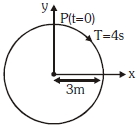
The radius of circle the period of revolution initial position and sense of revolution are indicated in the figure.

$y-$projection of the radius vector of rotating particle $\mathrm{P}$ is

A body of mass $2\, kg$ is hung on a spring balance mounted vertically in a lift. If the lift descends with an acceleration equal to the acceleration due to gravity $‘g’$,  if the lift moves up with a constant velocity of $2 \,m/sec$, the reading on the balance will be ......... $kg$
A particle of mass $ M$ is moving in a horizontal circle of radius $R$ with uniform speed $V$. When it moves from one point to a diametrically opposite point, its
A coin placed on a rotating table just slips if it is placed at a distance $4r$ from the centre. On doubling the angular velocity of the table, the coin will just slip when at a distance from the centre equal to
Two conducting spheres of radii $R_1$ and $R_2$ are charged with charges $Q_1$ and $Q_2$ respectively. On bringing them in contact there is
A series $LCR$ circuit is designed to resonate at an angular frequency $\omega_{0}=10^{5} \,rad / s$. The circuit draws $16\, W$ power from $120\, V$ source at resonance. The value of resistance $'R'$ in the circuit is ...... $\Omega$.
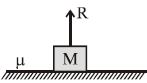
If reaction is $R$ and coefficient of friction is $\mu,$ what is work done against friction in moving a body by distance $d$ slowly ?
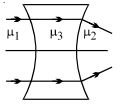
From the figure shown establish a relation between, $\mu_1, \mu_2, \mu_3.$
With respect to a rectangular cartesian coordinate system, three vectors are expressed as

$\vec a = 4\hat i - \hat j$, $\vec b = - 3\hat i + 2\hat j$ and $\vec c = - \hat k$ 

where $\hat i,\,\hat j,\,\hat k$ are unit vectors, along the $X, Y $ and $Z-$axis respectively. The unit vectors $\hat r$ along the direction of sum of these vector is

According to corpuscular theory of light, the different colours of light are due to