MCQ
A 0.2 molar solution of formic acid is 3.2% ionised. Its ionisation constant is:
- A9.6 × 10-3
- B2.1 × 10-4
- C1.25 × 10-6
- D4.8 × 10-5
Explanation:
$\text{K}=\text{C}\alpha^2=0.2\times(0.032)^2$
$=2.1\times10^{-4}$
Generate a complete, print-ready paper with questions like this in minutes — across 16+ boards, with answer keys.
[Given : $R_{\mathrm{H}}\left(\right.$ Rydberg constant) $=2.18 \times 10^{-18} \mathrm{~J}$.
$h($ Plank's constant $)=6.6 \times 10^{-34}$ J.s. $]$
$xMnO_4^ - \, + \,y{C_2}O_4^{2 - }\, + \,z{H^ + }\, \rightarrow $$\,xM{n^{2 + }} + 2yC{O_2} + \frac{z}{2}{H_2}O$
The value's of $x, y$ and $z$ in the reaction are, respectively :
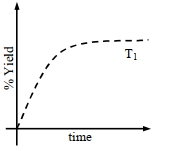
$N _2( g )+3 H _2( g ) \rightleftharpoons 2 NH _3( g ), \Delta H < 0$
at $\left( P , T _1\right)$ is given below:
$Image$
If this reaction is conducted at $\left(P, T_2\right)$, with $T_2>T_1$, the $\%$ yield of ammonia as a function of time is represented by