MCQ
A $1 cm$ long string vibrates with fundamental frequency of $256\, Hz$. If the length is reduced to $\frac{1}{4}cm$ keeping the tension unaltered, the new fundamental frequency will be
  • A
    $64$
  • B
    $256$
  • C
    $512$
  • $1024$

Answer

Correct option: D.
$1024$
d
(d) $n \propto \frac{1}{l}$==> $\frac{{{n_2}}}{{{n_1}}} = \frac{{{l_1}}}{{{l_2}}}$

==> ${n_2} = \frac{{{l_1}}}{{{l_2}}}{n_1} = \frac{{1 \times 256}}{{1/4}} = 1024Hz$

Need a full question paper?

Generate a complete, print-ready paper with questions like this in minutes — across 16+ boards, with answer keys.

Start Generating Free

Similar questions

A gas is taken in a sealed container at $300K$. it is heated at constant volume to a temperature $600K.$ the mean $K.E.$ of its molecules is:
A force $\overrightarrow {\rm{F}} = 5\hat i + 6\hat j + 4\hat k$ acting on a body, produces a displacement $\overrightarrow {\rm{S}} = 6\hat i - 5\hat k.$Work done by the force is
Mark the correct options:
Two bodies $A$ and $B$ having masses in the ratio of $3 : 1$ possess the same kinetic energy. The ratio of their linear momenta is then
$A$ student calculates the acceleration of $m_1$ in figure shown as  ${a_1} = \frac{{({m_1} - {m_2})\,g}}{{{m_1}\, + \,{m_2}}}\,$. Which assumption is not required to do this calculation.
The volume of air increases by $5\%$ in its adiabatic expansion. The percentage decrease in its pressure will be ...... $\%$
If fundamental frequency of closed pipe is $50\,Hz$ then frequency of $2^{nd}$ overtone is .... $Hz$
A train is moving along a straight line with a constant acceleration ' $a$ '. A boy standing in the train throws a ball forward with a speed of $10 \ m / s$, at an angle of $60^{\circ}$ to the horizontal. The boy has to move forward by $1.15 \ m$ inside the train to catch the ball back at the initial height. The acceleration of the train, in $m / s ^2$, is
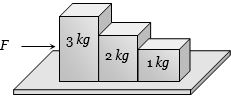
Consider the following statements about the blocks shown in the diagram that are being pushed by a constant force on a frictionless table

$A.$All blocks move with the same acceleration

$B.$The net force on each block is the same

Which of these statements are/is correct
A smooth sphere of mass $M$ moving with velocity $u$ directly collides elastically with another sphere of mass m at rest. After collision their final velocities are $V$ and $v$ respectively. The value of $v$ is