A $10\, V$ storage battery of negligible internal resistance is connected across a $50\,\Omega $ resistor. How much heat energy is produced in the resistor in $1$ hour ............... $J$
Medium


Download our appand get started for free
Experience the future of education. Simply download our apps or reach out to us for more information. Let's shape the future of learning together!No signup needed.*
Similar Questions
- 1Two circuits (shown below) are called ‘Circuit $A$ ’and ‘Circuit $B$’. The equivalent resistance of ‘Circuit $a$’ is $x$ and that of ‘Circuit $B$’ is $y$ between $1$ and $2.$View Solution

- 2View SolutionEmf is most closely related to
- 3View SolutionIn the circuit shown in the figure, the current through
- 4If voltage across a bulb rated $220$ $volt-$ $100$ $watt$ drops by $2.5\%$ of its rated value, the percentage of the rated value by which the power would decrease is ............... $\%$View Solution
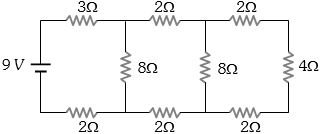
- 5Seven resistances are connected as shown in the figure. The equivalent resistance between $A$ and $B$ is ............... $\Omega$View Solution
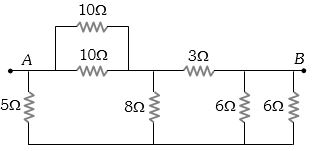
- 6In a potentiometer arrangement. $E_1$ is the cell establishing current in primary circuit. $E_2$ is the cell to be measured. $AB$ is the potentiometer wire and $G$ is a galvanometer. Which of the following are the essential condition for balance to be obtained.View Solution
- 7A charged particle having drift velocity of $7.5 \times 10^{-4}\, ms ^{-1}$ is an electric field of $3 \times 10^{-10}\, Vm ^{-1}$ has a mobility in $m ^{2} V ^{-1} s ^{-1}$ ofView Solution
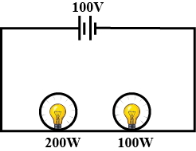
- 8Two bulbs, one of $200 \,W$ and the other of $100 \,W$ are connected in series with a $100 \,V$ battery which has no internal resistance. Then,View Solution
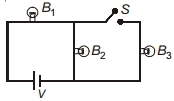
- 9Three identical bulbs $B_1, B_2$ and $B_3$ are connected to the mains as shown in figure. If $B_3$ is disconnected from the circuit by opening switch $S$, then incandescence of bulb $B_1$ willView Solution
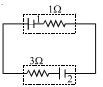
- 10In the figure shown, battery $1$ has $\mathrm{emf}$ $= 6\, V$ and internal resistance $= 1 \,\Omega$. Battery $2$ has $\mathrm{emf}$ $= 2\,V$ and internal resistance $= 3\, \Omega$ . The wires have negligible resistance. What is the potential difference across the terminals of battery $2$ ? ................ $V$View Solution