Question
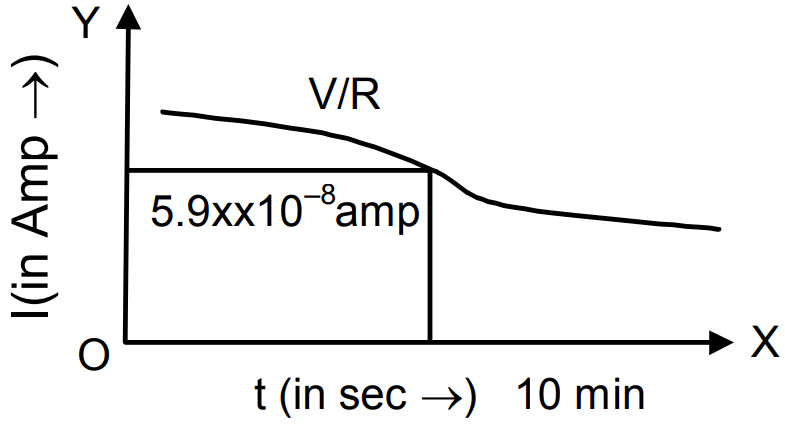
A $100\mu\text{F}$ capacitor is joined to a 24V battery through a $1.0\text{M}\Omega$ resistor. Plot qualitative graphs (a) between current and time for the first 10 minutes and (b) between charge and time for the same period.
Answer

Time constant $\text{RC} = 1 \times 10^6 \times 100 \times 10^6 = 100 \text{sec}$

  1. $\text{q}=\text{VC}\Big(1-\text{e}^{\frac{-\text{t}}{\text{CR}}}\Big)$

I = Current $=\frac{\text{dq}}{\text{dt}}=\text{VC}.(-)\text{e}^{\frac{-\text{t}}{\text{RC}}},\frac{-1}{\text{RC}}$

$=\frac{\text{V}}{\text{R}}\text{e}^{\frac{-\text{t}}{\text{RC}}}=\frac{\text{V}}{\text{R}\cdot\text{e}^{\frac{\text{t}}{\text{RC}}}}=\frac{24}{10^6}\times\frac{1}{\text{e}^{\frac{\text{t}}{100}}}$

$=24\times10^{-6}\frac{1}{\text{e}^{\frac{\text{t}}{100}}}$

$\text{t}=10\text{min},600\text{sec}.$
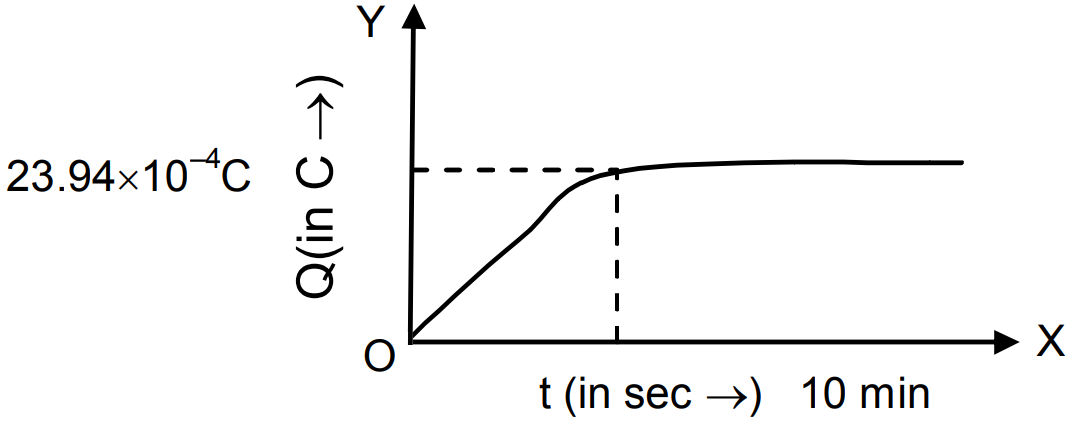
$\text{Q}=24\times10+-4\times\big(1-\text{e}^{-6}\big)=23.99\times10^{-4}$

$\text{I}=\frac{24}{10^6}\times\frac{1}{\text{e}^6}=5.9\times10^{-8}\text{Amp}.$

  1. $\text{q}=\text{VC}\Big(1-\text{e}^\frac{-\text{t}}{\text{CR}}\Big)$

Need a full question paper?

Generate a complete, print-ready paper with questions like this in minutes — across 16+ boards, with answer keys.
Start Generating Free

Similar questions

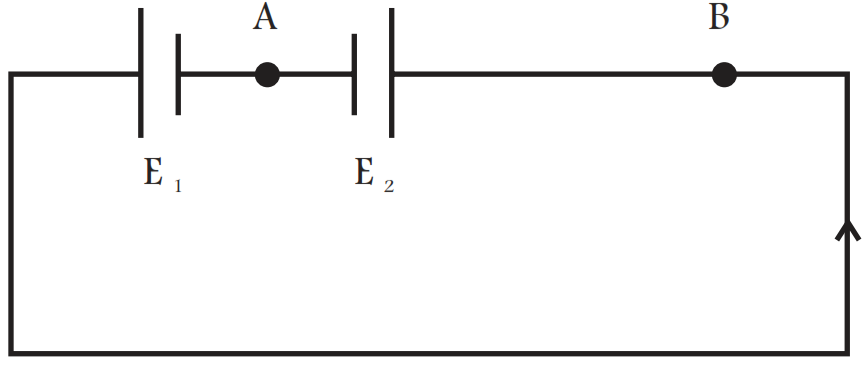
The circuit in Fig. shows two cells connected in opposition to each other. Cell E1 is of emf 6V and internal resistance 2Ω; the cell E2 is of emf 4V and internal resistance 8Ω. Find the potential difference between the points A and B.

Is the formula you employ in (a) valid for calculating radius of the path of a 20 MeV electron beam? If not, in what way is it modified?
A hollow sphere is released from the top of an inclined plane of inclination $\theta.$
  1. What should be the minimum coefficient of friction between the sphere and the plane to prevent sliding?
  2. Find the kinetic energy of the ball as it moves down a length 1 on the incline if the friction coefficient is half the value calculated in part (a).
Light is incident from glass $(\mu=1.50)$ to water $(\mu=1.33).$ Find the range of the angle of deviation for which there are two angles of incidence.
A wave is described by the equation

$\text{y}=(1.0\text{mm})\sin\pi\Big(\frac{\text{x}}{2.0\text{cm}}-\frac{\text{t}}{0.01\text{s}}\Big).$
  1. Find the time period and the wavelength.
  2. Write the equation for the velocity of the particles. Find the speed of the particle at x = 1.0cm at time t = 0.01s.
  3. What are the speeds of the particles at x = 3.0cm, 5.0cm and 7.0cm at t 0.01s?
  4. What are the speeds of the particles at x 1.0cm at t = 0.011, 0.012, and 0.013s?
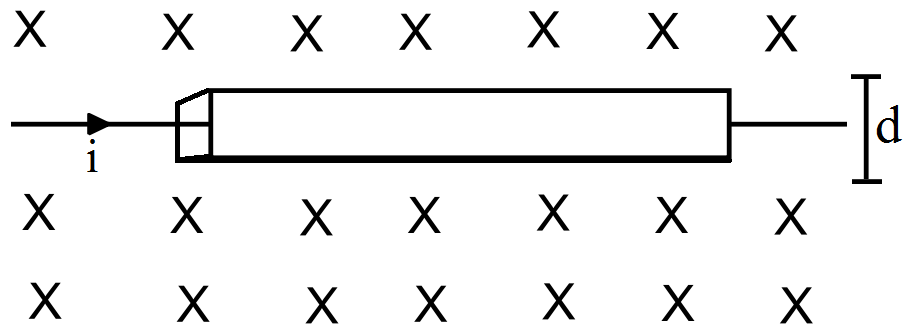
A current i is passed through a silver strip of width d and area of cross-section A. The number of free electrons per unit volume is n.
  1. Find the drift velocity v of the electrons.
  2. If a magnetic field B exists in the region, as shown in the figure, what is the average magnetic force on the free electrons?
  3. Due to the magnetic force, the free electrons get accumulated on one side of the conductor along its length. This produces a transverse electric field in the conductor, which opposes the magnetic force on the electrons. Find the magnitude of the electric field which will stop further accumulation of electrons.
  4. What will be the potential difference developed across the width of the conductor due to the electron-accumulation? The appearance of a transverse emf, when a current-carrying wire is placed in a magnetic field, is called Hall effect.

Using Huygens’ Principle, draw a diagram to show propagation of a wavefront originating from a monochromatic point source. Explain briefly.
Suppose the space between the two inner shells of the previous problem is filled with a dielectric of dielectric coastant K. Find the capacitance of the system between A and B.
A $20\mu\text{F}$ capacitor is joined to a battery of emf 6.0V through a resistance of $100\Omega.$ Find the charge on the capacitor 2.0ms after the connections are made.
In Young’s double-slit experiment using monochromatic light of wavelength λ, the intensity of light at a point on the screen where path difference is λ, is K units. What is the intensity of light at a point where path difference is λ/3?