Question
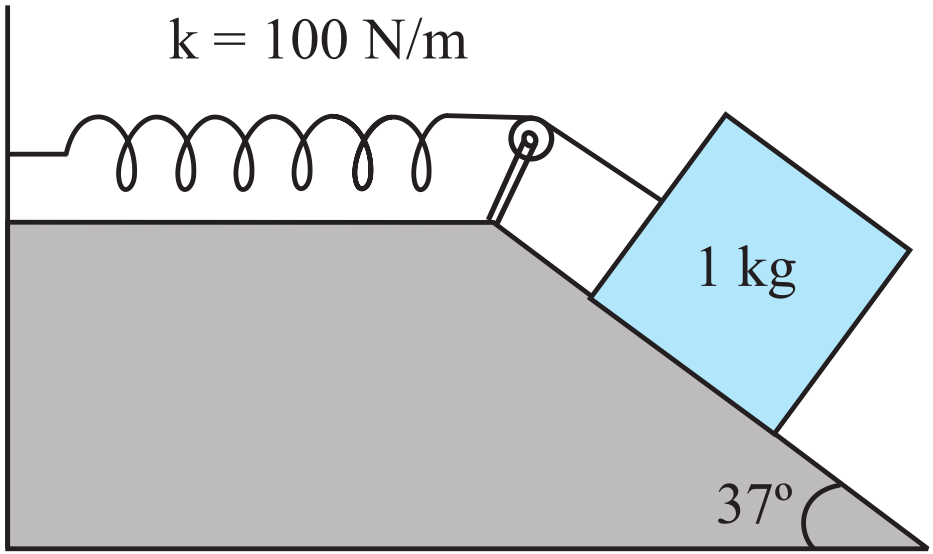
A $1kg$ block situated on a rough incline is connected to a spring of spring constant $100Nm^{-1}$ as shown in. The block is released from rest with the spring in the unstretched position. The block moves $10cm$ down the incline before coming to rest. Find the coefficient of friction between the block and the incline. Assume that the spring has a negligible mass and the pulley is frictionless.
Answer

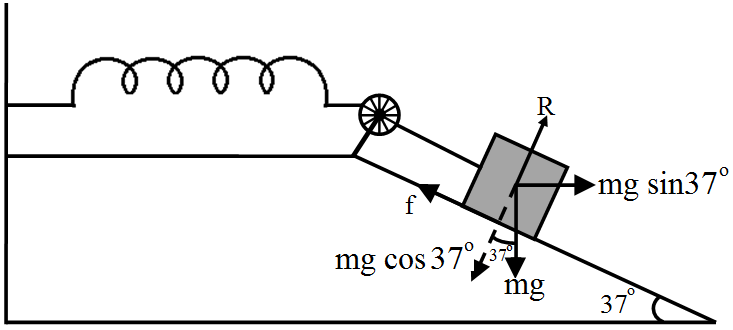
Mass of the block, $m = 1kg$ Spring constant, $k = 100Nm^{-1}$ Displacement in the block, $X = 10cm = 0.1m$ The given situation can be shown as in the following figure.At equilibrium:

 Normal reaction, $\text{R}=\text{mg}\cos37^{\circ}$ Frictional force, $\text{f}=\mu\text{R}=\text{mg}\sin37^{\circ}$ Where, $\mu$ is the coefficient of friction Net force acting on the block $ =\text{mg}\sin 37^{\circ}-\text{f}$ $=\text{mg}\sin37^{\circ}-\mu\text{m}\cos37^{\circ}$ $=\text{mg}(\sin37^{\circ}-\mu\cos37^{\circ})$ At equilibrium, the work done by the block is equal to the potential energy of the spring, i.e., $=\text{mg}(\sin37^{\circ}-\mu\cos37^{\circ})\text{x}=\Big(\frac{1}{2}\Big)\text{kx}^2$ $1\times9.8(\sin37^{\circ}-\mu\cos37^{\circ})=\Big(\frac{1}{2}\Big)\times100\times(0.1)$ $0.602-\mu\times0.799=0.510$ $\therefore\mu=\frac{0.092}{0.799}=0.115$

Need a full question paper?

Generate a complete, print-ready paper with questions like this in minutes — across 16+ boards, with answer keys.

Start Generating Free

Similar questions

The terminal velocity of a copper ball of radius $2.0 mm$ falling through a tank of oil at $20^{\circ} C$ is $6.5 \ cm s ^{-1}$. Compute the viscosity of the oil at $20^{\circ} C$. Density of oil is $1.5 \times 10^3 \ kg m ^{-3}$, density of copper is $8.9 \times 10^3 \ kg m ^3$.
A truck and a car are moving with the same kinetic energy on a straight road. Their engines are simultaneously switched off. Which one will stop at a lesser distance?
The number of molecules in a container is doubled. What will be the effect on the rms speed of the molecules?
The unit of length convenient on the atomic scale is known as an angstrom and is denoted by $\mathring{\text{A}}:1\mathring{\text{A}}=10^{-10}\text{m}.$
The size of a hydrogen atom is about $0.5\mathring{\text{A}}.$ What is the total atomic volume in m3 of a mole of hydrogen atoms?
A glass plate of length $10\ cm$, breadth $4\ cm$ and thickness $0.4\ cm$ weighs $20g$ in air. It is held vertically with long side horizontal and half the plate immersed in water. What will be its apparent weight? Surface tension of water $= 70 dyne/cm.$
A particle is in linear simple harmonic motion between two points, A and B, 10cm apart. Take the direction from A to B as the positive direction and give the signs of velocity, acceleration and force on the particle when it is:At 3cm away from A going towards B.
An experimenter measures the length of a rod. Initially the experimenter and the rod are at rest with respect to the lab. Consider the following statements:
  1. If the rod starts moving parallel to its length but the observer stays at rest, the measured length will be reduced.
  2. If the rod stays at rest but the observer starts moving parallel to the measured length of the rod, the length will be reduced.
Relation F = a + bx where F is force and x is distance. In this relation, find the dimension of a and b.
Name one material which is famous for a large elastic after effect.
Why is sound heard more intense in carbon dioxide in comparison to air?