Question
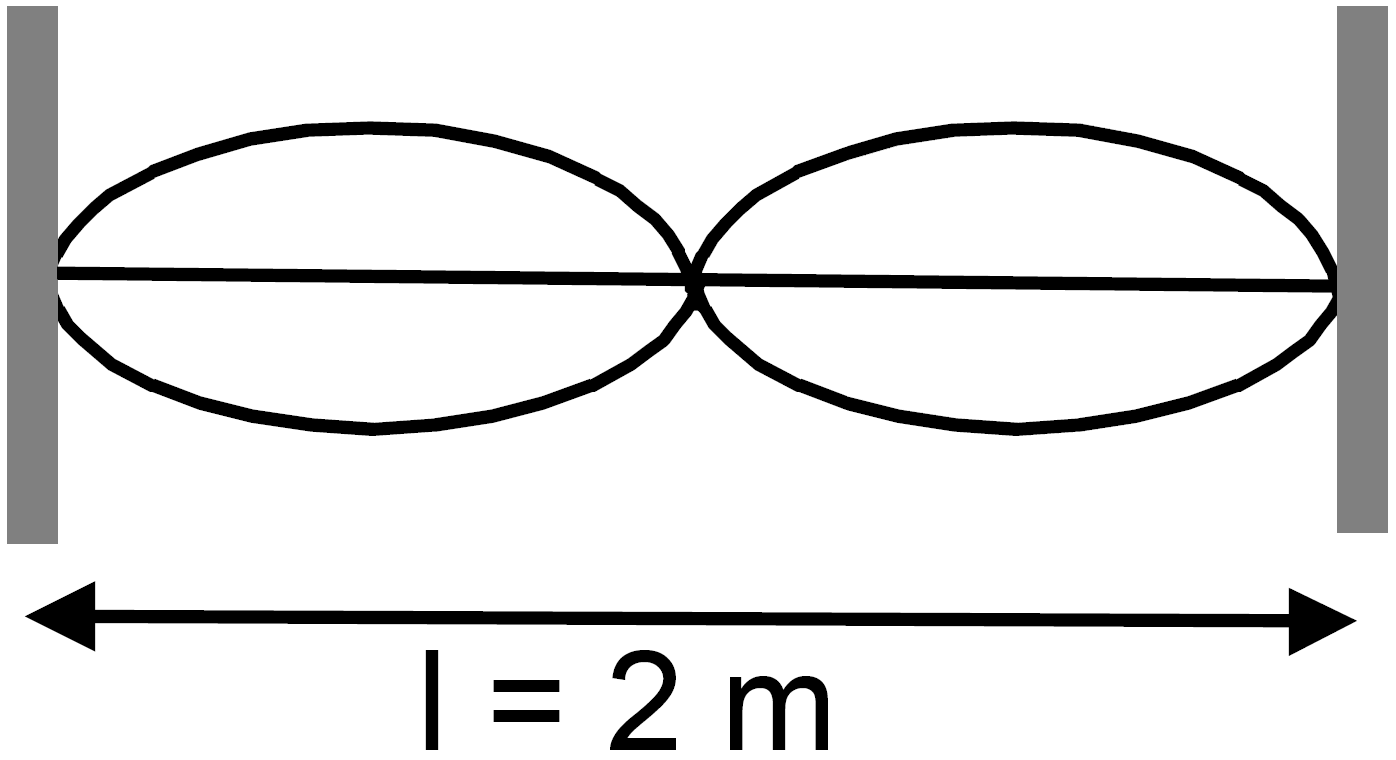
A 2 in long string fixed at both ends is set into vibrations in its first overtone. The wave speed on the string is 200m/s and thee amplitude is 0.5cm.
  1. Find the wavelength and the frequency.
  2. Write the equation giving the displacement of different points as a function of time. Choose the X-axis along the string with the origin at one end and t = 0 at the instant when the point x = 50cm has reached its maximum displacement.

Answer


$\text{V}=200\text{m/s},\ 2\text{A}=0.5\text{m}$
  1. The string is vibrating in its $1^{st}$ overtone
$\Rightarrow\lambda=1=2\text{m}$
$\Rightarrow\text{f}=\frac{\text{v}}{\lambda}=100\text{Hz}$
  1. The stationary wave equation is given by
$\text{y}=2\text{A}\cos\frac{2\pi\text{x}}{\lambda}\sin\frac{2\pi\text{Vt}}{\lambda}$
$=(0.5\text{cm})\cos\big[(\pi\text{m}^{-1})\text{x}\big]\sin\big[(200\pi\text{s}^{-1})\text{t}\big]$

Need a full question paper?

Generate a complete, print-ready paper with questions like this in minutes — across 16+ boards, with answer keys.

Start Generating Free

Similar questions

Suppose A and B in the previous problem change their positions in such a way that the line joining them becomes perpendicular to the direction of wind while maintaining the separation x. What will be the time lag B finds between seeing and hearing the drum beating by A?
Light of wavelength 5000 Å falls on a plane reflecting surface. What are the wavelength and frequency of the reflected light? For what angle of incidence is the reflected ray normal to the incident ray?
A body stretches a spring by a particular length at the earth's surface at equator. At what height above the south pole will it stretch the same spring by the same length? Assume the earth to be spherical.
A block hangs from a string wrapped on a disc of radius 20cm free to rotate about its axis which is fixed in a horizontal position. If the angular speed of the disc is 10rad/s at some instant, with what speed is the block going down at that instant?
Figure, shows a copper rod joined to a steel rod. The rods have equal length and equal cross sectional area. The free end of the copper rod is kept at $0^\circ C$ and that of the steel rod is kept at $100^\circ C.$ Find the temperature at the junction of the rods. Conductivity of copper ${= 390Wm^{-1}}{^\circ C^{-1}.}$ and that of steel ${= 46Wm^{-1}}{^\circ c^{-1}.}$
Calculate the height of the potential barrier for a head on collision of two deuterons. (Hint: The height of the potential barrier is given by the Coulomb repulsion between the two deuterons when they just touch each other. Assume that they can be taken as hard spheres of radius 2.0 fm.)
What is the effect on the interference fringes in Young’s double slit experiment due to each of the following operations? Justify your answers.
  1. The screen is moved away from the plane of the slits.
  2. The separation between slits is increased.
  3. The source slit is moved closer to the plane of double slit.
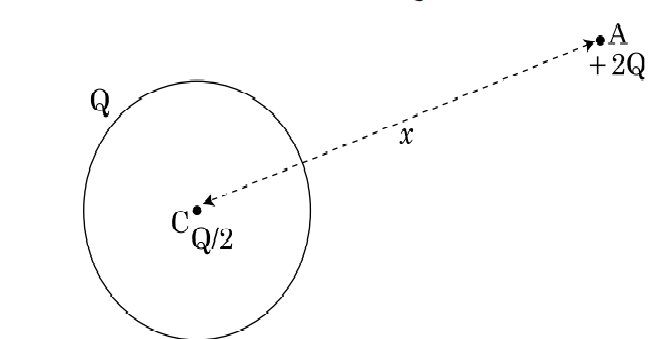
A thin metallic spherical shell of radius R carries a charge Q on its surface. A point charge Q/2 is placed at the centre C, and another charge + 2Q is placed outside the shell at A at a distance x from the centre as shown in the figure.
  1. Find the electric flux through the shell.
  2. State the law used.
  3. Find the force on the charges at the centre C of the shell and at the point A.
The force of surface tension acts tangentially to the surface whereas the force due to air pressure acts perpendicularly on the surface. How is then the force due to excess pressure inside a bubble balanced by the force due to the surface tension?
  1. Drive the expression for electric field at a point on the equatorial line of an electric dipole.
  2. Depict the orientation of the dipole in (i) stable, (ii) unstable equilibrium in a uniform electric field.