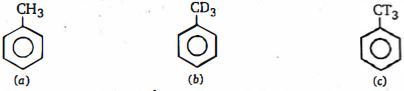
MCQ
A $20\, ml$ sample of a $0.1\, M$ solution of the weak monoprotic acid $HA$ is titrated with $0.25\, M \,NaOH$, volume of $NaOH$ solution required till equivalent point is :- ............. $\mathrm{mL}$
- A$10$
- B$6$
- C$12$
- ✓$8$
$0.1 \,\mathrm{N} \times 20\, \mathrm{mL}=0.25\, \mathrm{N} \times \mathrm{V}$
Generate a complete, print-ready paper with questions like this in minutes — across 16+ boards, with answer keys.
$(i)$ $\begin{array}{*{20}{c}}
{\begin{array}{*{20}{c}}
{\,\,\,\,\,\,\,\,\,\,\,\,\,\,\,\,\,\,\,\,\,\,\,\,\,\,\,\,\,\,\,\,\,\,\,\,\,\,\,\,C{H_3}-CH_2} \\
{\,\,\,\,\,\,\,\,\,\,\,\,\,|}
\end{array}} \\
{C{H_3} - {C^ + }} \\
{\,\,\,\,\,\,\,\,\,\,\,\,\,\,|} \\
{\,\,\,\,\,\,\,\,\,\,\,\,\,\,\,\,\,\,\,\,\,C{H_3}}
\end{array}$
$(ii)$ $\begin{array}{*{20}{c}}
{\begin{array}{*{20}{c}}
{\,\,\,\,\,\,\,\,\,\,\,\,\,\,\,\,\,\,\,\,\,\,C{H_3}} \\
{\,\,\,\,\,\,\,\,\,\,\,\,\,|}
\end{array}} \\
{C{H_3} - {C^ + }} \\
{\,\,\,\,\,\,\,\,\,\,\,\,\,\,|} \\
{\,\,\,\,\,\,\,\,\,\,\,\,\,\,\,\,\,\,{H}}
\end{array}$
$(iii)$ $\begin{array}{*{20}{c}}
{\begin{array}{*{20}{c}}
{\,\,\,\,\,\,\,\,\,\,\,\,\,\,\,\,\,\,\,C{H_3}} \\
{\,\,\,\,\,\,\,\,\,\,\,\,\,|}
\end{array}} \\
{C{H_3} - {C^ + }} \\
{\,\,\,\,\,\,\,\,\,\,\,\,\,\,|} \\
{\,\,\,\,\,\,\,\,\,\,\,\,\,\,\,\,\,\,\,\,\,C{H_3}}
\end{array}$
$(iv)$ $Ph - CH ^{+}-\underline{ CH }_{3}$
| List $I$(Quantum Number) | List $II$(Information provided) |
| $A$. mı | $I$. Shape of orbital |
| $B$. $m_s$ | $II$. Size of orbital |
| $C$. $1$ | $III$. Orientation of orbital |
| $D$. $\mathrm{n}$ | $IV$. Orientation of spin of electron |
Choose the correct answer from the options given below :
| Element | $IE_1$ | $IE_2$ | $IE_3$ | $IE_4$ |
| $W$ | $10.5$ | $15.5$ | $24.9$ | $79.8$ |
| $X$ | $8$ | $14.8$ | $78.9$ | $105.8$ |
Other two elements $Y$ and $Z$ have outer electronic configuration $ns^2$ $np^4$ and $ns^2$ $np^5$ respectively. According to given information which of the following compound $(s)$ is/are not possible
$(a)\, W_2Y_3\, (b)\, X_2Y_3\, (c)\, WZ_2\, (d)\, XZ_2$
$\mathop {Al}\limits_{metal} \xrightarrow[{(aq.)}]{{HCl}}'X' + Gas\,'P'$
$\mathop {Al}\limits_{metal} \xrightarrow[{ + {H_2}O}]{{NaOH\,(aq.)}}'Y' + Gas\,'Q'$