Question
A 250g block slides on a rough horizontal table. Find the work done by the frictional force in bringing the block to rest if it is initially moving at a speed of 40cm/s. If the friction coefficient between the table and the block is 0.1, how far does the block move before coming to rest?

Answer

Given, m = 250g = 0.250kg, u = 40cm/sec = 0.4m/sec$\mu=0.1,\ \text{v}=0$
Here, $\mu\text{R}=\text{ma}$ {where, a = deceleration}$\text{a}=\frac{\mu\text{R}}{\text{m}}=\frac{\mu\text{mg}}{\text{m}}=\mu\text{g}$
$=0.1\times9.8=0.98\text{m}/\text{sec}^2$
$\text{S}=\frac{\text{v}^2-\text{u}^2}{2\text{a}}$
$=0.082\text{m}=8.2\text{cm}$
Again, work done against friction is given by,$\text{w}=\mu\text{RS}\cos\theta$
$=0.1\times2.5\times0.082\times1(\theta=0^\circ)=0.02\text{J}$
$\Rightarrow\text{W}=-0.02\text{J}$

Need a full question paper?

Generate a complete, print-ready paper with questions like this in minutes — across 16+ boards, with answer keys.

Start Generating Free

Similar questions

A small source of sound oscillates in simple harmonic motion with an amplitude of $1.7\ cm.$ A detector is placed along the line of motion of the source. The source emits a sound of frequency $800Hz$  which travels at a speed of $340m/s.$ If the width of the frequency band detected by the detector is $8Hz,$ find the time period of the source.
If the outer coil of the previous problem is rotated through 90° about a diameter, what would be the magnitude of the magnetic field B at the centre?
Two wires of equal length, one of aluminium and the other of copper have the same resistance. Which of the two wires is lighter? Hence explain why aluminium wires are preferred for overhead power cables.
$(\rho_{\text{A}1}=2.63\times10^{-8}\Omega\ \text{m,}$ Relative density of $Al=2.7,\ \text{of Cu}=8.9)$
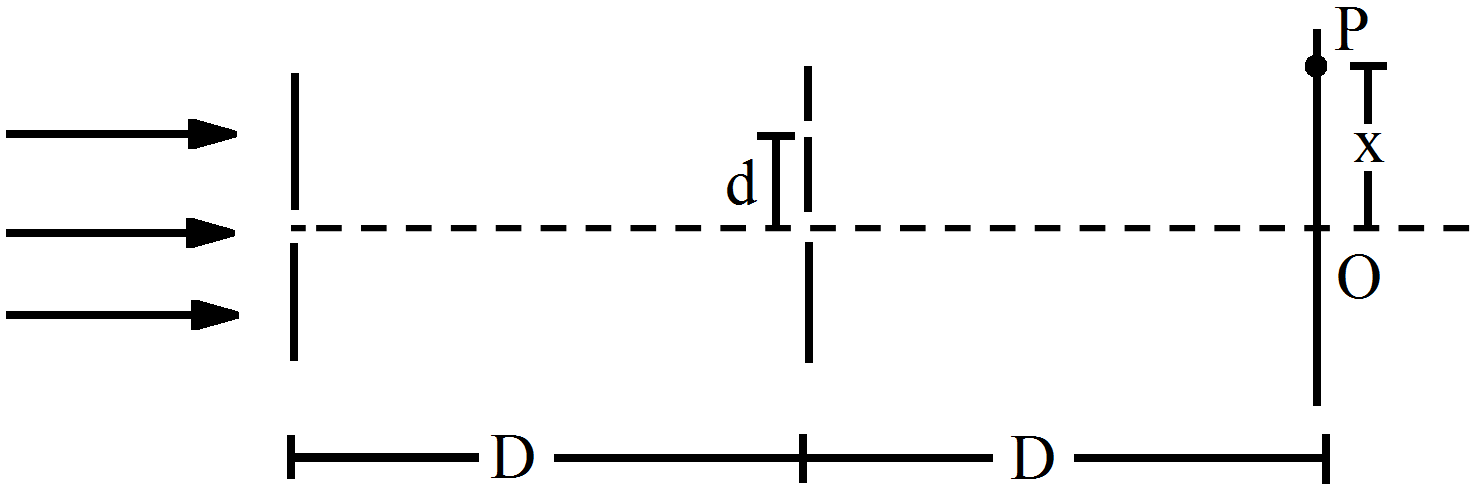
Consider the arrangement shown in figure (17-E4). The distance D is large compared to the separation d between the slits.
  1. Find the minimum value of d so that there is a dark fringe at 0.
  2. Suppose d has this value. Find the distance x at which the next bright fringe is formed.
  3. Find the fringe-width.
  1. With the help of a diagram, explain the principle and working of a moving coil galvanometer.
  2. What is the importance of a radial magnetic field and how is it produced?
  3. Why is it that while using a moving coil galvanometer as a voltmeter a high resistance in series is required whereas in an ammeter a shunt is used?
Define electric dipole moment. Calculate the value of electric potential generated from electric dipole and prove that its value is maximum at the point situated on the axis and zero at the equatorial point? ###Define electric dipole moment of electric dipole. Obtain an expression for the electric potential at a common point due to electric dipole. Also draw necessary diagram.
  1. Explain the formation of depletion layer and potential barrier in a p-n junction.
  2. In the figure given below the input waveform is converted into the output waveform by a device ‘X’. Name the device and draw its circuit diagram.
  1. Identify the logic gate represented by the circuit as shown and write its truth table.
A spherical tungsten piece of radius $1.0\ cm$ is suspended in an evacuated chamber maintained at $300K.$ The piece is maintained at $1000K$ by heating it electrically. Find the rate at which the electrical energy must be supplied. The emissivity of tungsten is $0.30$ and the Stefan constant $\sigma$ is $6.0 \times 10^{-8}Wm^{-2}K^{-4}.$
$a.$ Using the ray diagram for a system of two lenses of focal lengths $f_1$ and $f_2$ in contact with each other, show that the two lens system can be regarded as equivalent to a single lens of focal length $f$, where
$\frac{1}{ f }=\frac{1}{ f _1}+\frac{1}{ f _2}$
Also write the relation for the equivalent power of the lens combination.
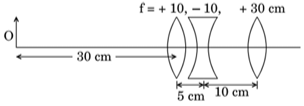
$b.$ Determine the position of the image formed by the lens combination given in the figure.
Image
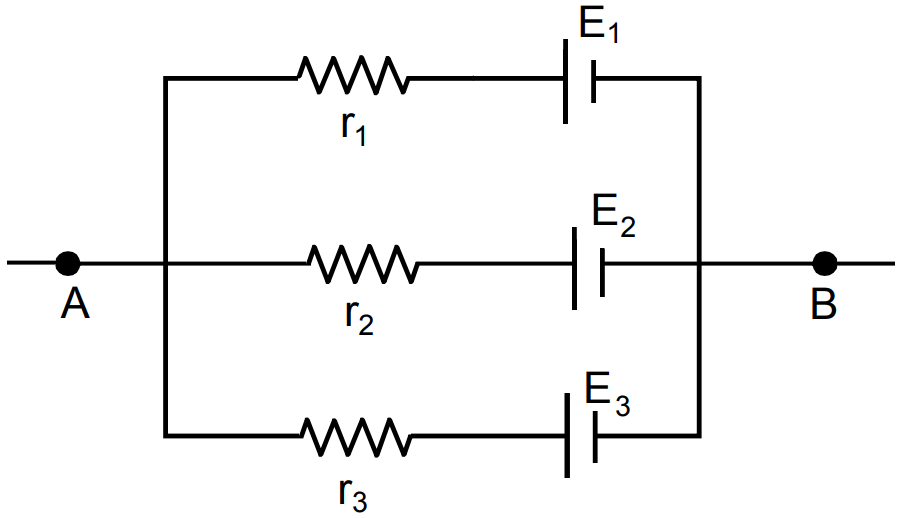
In the circuit shown in the figure. $\epsilon_1=3\text{V},\epsilon_2=2\text{V},\epsilon_3=1\text{V}$ and $\text{r}_1=\text{r}_2=\text{r}_3=1\Omega.$ Find the potential difference between the points A and B and the current through each branch.