MCQ
A $40\ g$ ball dropped from a certain height bounces back from the horizontal ground without losing mechanical energy. If its speed is $10\ m/s$ just before making contact with the ground, and the average value of the force of the ground on the ball is equal to $16\ N$ while ball and wall are in contact, how long were they in contact .......... $m/s$ 
  • A
    $25$
  • $50$
  • C
    $75$
  • D
    $100$

Answer

Correct option: B.
$50$
b
$\begin{gathered}
  2 \times 40 \times {10^{ - 3}} \times 10 = 16\,t \hfill \\
  50 \times {10^{ - 3}}\,s\, = \,t \hfill \\ 
\end{gathered} $

Need a full question paper?

Generate a complete, print-ready paper with questions like this in minutes — across 16+ boards, with answer keys.

Start Generating Free

Similar questions

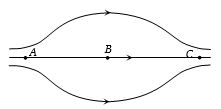
The figure shows some of the electric field lines corresponding to an electric field. The figure suggests
When a dc voltage of $100 \mathrm{~V}$ is applied to an inductor, a dc current of $5 \mathrm{~A}$ flows through $1$ . When an ac voltage of $200 \mathrm{~V}$ peak value is connected to inductor, its inductive reactance is found to be $20 \sqrt{3} \Omega$. The power dissipated in the circuit is__________.$W$.
A force $\vec F = 5\hat i + 6\hat j - 4\hat k$ acting on a body, produces a displacement $\vec s = 6\vec i + 5\vec k.$ Work done by the force is......$ units$
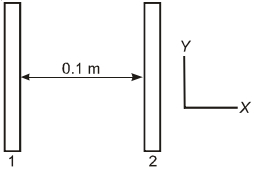
Two insulating plates are both uniformly charged in such a way that the potential difference between them is $V_2 - V_1 = 20\ V$. (i.e., plate $2$ is at a higher potential). The plates are separated by $d = 0.1\ m$ and can be treated as infinitely large. An electron is released from rest on the inner surface of plate $1. $ What is its speed when it hits plate $2?$
$(e = 1.6 \times 10^{-19}\ C, m_e= 9.11 \times 10^{-31}\ kg)$
The specific heat at constant pressure of a real gas obeying $\mathrm{PV}^2=\mathrm{RT}$ equation is :
A particle moves so that its position vector is given by $\overrightarrow {\;r} = \cos\omega t\,\hat x + \sin\omega t\,\hat y$ , where $\omega$ is a constant. Which of the following is true?
In an experiment to study standing waves, you use a string whose mass per length is $μ$ = $(1.0 ± 0.1) × 10^{-4}\ kg/m$ . You look at the fundamental mode, whose frequency $f$ is related to the length $L$ and tension $T$ of the string by the following equation $L$ = $\frac{1}{{2f}}\sqrt {\frac{T}{\mu }} $ You make a plot with $L$ on the $y-$ axis and $\sqrt T$ on the $x-$ axis, and find that the best fitting line is $y$ = $(8.0 ± 0.3) × 10^{-3}x + (0.2 ± 0.04)$ in $SI\ units$ . What is the value of the frequency of the wave (including the error)? Express your result in $SI\ unit\ (Hz)$
If there are $n$ capacitors in parallel connected to $V$ volt source, then the energy stored is equal to
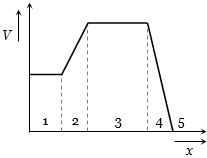
The figure gives the electric potential $V$ as a function of distance through five regions on $x$-axis. Which of the following is true for the electric field $E$ in these regions
An ideal gas has an initial pressure of $3$ pressure units and an initial volume of $4$ volume units. The table gives the final pressure and volume of the gas (in those same units) in four, processes. Which processes start and end on the same isotherm

$\begin{array}{|c|c|c|c|c|} \hline & A & B & C & D \\ \hline P & 5 & 4 & 12 & 6 \\ \hline V & 7 & 6 & 1 & 3 \\ \hline \end{array}$