Question
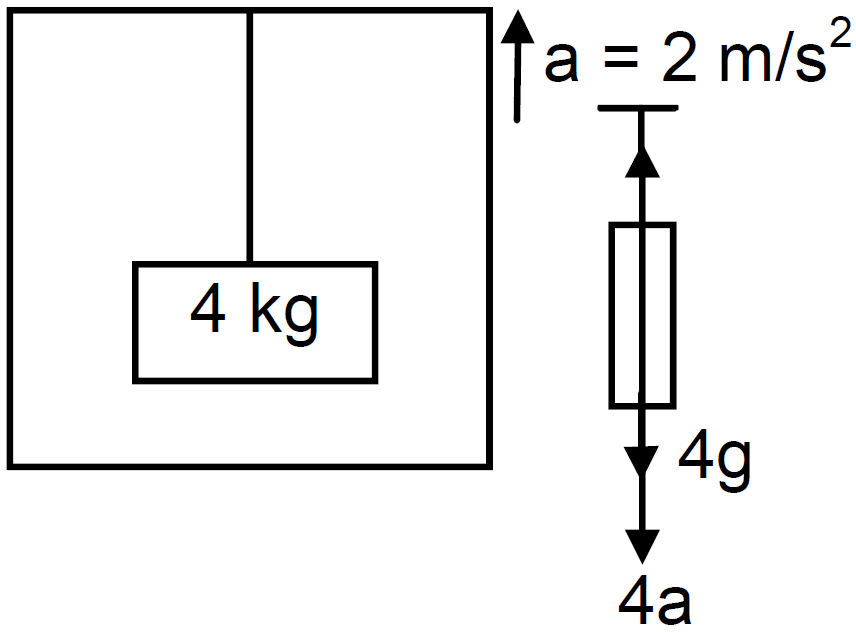
A 4.0kg block is suspended from the ceiling of an elevator through a, string having a linear mass density of 19.2 × 10-3kg/m. Find the speed (with respect to the string) with which a wave pulse can proceed on the string if the elevator accelerates up at the rate of 2.0m/s2. Take g = 10m/s2.
Answer

$\text{m}=19.2\times10^{-3}\text{kg/m}$

From the freebody diagram,

$\text{T}-4\text{g}-4\text{a}=0$

$\Rightarrow\text{T}=4(\text{a}+\text{g})=48\text{N}$

Wave speed, $\text{v}=\sqrt{\Big(\frac{\text{T}}{\text{m}}\Big)}=50\text{m/s}$

Need a full question paper?

Generate a complete, print-ready paper with questions like this in minutes — across 16+ boards, with answer keys.

Start Generating Free

Similar questions

The magnetic moment of the assumed dipole at the earth's centre is 8.0 × 1022 A-m2. Calculate the magnetic field B at the geomagnetic poles of the earth. Radius of the earth is 6400km.
Indian style of cooling drinking water is to keep it in a pitcher having porous walls. Water comes to the outer surface very slowly and evaporates. Most of energy needed for evaporation is taken from the water itself and the water is cooled down. Assume that a pitcher contains 10kg of water and 0.2g of water comes out per second. Assuming no backward heat transfer from the atmosphere to the water, calculate the time in which the temperature decrease by 5°C. Specific heat capacity of water = 4200J kg-1°C-1 and latent heat of vaporization of water = 2.27 × 10⁶ J kg-1.
When a current/ flows through a coil, flux linked with it is $\phi=\text{LI},$ where L is a constant known as self inductance of the coil. Any change in current sets up an induced emf in the coil. Tims, self inductance of a coil is the induced emf set up in it when the current passing through it changes at the unit rate. It is a measure of the opposition to the growth or the decay of current flowing through the coil. Also, value of self inductance depends on the number of turns in the solenoid, its area of cross-section and the relative permeability of its core material.

  1. The inductance in a coil plays the same role as:
  1. Inertia in mechanics.
  2. Energy in mechanics.
  3. Momentum in mechanics.
  4. Force in mechanics.
  1. A current of 2.5A flows through a coil of inductance 5H. The magnetic flux linked with the coil is:
  1. 0.5Wb
  2. 12.5Wb
  3. Zero
  4. 2Wb
  1. The inductance L of a solenoid depends upon its radius R as:
  1. $\text{L}\propto\text{R}$

  2. $\text{L}\propto\frac{1}{\text{R}}$

  3. $\text{L}\propto\text{R}^2$

  4. $\text{L}\propto\text{R}^3$

  1. The unit of self-inductance is:
  1. Weber ampere
  2. Weber-1 ampere
  3. Ohm second
  4. Farad
  1. The induced e.m.f. in a coil of 10 henry inductance in which current varies from 9A to 4A in 0.2 second is:
  1. 200V
  2. 250V
  3. 300V
  4. 500V 
Draw a graph showing the change in potential corresponding to the change in distance from a point charge. For the charged system shown in the figure, prove that the potential difference between points $A$ and $B$ is
Image
Find the acceleration due to gravity of the moon at a point 1000km above the moon's surface. The mass of the moon is 7.4 × 10²²kg and its radius is 1740km.
A sample contains a mixture of 108Ag and 110Ag isotopes each having an activity of 8.0 × 10⁸ disintegration per second. 110Ag is known to have larger half-life than 108Ag. The activity A is measured as a function of time and the following data are obtained.
Time (s) Activity (A) (108 disinte- grations s-1)
Time (s) Activity (A) (108 disinte-grations s-1)
20 11.799 200 3.0828
40 9.1680 300 1.8899
60 7.4492 400 1.1671
80 6.2684 500 0.7212
100 5.4115    
  1. Plot ln $\Big(\frac{\text{A}}{\text{A}_0}\Big)$ versus time.
  2. See that for large values of time, the plot is nearly linear. Deduce the half-life of 110Ag from this portion of the plot.
  3. Use the half-life of 110Ag to calculate the activity corresponding to 108Ag in the first 50s.
  4. Plot In $\Big(\frac{\text{A}}{\text{A}_0}\Big)$ versus time for 108Ag for the first 50s.
  5. Find the half-life of 108Ag.
Derive the formula for electric potential due to an electric dipole at a point having position vector $\bar{r}$ with respect to the mid-point of the dipole and discuss the electric potential on
(a) equator
(b) axis
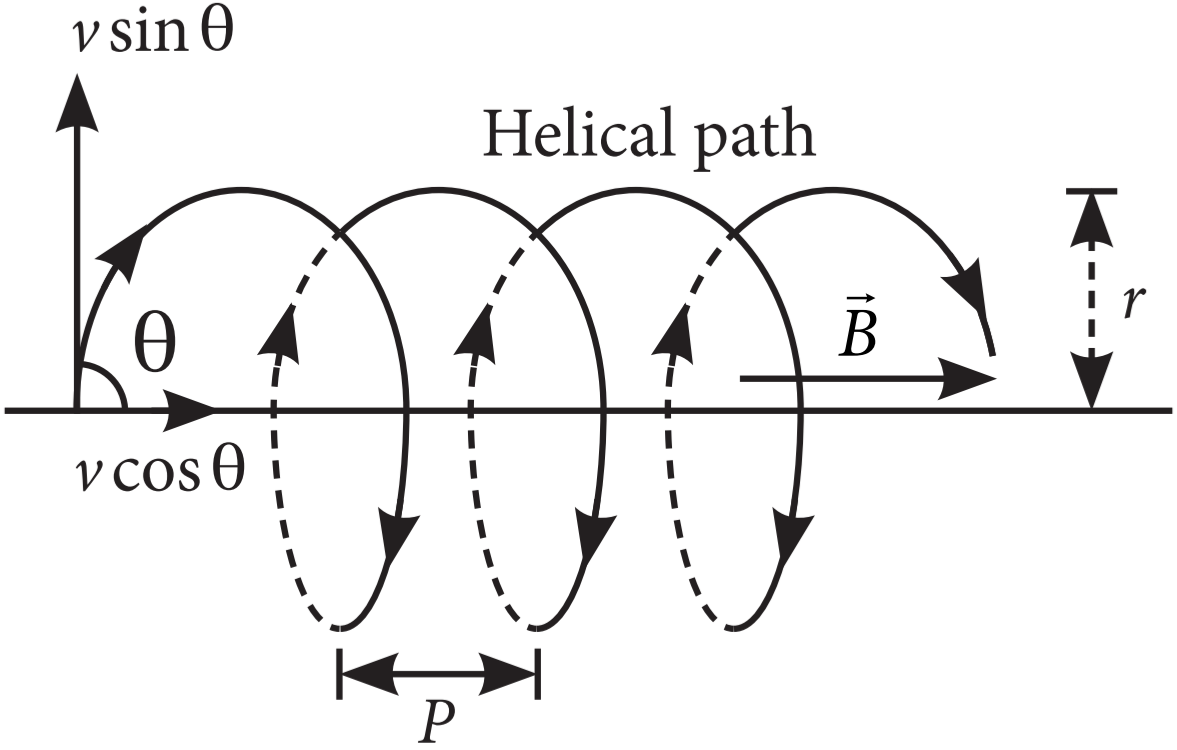
The path of a charged particle in magnetic field depends upon angle between velocity and magnetic field. If velocity $\vec{\text{v}}$ is at angle $\theta$ to $\vec{\text{B}},$ component of velocity parallel to magnetic field $(\text{v}\cos\theta)$ remains constant and component of velocity perpendicular to magnetic field $(\text{v}\sin\theta)$ is responsible for circular motion, thus the charge particle moves in a helical path.

The plane of the circle is perpendicular to the magnetic field and the axis of the helix is parallel to the magnetic field. The charged particle moves along helical path touching the line parallel to the magnetic field passing through the starting point after each rotation.

Radius of circular path is $\text{r}=\frac{\text{mv}\sin\theta}{\text{qB}}$

Hence the resultant path of the charged particle will be a helix, with its axis along the direction of $\vec{\text{B}}$ as shown in figure.

  1. When a positively charged particle enters into a uniform magnetic field with uniform velocity, its trajectory can b:
  1. A straight line.
  2. A circle.
  3. A helix.
  1. (i) Only
  2. (i) or (ii)
  3. (i) or (iii)
  4. Any one of (i), (ii) and (iii)
  1. Two charged particles A and B having the same charge, mass and speed enter into a magnetic field in such a way that the initial path of A makes an angle of 30º and that of B makes an angle of 90º with the field. Then the trajectory of:
  1. B will have smaller radius of curvature than that of A.
  2. Both will have the same curvature.
  3. A will have smaller radius of curvature than that of B.
  4. Both will move along the direction of their original velocities.
  1. An electron having momentum 2.4 × 10⁻²³kg m/ s enters a region of uniform magnetic field of 0.15T. The field vector makes an angle of 30º with the initial velocity vector of the electron. The radius of the helical path of the electron in the field shall be:
  1. mm
  2. 1mm
  3. $\frac{\sqrt{3}}{2}\text{mm}$

  4. 0.5mm
  1. The magnetic field in a certain region of space is given by $\vec{\text{B}}=8.35\times10^{-2}\hat{\text{i}}\text{T}.$ A proton is shot into the field with velocity $\vec{\text{v}}=(2\times10\hat{\text{i}}+4\times10^5\hat{\text{j}.}$ The proton follows a helical path in the field. The distance moved by proton in the x-direction during the period ofone revolution in the yz-plane will be:

(Mass of proton = 1.67 × 10⁻²⁷kg)

  1. 0.053m
  2. 0.136m
  3. 0.157m
  4. 0.236m
  1. The frequency of revolution of the particle is:
  1. $\frac{\text{m}}{\text{pB}}$

  2. $\frac{\text{qB}}{2\pi\text{m}}$

  3. $\frac{2\pi\text{R}}{\text{v}\cos\theta}$

  4. $\frac{2\pi\text{R}}{\text{v}\sin\theta}$ 

Derive the formula for the magnetic field produced at a point on the axis of a current carrying circular loop.
A tangent galvanometer shows a deflection of 45° when 10mA of current is passed through it. If the horizontal component of the earth's magnetic field is BH = 3.6×10⁻⁵ T and radius of the coil is 10cm, find the number of turns in the coil.