A $5\, m$ long aluminium wire ($Y = 7 \times {10^{10}}N/{m^2})$ of diameter $3\, mm$ supports a $40\, kg$ mass. In order to have the same elongation in a copper wire $(Y = 12 \times {10^{10}}N/{m^2})$ of the same length under the same weight, the diameter should now be, in $mm.$
Diffcult
Download our app for free and get started
(c) $l = \frac{{FL}}{{\pi {r^2}Y}} \Rightarrow {r^2} \propto \frac{1}{Y}$ $(F,L$ and $l$ are constant$)$
$\frac{{{r_2}}}{{{r_1}}} = {\left( {\frac{{{Y_1}}}{{{Y_2}}}} \right)^{1/2}} = {\left( {\frac{{7 \times {{10}^{10}}}}{{12 \times {{10}^{10}}}}} \right)^{1/2}}$
$⇒$ ${r_2} = 1.5 \times {\left( {\frac{7}{{12}}} \right)^{1/2}}$$= 1.145 mm$
dia $ = 2.29 mm$
$⇒$

Download our appand get started for free
Experience the future of education. Simply download our apps or reach out to us for more information. Let's shape the future of learning together!No signup needed.*
Similar Questions
- 1Two wires $A$ and $B$ of same length, same area of cross-section having the same Young's modulus are heated to the same range of temperature. If the coefficient of linear expansion of $A$ is $3/2$ times of that of wire $B$. The ratio of the forces produced in two wires will beView Solution
- 2Calculate the work done, if a wire is loaded by $'Mg'$ weight and the increase in length is $'l'$View Solution
- 3Two separate wires $A$ and $B$ are stretched by $2 \,mm$ and $4\, mm$ respectively, when they are subjected to a force of $2\, N$. Assume that both the wires are made up of same material and the radius of wire $B$ is 4 times that of the radius of wire $A$. The length of the wires $A$ and $B$ are in the ratio of $a : b$. Then $a / b$ can be expressed as $1 / x$ where $x$ isView Solution
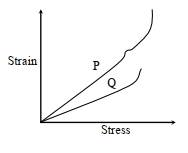
- 4In plotting stress versus strain curves for two materials $P$ and $Q$, a student by mistake puts strain on the $y$-axis and stress on the $x$-axis as shown in the figure. Then the correct statement$(s)$ is(are)View Solution
$(A)$ $P$ has more tensile strength than $Q$
$(B)$ $P$ is more ductile than $Q$
$(C)$ $P$ is more brittle than $Q$
$(D)$ The Young's modulus of $P$ is more than that of $Q$
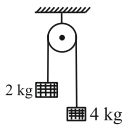
- 5Two blocks of mass $2 \mathrm{~kg}$ and $4 \mathrm{~kg}$ are connected by a metal wire going over a smooth pulley as shown in figure. The radius of wire is $4.0 \times 10^{-5}$ $\mathrm{m}$ and Young's modulus of the metal is $2.0 \times 10^{11} \mathrm{~N} / \mathrm{m}^2$. The longitudinal strain developed in the wire is $\frac{1}{\alpha \pi}$. The value of $\alpha$ is [Use $\mathrm{g}=10 \mathrm{~m} / \mathrm{s}^2$ )View Solution
- 6A uniform rod of mass $m$, length $L$, area of cross-section $A$ and Young's modulus $Y$ hangs from the ceiling. Its elongation under its own weight will beView Solution
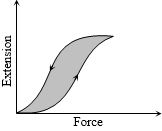
- 7The diagram shows a force-extension graph for a rubber band. Consider the following statementsView Solution
$I.$ It will be easier to compress this rubber than expand it
$II.$ Rubber does not return to its original length after it is stretched
$III.$ The rubber band will get heated if it is stretched and released
Which of these can be deduced from the graph
- 8View SolutionThe material which practically does not show elastic after effect is
- 9The upper end of a wire of radius $4\, mm$ and length $100\, cm$ is clamped and its other end is twisted through an angle of $60^o$. Then angle of shear is .......... $^o$View Solution
- 10A string of area of cross-section $4\,mm ^{2}$ and length $0.5$ is connected with a rigid body of mass $2\,kg$. The body is rotated in a vertical circular path of radius $0.5\,m$. The body acquires a speed of $5\,m / s$ at the bottom of the circular path. Strain produced in the string when the body is at the bottom of the circle is $\ldots . . \times 10^{-5}$. (Use Young's modulus $10^{11}\,N / m ^{2}$ and $g =10\,m / s ^{2}$ )View Solution