A $5\, \mu F$ capacitor is charged fully by a $220\,V$ supply. It is then disconnected from the supply and is connected in series to another uncharged $2.5\;\mu F$ capacitor. If the energy change during the charge redistribution is $\frac{ X }{100} \;J$ then value of $X$ to the nearest integer is$.....$
JEE MAIN 2020, Medium
Download our app for free and get started
$u _{ i }=\frac{1}{2} \times 5 \times 10^{-6}(220)^{2}$
Final common potential
$v=\frac{220 \times 5+0 \times 2.5}{5+2.5}=220 \times \frac{2}{3}$
$u _{ f }=\frac{1}{2}(5+2.5) \times 10^{-6}\left(220 \times \frac{2}{3}\right)^{2}$
$\Delta u = u _{ f }- u _{ i }$
$\Delta u =-403.33 \times 10^{-4}$
$\Rightarrow-403.33 \times 10^{-4}=\frac{ X }{100}$
$X=-4.03$
or magnitude or value of $X$ is approximate $4$

Download our appand get started for free
Experience the future of education. Simply download our apps or reach out to us for more information. Let's shape the future of learning together!No signup needed.*
Similar Questions
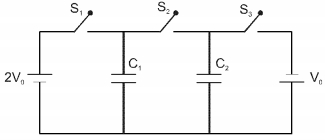
- 1In the circuit shown in the figure, there are two parallel plate capacitors each of capacitance $C$. The switch $S _1$ is pressed first to fully charge the capacitor $C_1$ and then released. The switch $S_2$ is then pressed to charge the capacitor $C _2$. After some time, $S _2$ is released and then $S _3$ is pressed. After some time.View Solution
$(A)$ the charge on the upper plate of $C _1$ is $2 CV _0$
$(B)$ the charge on the upper plate of $C _1$ is $CV _0$
$(C)$ the charge on the upper plate of $C _2$ is $0$
$(D)$ the charge on the upper plate of $C _2$ is $- CV _0$
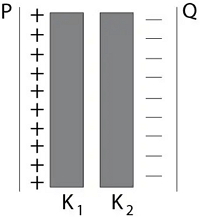
- 2Two thin dielectric slabs of dielectric constants $K_1$ and $K_2$ $(K_1 < K_2)$ are inserted between plates of a parallel plate capacitor, as shown in the figure. The variation of electric field $E$ between the plates with distance $d$ as measured from plate $P$ is correctly shown byView Solution
- 3A parallel plate capacitor of plate area $A$ and plate separation $d$ is charged to potential $V$ and then the battery is disconnected. A slab of dielectric constant $k$ is then inserted between the plates of the capacitors so as to fill the space between the plates. If $Q,\;E$ and $W$ denote respectively, the magnitude of charge on each plate, the electric field between the plates (after the slab is inserted) and work done on the system in question in the process of inserting the slab, then state incorrect relation from the followingView Solution
- 4Two identical metal balls of radius $r$ are at a distance $a (a >> r)$ from each other and are charged, one with potential $V_1$ and other with potential $V_2$. The charges $q_1$ and $q_2$ on these balls in $CGS$ esu areView Solution
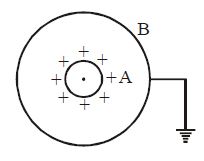
- 5$A$ and $B$ are concentric conducting spherical shells. $A$ is given a positive charge while $B$ is earthed. Then :-View Solution
- 6Three charges $Q, +q$ and $+q$ are placed at the vertices of a right -angle isosceles triangle as shown below. The net electrostatic energy of the configuration is zero, if the value of $Q$ isView Solution
- 7A capacitor is charged with a battery and energy stored is $U$. After disconnecting battery another capacitor of same capacity is connected in parallel to the first capacitor. Then energy stored in each capacitor isView Solution
- 8In free space, a particle $A$ of charge $1\,\mu C$ is held fixed at a point $P.$ Another particle $B$ of the same charge and mass $4\,\mu g$ is kept at a distance of $1\,mm$ from $P$. If $B$ is released, then its velocity at a distance of $9\,mm$ from $P$ is [ Take $\frac{1}{{4\pi {\varepsilon _0}}} = 9 \times {10^9}\,N{m^2}{C^{ - 2}}$ ]View Solution
- 9A parallel plate capacitor of capacitance $5\,\mu F$ and plate separation $6\, cm$ is connected to a $1\, V$ battery and charged. A dielectric of dielectric constant $4$ and thickness $4\, cm$ is introduced between the plates of the capacitor. The additional charge that flows into the capacitor from the battery is........$\mu C$View Solution
- 10Two electric dipoles $A, B$ with respective dipole moments $\overrightarrow {{d_A}} = - 4\,qa\,\hat i$ and $\overrightarrow {{d_B}} = 2\,qa\,\hat i$ are placed on the $x-$ axis with a separation $R$, as shown in the figure. The distance from $A$ at which both of them produce the same potential isView Solution