Question
(a) A current-carrying circular loop lies on a smooth horizontal plane. Can a uniform magnetic field be set up in such a manner that the loop turns around itself (i.e., turns about the vertical axis).
(b) A current-carrying circular loop is located in a uniform external magnetic field. If the loop is free to turn, what is its orientation of stable equilibrium? Show that in this orientation, the flux of the total field (external field + field produced by the loop) is maximum.
(c) A loop of irregular shape carrying current is located in an external magnetic field. If the wire is flexible, why does it change to a circular shape?
Answer

(a) No, because that would require $\tau$ to be in the vertical direction. But $\tau=I A \times B$, and since $A$ of the horizontal loop is in the vertical direction, $\tau$ would be in the plane of the loop for any $B$.
(b) Orientation of stable equilibrium is one where the area vector $A$ of the loop is in the direction of external magnetic field. In this orientation, the magnetic field produced by the loop is in the same direction as external field, both normal to the plane of the loop, thus giving rise to maximum flux of the total field.
(c) It assumes circular shape with its plane normal to the field to maximise flux, since for a given perimeter, a circle encloses greater area than any other shape.

Need a full question paper?

Generate a complete, print-ready paper with questions like this in minutes — across 16+ boards, with answer keys.

Start Generating Free

Similar questions

A circular loop of radius r carrying a current i is held at the centre of another circular loop of radius R(>> r) carrying a current I. The plane of the smaller loop makes an angle of 30° with that of the larger loop. If the smaller loop is held fixed in this position by applying a single force at a point on its periphery, what would be the minimum magnitude of this force?
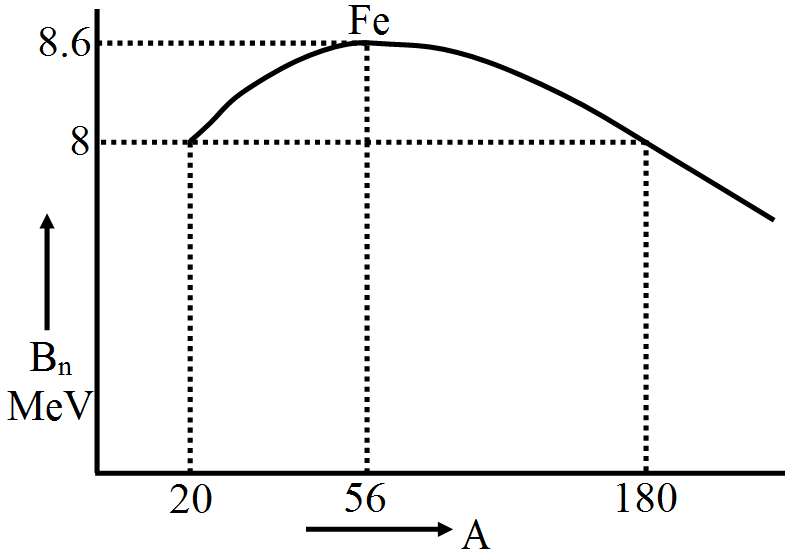
Draw the graph showing the variation of binding energy per nucleon with mass numbers. Give the reason for the decrease of binding energy per nucleon for nuclei with higher mass number.
A flywheel of moment of inertia $5.0kg-m^2$ is rotated at a speed of 60rad/s. Because of the friction at the axle, it comes to rest in 5.0 minutes. Find:
  1. The average torque of the friction.
  2. The total work done by the friction.
  3. The angular momentum of the wheel 1 minute before it stops rotating.
A uniform conducting wire of length 12a and resistance R is wound up as a current carrying coil in the shape of:
  1. An equilateral triangle of side a.
  2. A square of sides a.
  3. A regular hexagon of sides a. The coil is connected to a voltage source $V_0.$ Find the magnetic moment of the coils in each case.
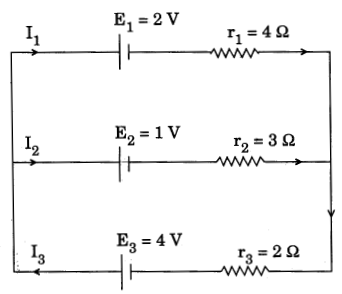
State Kirchhoff’s rules. Use these rules to write the expressions for the currents $I_1, I_2$ and $I_3$ in the circuit diagram shown.
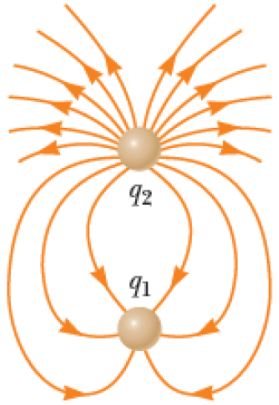
Consider the situation shown in figure. What are the signs of $q_1$ and $q_2?$ If the lines are drawn in proportion to the charge, what is the ratio $\frac{\text{q}_1}{\text{q}_2}?$
Two capacitors of unknown capacitances $C_1$ and $C_2$​​​​​​​ are connected first in series and then in parallel across a battery of 100 V. If the energy stored in the two combinations is 0.045 J and 0.25 J respectively, determine the value of $C_1$ and $C_2$. Also calculate the charge on each capacitor in parallel combination.
  1. Name the phenomenon on which the working of an optical fibre is based.
  2. What are the necessary conditions for this phenomenon to occur?
  3. Draw a labelled diagram of an optical fibre and show how light propagates through the optical fibre using this phenomenon.
A thin prism is made of a material having refractive indices 1.61 and 1.65 for red and violet light. The dispersive power of the material is 0.07. It is found that a beam of yellow light passing through the prism suffers a minimum deviation of 4.0° in favourable conditions. Calculate the angle of the prism.
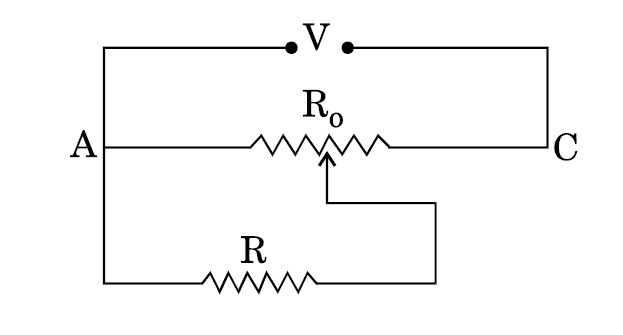
A resistance of R $\Omega$ draws current from a potentiometer as shown in the figure. The potentiometer has a total resistance $R_oΩ.$ A voltage V is supplied to the potentiometer. Derive an expression for the voltage across R when the sliding contact is in the middle of the potentiometer.