MCQ
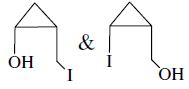
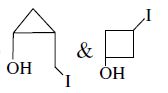
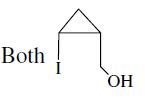
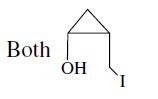
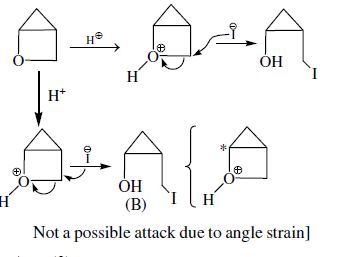
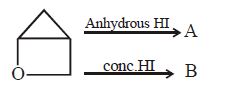
$A$ & $B$ are respectively:
  • A

  • B

  • C


Answer

Correct option: D.

d

Need a full question paper?

Generate a complete, print-ready paper with questions like this in minutes — across 16+ boards, with answer keys.

Start Generating Free

Similar questions

The molar conductivity of a $0.5\, mol/dm^3$ solution of $AgNO_3$ with electrolytic conductivity of $5.76 \times 10^{-3}\, S\, cm^{-1}$ at $298\, K$ is ......... $S\, cm^2/mol$.
For the given reaction :
$H_2(g) + S(s) \to H_2S(g)$ ;  $\Delta {H_r} = 100\, kJ/mol$ and $\Delta {S_r} = 400\, J/mol/K$ Temperature at which above reaction occurs reversibly is (Assumning $\Delta {H_r}$ and $\Delta {S_r}$ are independent of temperature).....$K$
The equilibrium

$S{O_2}C{l_2}(g)\, \rightleftharpoons S{O_2}(g)\, + \,C{l_2}(g)$

is attained at $25\,^oC$ in a closed container and inert gas helium is introduced at constant volume. Which of the following statements are not correct

$(a)$ Concentrations of $SO_2, Cl_2$ and $SO_2Cl_2$ change

$(b)$ More chlorine is formed

$(c)$ Concentration of $SO_2$ is reduced

$(d)$ More $SO_2Cl_2$ is formed

The reaction conditions leading to the best yields of $C_2H_5Cl$ are
$E^o _{cell}$ for the cell : 

$Pt(s) |H_2(g)\,|\,HCOOH(aq.)\,||\,CH_3COOH(aq.)\,|\,H_2(g)|Pt(s)$
at $25\,^o C$ is ............ $\mathrm{V}$

$(K_a$ of  $HCOOH \,= 2.4 × 10^{-4}$  , $K_a$ of $CH_3COOH = 1.8 × 10^{-5}$ , $log\,2\, = 0.3,\, log \,0.48, \frac{2.303 \times 298 \times R}{F} = 0.06)$

In the reaction $C{H_3}CH = C{H_2} + {H_2}O + \mathop {[O]}\limits_{Acid} $ $  \xrightarrow[Acid]{KMnO_4}  $  $\begin{array}{*{20}{c}}
  {C{H_3} - CH - C{H_2}} \\ 
  {\,\,\,\,\,\,\,\,\,\,\,\,\,\,|\,\,\,\,\,\,\,\,\,\,\,\,\,\,\,|\,\,} \\ 
  {\,\,\,\,\,\,\,\,\,\,\,\,\,\,OH\,\,\,\,\,\,\,\,OH} 
\end{array}$ $\xrightarrow{{[O]}}X + HCOOH$

$X$ is

Which of following has highest $EA$
The conversion of $2, 3$ -dibromobutane to $2$ -butene with $Zn$ is
$\Delta G$ in the process of melting of ice at $-15\,^oC$ is
Which of the following fails to answer the iodoform test.