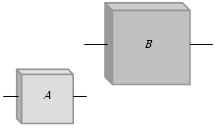
$A$ and $B$ are two square plates of same metal and same thickness but length of $B$ is twice that of $A$. Ratio of resistances of $A$ and $B$ is
Medium


Download our appand get started for free
Experience the future of education. Simply download our apps or reach out to us for more information. Let's shape the future of learning together!No signup needed.*
Similar Questions
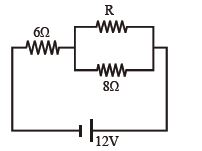
- 1In the circuit shown in figure, the power which is dissipated as heat in the $6\,\Omega$ resistor is $6\,W$. What is the value of resistance $R$ in the circuit?................... $\Omega$View Solution
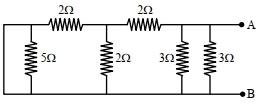
- 2The equivalent resistance of the given circuit between the terminals ${A}$ and ${B}$ is $....\Omega$View Solution
- 3To get the maximum current from a parallel combination of $n$ identical cells each of internal resistance $r$ in an external resistance $R$, whenView Solution
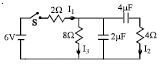
- 4In the circuit shown in the figure, the switch $S$ is initially open and the capacitor is initially uncharged. $ I_1, I_2$ and $I_3$ represent the current in the resistance $2\,\Omega , 4\,\Omega $ and $8\,\Omega$ respectively.View Solution
- 5View SolutionThe resistance of an incandescent lamp is
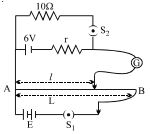
- 6In the arrangement shown in figure when the switch $S_2$ is open, the galvanometer shows no deflection for $l = L/2$. When the switch $S_2$ is closed, the galvanometer shows no deflection for $l = 5L /12$ . The internal resistance $(r)$ of $6\, V$ cell, and the $\mathrm{emf}$ $E$ of the other battery are respectivelyView Solution
- 7Two wires that are made up of two different materials whose specific resistance are in the ratio $2 : 3$, length $3 : 4$ and area $4 : 5$. The ratio of their resistances isView Solution
- 8Three resistances of magnitude $2$, $3$ and $5$ $ohm$ are connected in parallel to a battery of $10\, volts$ and of negligible resistance. The potential difference across $3\,\Omega $ resistance will be ............... $volts$View Solution
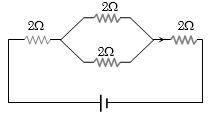
- 9The equivalent resistance of the circuit shown in the figure is ............. $\Omega$View Solution
- 10A uniform wire of $16\,\Omega $ is made into the form of a square. Two opposite corners of the square are connected by a wire of resistance $16\,\Omega $. The effective resistance between the other two opposite corners is ............... $\Omega$View Solution