Question
A, B and C are all liquids. Liquid A has a comparatively low boiling point. On heating, liquid a vaporizes completely without leaving behind any residue. Liquid A is being used increasingly as a fuel in motor vehicles either alone or by mixing with petrol. Liquid B has a very high boiling point. It also vaporizes completely on heating, without leaving any residue. Liquid B is a conductor of electricity and used in making thermometers. Liquid c has a moderate boiling point. On heating, liquid C vaporises leaving behind a white solid D which is used in cooking vegetables. The condensation of vapours from C give a liquid E which turns anhydrous CuSO4 to blue.
  1. Which liquid could be an element? Name this element.
  2. Which liquid could be a mixture? Name this mixture.
  3. Which liquid could be a compound? Name this compound.
  4. What could the solid D be?
  5. What do you think is liquid E?

Answer

  1. Liquid B has a very high boiling point. It also vaporises on heating. It is a conductor of electricity and is used in making thermometers. So, B could be an element. Further, liquid B is mercury as mercury is a liquid metal, which expands on heating and is used extensively in thermometers.
  2. Liquid C has a moderate boiling point. It could be a mixture. It is a salt solution because when C is heated, it vaporises and leaves behind a white solid (salt), which is used in the process of cooking.
  3. Liquid A is used in motor vehicles as fuel, either alone or after mixing with petrol. It could be a compound because on heating, it does not leave any residue. It is alcohol as alcohol is being used in motor vehicles nowadays.
  4. Solid D is sodium chloride. It is also known as common salt and is added in food.
  5. Liquid E is water as, on heating, liquid C, which is a salt solution, leaves water vapours. On condensing these vapours, we obtain pure water. When water is mixed with anhydrous copper sulphate, we obtain a blue colour solution. This is because of the formation of hydrated copper sulphate solution.

$\text{CuSO}_4+5\text{H}_2\text{O}\xrightarrow{\ \ \ \ \ \ \ \ \ \ \ \ }\text{CuSO}_4\cdot5\text{H}_2\text{O}\\ \ \ \ \ \ \ \ \ \ \ \ \ \ \ \ \ \ \ \ \ \ \ \ \ \ \ \ \ \ \ \ \ \ \ \ \ \ {^\text{hydrated copper sulphate}}$

Need a full question paper?

Generate a complete, print-ready paper with questions like this in minutes — across 16+ boards, with answer keys.

Start Generating Free

Similar questions

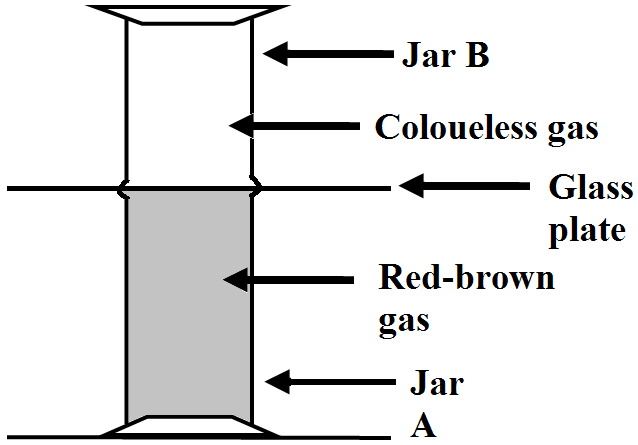
Look at the diagram on the right side. Jar A contains are d-brown gas whereas Jar B contains a colourless gas. The two gas jars are separated by a glass plate placed between them:

  1. What will happen when the glass plate between the two jars is pulled away?
  2. What name is given to the phenomenon which takes place?
  3. Name the brown gas which could be in jar A.
  4. Which is the colorless gas most likely to be present in jar B?
  5. Name one coloured solid and one colourless liquid which can show the same phenomenon.
Name the following:
  1. Smallest cell organelle.
  2. Largest cell organelle.
  3. ER studded with ribosomes.
  4. Functional segments of the DNA molecule.
What do you mean by passive and active transport? Write a note on diffusion.
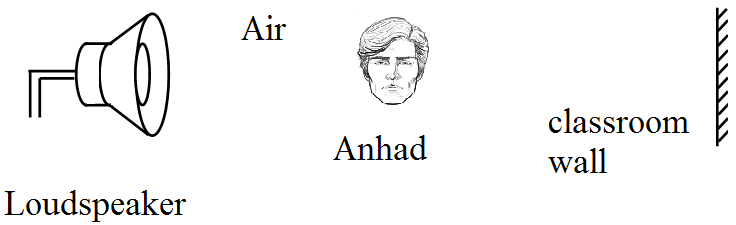
In an experiment, Anhad studies sound waves. He sets up a loudspeaker to produce sound as shown below:

Anhad adjusts the signal to the loudspeaker to give a sound of frequency 200Hz.

  1. What happens to the air in-between Anhas and the loudspeaker?
  2. Explain how Anhad receives sound in both ears.
How could you  convince a small child that when ou speak, it is not necessary for air to travel from your mouth to the ear of a listener?
Mention any two desirable agronomic characters for crop improvement. Explain how farmers get desired characters incorporated into the new varieties produced. List two conditions necessary for the new varieties to be accepted.

Discuss:

  1. Principles of treatment.
  2. Vaccination.
What are ionic and molecular compounds? Give examples.
Explain the transformation of energy in the following cases:
  1. A ball thrown upwards.
  2. A stone dropped from the roof of a building.
How will you separate a mixture of common salt, sulphur powder and sand?