MCQ
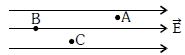
$A, B$ and $C$ are three points in a uniform electric field. The electric potential is
  • A
    Same at all the three points $A,B$ and $C$
  • B
    Maximum at $A$
  • Maximum at $B$
  • D
    Maximum at $C$

Answer

Correct option: C.
Maximum at $B$
c
Electric potential decreases in the direction of electric field.

Need a full question paper?

Generate a complete, print-ready paper with questions like this in minutes — across 16+ boards, with answer keys.
Start Generating Free

Similar questions

What will be the self inductance of a coil, to be connected in a series with a resistance of $\pi \sqrt 3 \,\Omega $ such that the phase difference between the emf and the current at $50\, Hz$ frequency is $30^o$......$Henry$
Find the correct order boiling point among the following
The number of electrons to be put on a spherical conductor of radius $0.1\,m$ to produce an electric field of $0.036\, N/C$ just above its surface is
A bucket full of water is revolved in vertical circle of radius $2\,m$. What should be the maximum time-period of revolution so that the water doesn't fall off the bucket ......... $\sec$.
m-chlorobenzaldehyde on treatment with $50 \%$ $\mathrm{KOH}$ solution yields
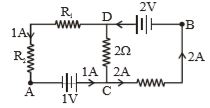
In the circuit shown below, if the potential at point $A$ is taken to be zero, the potential at point $B$ is .............. $V$
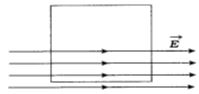
A square surface of side $L$ metres is in the plane of the paper. A uniform electric field $\vec E(V/m) $, also in the plane of the paper, is limited only to the lower half of the square surface, (see figure). The electric flux in SI units associated with the surface is
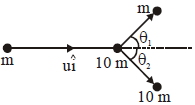
A particle of mass $m$ is moving along the $x$ -axis with initial velocity $u \hat i$. It collides elastically with a particle of mass $10\, m$ at rest and then moves with half its initial kinetic energy (see figure). If $\sin \theta_{1}=\sqrt{n} \sin \theta_{2}$ then value of $n$ is.....
The force is given in terms of time $t$ and displacement $x$ by the equation

${F}={A} \cos {Bx}+{C} \sin {Dt}$

The dimensional formula of $\frac{{AD}}{{B}}$ is -

An ideal battery of $4\, V$ and resistance $R$ are connected in series in the primary circuit of a potentiometer of length $1\, m$ and resistance $5\,\Omega $ . The value of $R$, to give a difference of $5\, mV$ across $10\, cm$ of potentiometer wire, is: ................ $\Omega$