Question
A ball is given a speed v on a rough horizontal surface. The ball travels through a distance l on the surface and stops.
  1. What are the initial and final kinetic energies of the ball?
  2. What is the work done by the kinetic friction?
Answer

  1. Initial kinetic energy of the ball, $\text{K}_\text{i}=\frac{1}{2}\text{mv}^2$
Here, m is the mass of the ball.
The final kinetic of the ball is zero.
Work done by the kinetic friction is equal to the change in kinetic energy of the ball.
  1. $\therefore$ Work done by the kinetic friction $=\text{K}_\text{f}-\text{K}_\text{i}$
$=0-\frac{1}{2}\text{mv}^2$
$=-\frac{1}{2}\text{mv}^2$

Need a full question paper?

Generate a complete, print-ready paper with questions like this in minutes — across 16+ boards, with answer keys.

Start Generating Free

Similar questions

The surface density (mass/ area) of a circular disc of radius a depends on the distance from the centre as p(r) = A + Br. Find its moment of inertia about the line perpendicular to the plane of the disc through its centre.
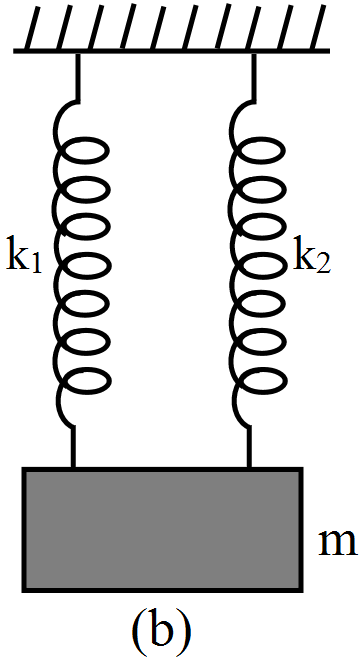
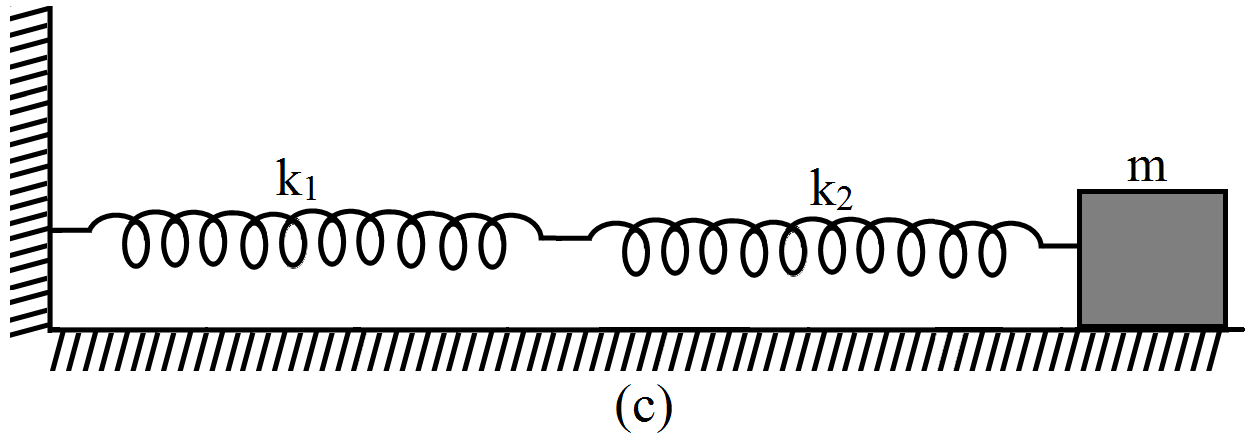
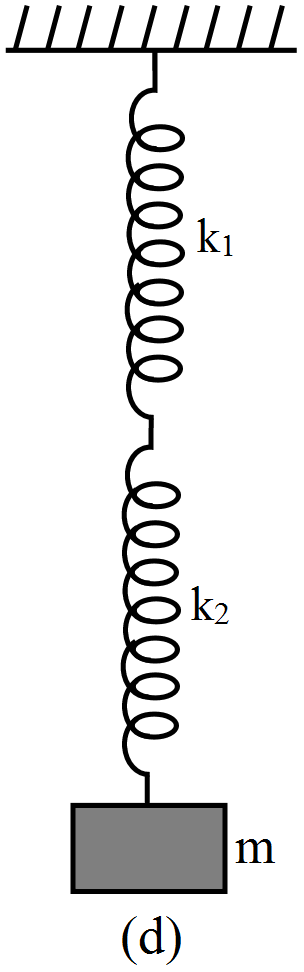
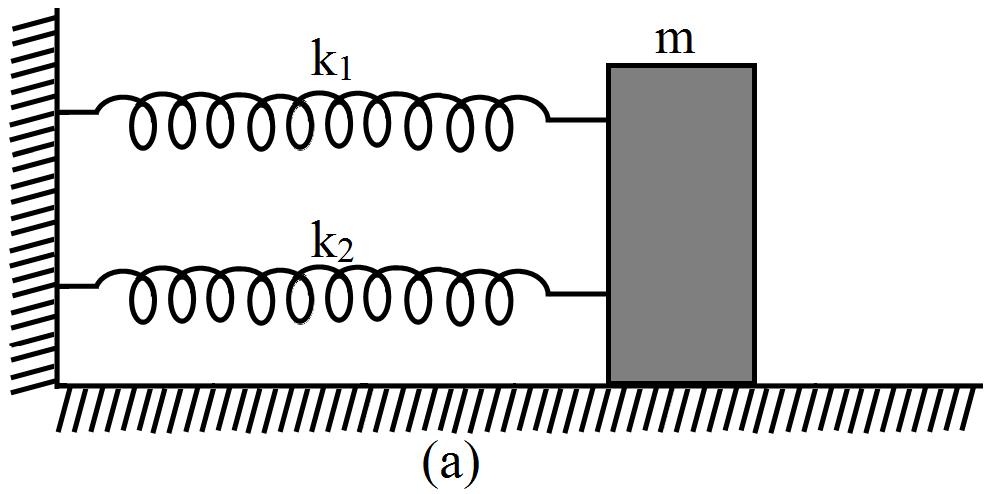
Figure below shows four different spring arrangements. If the mass in each arrangement is displaced from its equilibrium position and released, what is the resulting frequency of vibration in each case? Neglect the mass of the spring. (Fig. (a) and (b) represent an arrangement of springs in parallel, and (c) and (d) represent springs in series)


Iceberg floats in water with part of it submerged. What is the fraction of the volume of iceberg submerged if the density of ice is $\rho_\text{i}=0.917\text{g cm}^{-3}?$
A block of mass 5.0kg is suspended from the end of a vertical spring which is stretched by 10cm under the load of the block. The block is given a sharp impulse from below so that it acquires an upward speed of 2.0m/s. How high will it rise? Take g = $10m/s^2.$
A free atom of iron emits $\text{K}_\alpha$ X-rays of energy 6.4keV. Calculate the recoil kinetic energy of the atom. Mass of an iron atom = $9.3 \times 10^{-26}kg$.
Transverse waves are generated in two uniform steel wires $A$ and $B$ of diameters $10^{-3} m$ and $0.5 \times 10^{-3} m$ respectively, by attaching their free end to a vibrating source of frequency $500 Hz$ . Find the ratio of the wavelengths if they are stretched with the same tension.
What is gravitational potential energy at a point? How much of work is done in shifting a mass from the surface to a height equal to its radius?
Give example of a situation in which an applied force does not result in a change in kinetic energy.
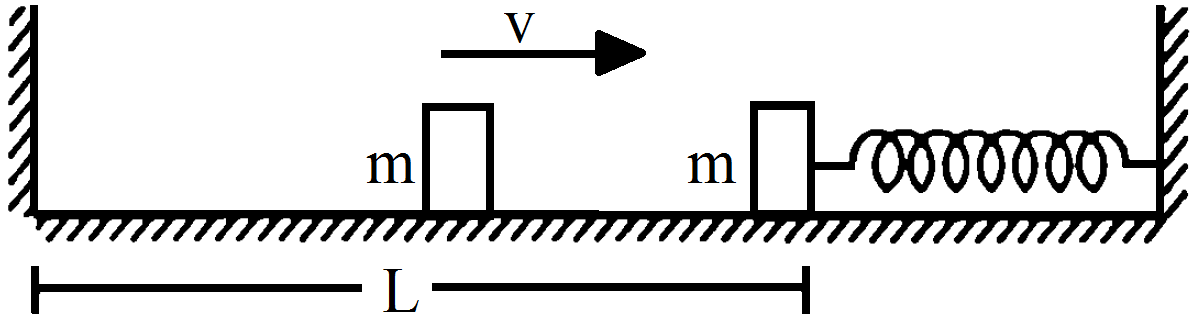
The left block in figure moves at a speed v towards the right block placed in equilibrium. All collisions to take place are elastic and the surfaces are frictionless. Show that the motions of the two blocks are periodic. Find the time period of these periodic motions. Neglect the widths of the blocks.
Prove for an adiabatic process:
  1. $\text{TV}^{\gamma-1}=\text{constant}.$
  2. $\text{P}^{1-\gamma}\text{T}^\gamma=\text{constant.}$