MCQ
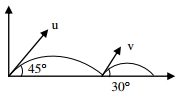
A ball is projected from the ground at an angle of $45^{\circ}$ with the horizontal surface. It reaches a maximum height of $120 m$ and returns to the ground. Upon hitting the ground for the first time, it loses half of its kinetic energy. Immediately after the bounce, the velocity of the ball makes an angle of $30^{\circ}$ with the horizontal surface. The maximum height it reaches after the bounce, in metres, is. . . . .
  • A
    $20$
  • $30$
  • C
    $40$
  • D
    $50$

Answer

Correct option: B.
$30$
b
$H =\frac{ u ^2 \sin ^2 45^{\circ}}{2 g }$

$h =\frac{ v ^2 \sin ^2 30^{\circ}}{2 g }$

$\frac{ h }{ H }=\frac{ v ^2 \times \frac{1}{4}}{ u ^2 \times \frac{1}{2}}=\frac{1}{2}$$\left(\frac{ v ^2}{ u ^2}\right)=\frac{1}{4}$

Need a full question paper?

Generate a complete, print-ready paper with questions like this in minutes — across 16+ boards, with answer keys.

Start Generating Free

Similar questions

Surface tension at critical temperature becomes:
Two blocks of masses $2 \,kg$ and $4 \,kg$ are hanging with the help of massless string passing over an ideal pulley inside an elevator. The elevator is moving upward with an acceleration $\frac{g}{2}$. The tension in the string connected between the blocks will be .......... $N$ (Take $g=10 \,m / s ^2$ ).
Molar specific heat of oxygen at constant pressure ${C_p} = 7.2\,cal/mol^\circ C$ and $R = 8.3 joule/mol/K$. At constant volume, $5\, mol$ of oxygen is heated from $10°C$ to $20°C$, the quantity of heat required is approximately ........ $cal$
The pressure applied from all directions on a cube is $P$. How much its temperature should be raised to maintain the original volume $?$ The volume elasticity of the cube is $\beta $ and the coefficient of volume expansion is $\alpha $
A ball of mass $m$ moving with velocity in collides elastically with wall and rebounds. The change in momentum of the ball will be:
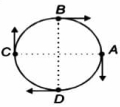
Four particles $A, B, C$ and $D$ are moving with constant speed $v$ each. At the instant shown relative velocity of $A$ with respect to $B, C$ and $D$ are in directions
The escape velocity for a planet is $v_e.$ A tunnel is dug along a diameter of the planet and a small body is dropped into it at the surface. When the body reaches the centre of the planet, its speed will be
The dimension of the ratio of angular to linear momentum is
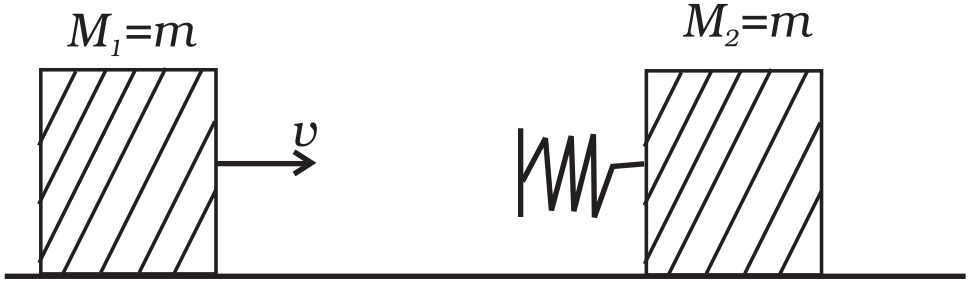
Two blocks $M_1$ and $M_2$ having equal mass are free to move on a horizontal frictionless surface. $M_2$ is attached to a massless spring as shown in. Iniially $M_2$ is at rest and $M_1$ is moving toward $M_2$​​​​​​​ with speed v and collides head$-$on with $M_2$​​​​​​​.
A particle is confined to rotate in a circular path decreasing linear speed, then which of the following is correct?