MCQ
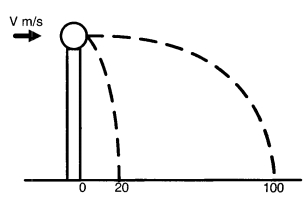
A ball of mass $0.2 \ kg$ rests on a vertical post of height $5 m$. A bullet of mass $0.01 \ kg$, traveling with a velocity $V / s$ in a horizontal direction, hits the centre of the ball. After the collision, the ball and bullet travel independently. The ball hits the ground at a distance of $20 \ m$ and the bullet at a distance of $100 \ m$ from the foot of the post. The initial velocity $V$ of the bullet is
  • A
    $250 \ m / s$
  • B
    $250 \sqrt{2} \ m / s$
  • C
    $400 \ m / s$
  • $500 \ m / s$

Answer

Correct option: D.
$500 \ m / s$
d
Let the mass of bullet be m and mass of ball be $M$ initially ball is at height $5$ m and t rest, the only acceleration is due to gravity therefore applying equation of motion

$S=u t+\frac{1}{2} g t^2$

$5=0+\frac{1}{2}(10) t^2$

therefore $t=1 \ sec$

$\text { so } V ( ball )=20 \ m / sec$

$V \text { (bullet) }=100 \ m / sec$

So by collision

$M \times V \text { (ball : final })+ m \times V \text { (bullet : final })=$

$M \times V \text { (boll : initial })+ m \times V \text { (bullet : initial })$

$0.01 \times V \text { (bulletfinal) }=0.01 \times 100+0.20 \times 20$

$V=500 \ m / sec$

Need a full question paper?

Generate a complete, print-ready paper with questions like this in minutes — across 16+ boards, with answer keys.

Start Generating Free

Similar questions

The acceleration due to gravity on the planet $ A $ is $9$ times the acceleration due to gravity on planet $B$. $A$ man jumps to a height of $2\,m$ on the surface of $ A$. What is the height of jump by the same person on the planet $B$..........$m$
Two spheres $P$ and $Q$ of equal radii have densities $\rho_1$ and $\rho_2$, respectively. The spheres are connected by a massless string and placed in liquids $L_1$ and $L_2$ of densities $\sigma_1$ and $\sigma_2$ and viscosities $\eta_1$ and $\eta_2$, respectively. They float in equilibrium with the sphere $P$ in $L_1$ and sphere $Q$ in $L _2$ and the string being taut (see figure). If sphere $P$ alone in $L _2$ has terminal velocity $\overrightarrow{ V }_{ P }$ and $Q$ alone in $L _1$ has terminal velocity $\overrightarrow{ V }_{ Q }$, then

$(A)$ $\frac{\left|\overrightarrow{ V }_{ P }\right|}{\left|\overrightarrow{ V }_{ Q }\right|}=\frac{\eta_1}{\eta_2}$ $(B)$ $\frac{\left|\overrightarrow{ V }_{ P }\right|}{\left|\overrightarrow{ V }_{ Q }\right|}=\frac{\eta_2}{\eta_1}$

$(C)$ $\overrightarrow{ V }_{ P } \cdot \overrightarrow{ V }_{ Q } > 0$ $(D)$ $\overrightarrow{ V }_{ P } \cdot \overrightarrow{ V }_{ Q } < 0$

The speed at the maximum height of a projectile is half of its initial speed $u$. The horizontal range of projectile is
The speed of sound in a medium depends on:
A block of mass $m$ slides down a smooth vertical circular track. During the motion, the block is in:
Gravitational potential difference between surface of a planet and a point situated at a height of $20\,m$ above its surface is $2\,joule/kg$. If gravitational field is uniform, then the work done in taking a $5\,kg$ body of height $4\,meter$ above surface will be ........ $J$
An aeroplane is flying horizontally with a velocity of $600\, km/h$ at a height of $1960\, m$. When it is vertically at a point $A$ on the ground, a bomb is released from it. The bomb strikes the ground at point $B$. The distance $AB$ is
In a gravitational field, at a point where the gravitational potential is zero
The energy that will be ideally radiated by a $100\,kW$ transmitter in $1$ hour is :
Ionization energy of a hydrogen$-$like ion $A$ is greater than that of another hydrogen$-$like ion $B$. Let $r, u, E$ and $L$ represent the radius of the orbit, speed of the electron, energy of the atom and orbital angular momentum of the electron respectively. In ground state: