Question
A ball of mass m, moving with a speed $2v_0$, collides inelastically $(e > 0)$ with an identical ball at rest. Show that:
For a general collision, the angle between the two velocities of scattered balls is less than $90°$
Answer

Consider the diagram shows general collision: (image not complet) Let angle between the $p_1$ and $p_2$ is $\theta$ By the law of conservation of momentum.$\vec{\text{p}}=\vec{\text{p}_1}+\vec{\text{p}_2}$
In inelastic collision, some part of KE lost in the from of heat, deshaping etc.$\therefore\ \text{KE}_\text{i}>\text{KE}_1+\text{KE}_2$
$\frac{1}{2}\text{mv}^2+\frac{1}{2}\text{m(0)}^2>\frac{1}{2}\text{mv}^2_1+\frac{1}{2}\text{mv}^2_2$
$\frac{\text{p}^2}{2\text{m}}>\frac{\text{p}^2_1}{2\text{m}}+\frac{\text{p}^2_2}{2\text{m}}$
$\therefore\ \vec{\text{p}}^2>\vec{\text{p}}^2_1+\vec{\text{p}}^2_2\ ....(\text{iii})$
If $\text{p}^2=\text{p}^2_1+\text{p}^2_2$ then angle between $p_1$ and $p_2$ is $90^\circ$ So, equation (iii) is true when angle between $p_1, p_2$ than $90^\circ$ or acute as shown in also.

Need a full question paper?

Generate a complete, print-ready paper with questions like this in minutes — across 16+ boards, with answer keys.

Start Generating Free

Similar questions

A pipe, $30.0 cm$ long, is open at both ends. Which harmonic mode of the pipe resonates a $1.1 kHz$ source? Will resonance with the same source be observed if one end of the pipe is closed? Take the speed of sound in air as $330 m s ^{-1}$.
Write the dimensions and derived units in M.K.S. unit system of the following quantities :
(i) Force, (ii) Power, (iii) Pressure, (iv) Stress, (v) Strain, (vi) Coefficient of elasticity, (vii) Relative density (viii) Gravitational constant.
Fig. shows two blocks of masses 5kg and 2kg placed on a frictionless surface and connected by a spring. An external kick gives a velocity 14 m/ s to the heavier block in the direction of lighter one. Deduce (i) the velocity gained by the centre of mass and (ii) the separate velocities of the two blocks in the centre of mass coordinates just after the kick.
Two satellites $S_1$ and $S_2$ revolve round a planet in coplanar circular orbit in the same sense. Their periods of revolution are one hour and $8$ hours respectively. The radius of the orbit of $S_1$ is $10^4km$. When $S_2$ is close to $S_1$ find:
  1. The speed of $S_2$ relative to $S_1$.
  2. The angular speed of $S_2$ as actually observed by an astronaut in $S_1$.
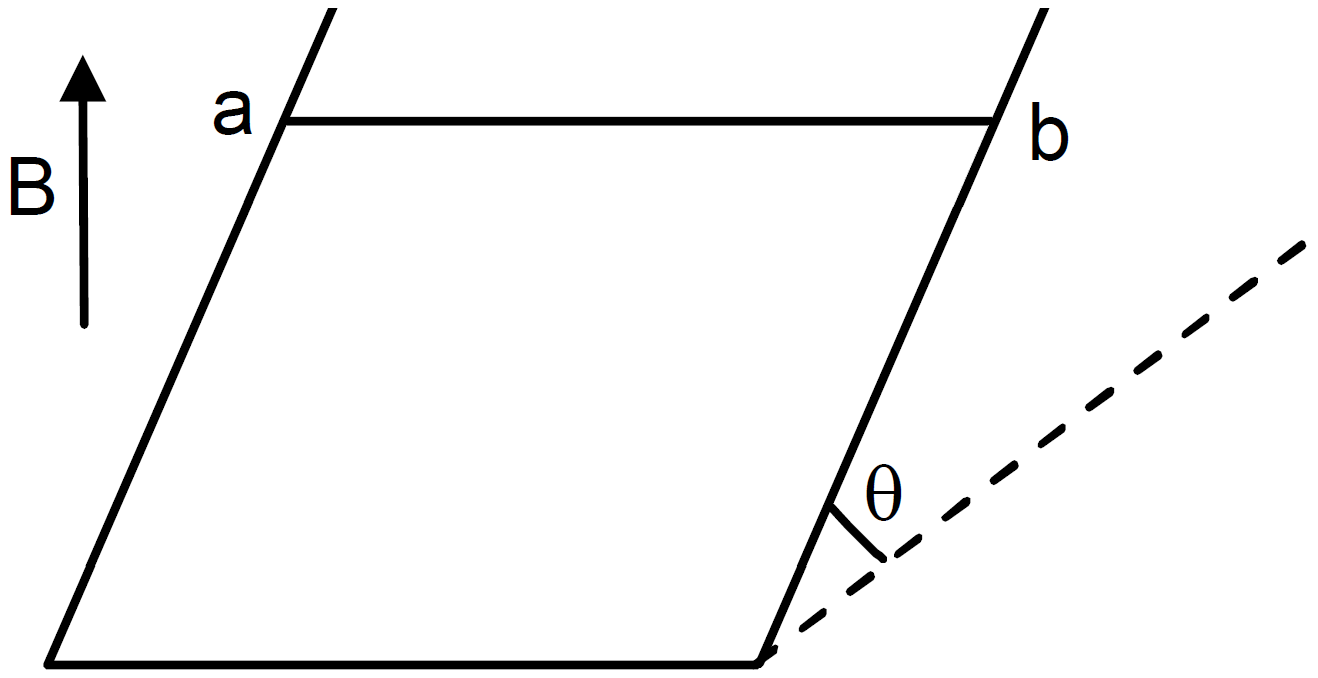
A wire ab of length l, mass m and resistance R slides on a smooth, thick pair of metallic rails joined at the bottom as shown in figure. The plane of the rails makes an angle θ with the horizontal. A vertical magnetic field B exists in the region. If the wire slides on the rails at a constant speed v, show that$\text{B}=\sqrt{\frac{\text{mgR}\sin\theta}{\text{vl}^2\cos^2\theta}}$
What is the moment of inertia? Explain its physical importance.
A mass is dropped from a height $h$ on to a floor with coefficient of restitution $'e\ '$. Find
  1. The height to which, it will go after $n$ collisions.
  2. The velocity after $'n\ '$ collisions with the floor.
  3. The time taken till the $n^{th}$ collision.
An ideal gas is kept in a long cylindrical vessel fitted with a frictionless piston of cross-sectional area $10cm^2$ and weight $1kg$. The length of the gas column in the vessel is $20cm$. The atmospheric pressure is $100kPa$. The vessel is now taken into a spaceship revolving round the earth as a satellite. The air pressure in the spaceship is maintained at $100kPa$. Find the length of the gas column in the cylinder.
In a gamma decay process, the internal energy of a nucleus of mass M decreases, a gamma photon of energy E and linear momentum $\frac{\text{E}}{\text{c}}$ is emitted and the nucleus recoils. Find the decrease in internal energy.
Explain isothermal, isobaric and adiabatic processes and write equations of state for them.