MCQ
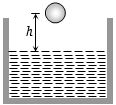
A ball of radius $r $ and density $\rho$ falls freely under gravity through a distance $h$ before entering water. Velocity of ball does not change even on entering water. If viscosity of water is $\eta$, the value of $h$ is given by
  • A
    $\frac{2}{9}{r^2}\left( {\frac{{1 - \rho }}{\eta }} \right)\,g$
  • B
    $\frac{2}{{81}}{r^2}\left( {\frac{{\rho - 1}}{\eta }} \right)\,g$
  • $\frac{2}{{81}}{r^4}{\left( {\frac{{\rho - 1}}{\eta }} \right)^2}g$
  • D
    $\frac{2}{9}{r^4}{\left( {\frac{{\rho - 1}}{\eta }} \right)^2}g$
Answer

Correct option: C.
$\frac{2}{{81}}{r^4}{\left( {\frac{{\rho - 1}}{\eta }} \right)^2}g$
c
(c)Velocity of ball when it strikes the water surface $v = \sqrt {2gh} $ …(i)
Terminal velocity of ball inside the water

$v = \frac{2}{9}{r^2}g\frac{{\left( {\rho - 1} \right)}}{\eta }$ …(ii)
Equating (i) and (ii) we get

$\sqrt {2gh} = \frac{2}{9}\frac{{{r^2}g}}{\eta }(\rho - 1)$
==> $h = \frac{2}{{81}}{r^4}{\left( {\frac{{\rho - 1}}{\eta }} \right)^2}g$

Need a full question paper?

Generate a complete, print-ready paper with questions like this in minutes — across 16+ boards, with answer keys.

Start Generating Free

Similar questions

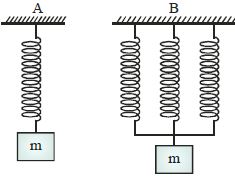
The springs in figure. $A$ and $B$ are identical but length in $A$ is three times that in $B$. The ratio of period $T_A/T_B$ is
A cyclist moves in a circular track of radius $100$ m. If the coefficient of friction is $0.2$, then the maximum velocity with which the cyclist can take the turn with leaning inwards is ...... $m/s$ 
A player caught a cricket ball of mass $150\, gm$ moving at the rate of $20 \,m/sec$. if the catching process be completed in $ 0.1 \,sec$ the force of the blow exerted by the ball on the hands of player is  ........... $N$
A particle moves $21\, m$ along the vector $6\hat i + 2\hat j + 3\hat k$ , then $14\, m$ along the vector $3\hat i - 2\hat j + 6\hat k$ . Its total displacement (in meters) is
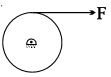
$A$ pulley is hinged at the centre and a massless thread is wrapped around it. The thread is pulled with a constant force $F$ starting from rest. As the time increases,
A uniform rod $AB$ of length $l$ and mass $m$ is free to rotate about point $A$ . The rod is released from rest in the horizontal position. Given that the moment of inertia of the rod about $A$ is $\frac {ml^2}{3}$ , the initial angular acceleration of the rod will be 
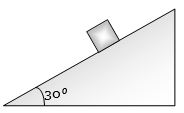
The time taken by a block of wood (initially at rest) to slide down a smooth inclined plane $9.8\, m$ long (angle of inclination is ${30^o}$) is.........$sec$
Two vectors $\vec A$ and $\vec B$ have equal magnitudes. The magnitude of $(\vec A + \vec B)$ is $‘n’$ times the magnitude of $(\vec A - \vec B)$. The angle between $ \vec A$ and $\vec B$ is
A point moves in $x-y$ plane as per $x=kt,$ $y = kt\left( {1 - \alpha t} \right)$ where $k\,\& \,\alpha \,$ are $+ve$ constants. The equation of trajectory is 
Find the value of $\frac{1.53 \times 0.9995}{1.592}$ with due regard for significant figures