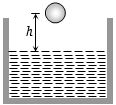
A ball of radius $r $ and density $\rho$ falls freely under gravity through a distance $h$ before entering water. Velocity of ball does not change even on entering water. If viscosity of water is $\eta$, the value of $h$ is given by
Diffcult


Download our appand get started for free
Experience the future of education. Simply download our apps or reach out to us for more information. Let's shape the future of learning together!No signup needed.*
Similar Questions
- 1View SolutionBernoulli’s principle is based on the law of conservation of
- 2A table tennis ball has radius $(3 / 2) \times 10^{-2} m$ and mass $(22 / 7) \times 10^{-3} kg$. It is slowly pushed down into a swimming pool to a depth of $d=0.7 m$ below the water surface and then released from rest. It emerges from the water surface at speed $v$, without getting wet, and rises up to a height $H$. Which of the following option(s) is (are) correct?View Solution
[Given: $\pi=22 / 7, g=10 ms ^{-2}$, density of water $=1 \times 10^3 kg m ^{-3}$, viscosity of water $=1 \times 10^{-3} Pa$-s.]
$(A)$ The work done in pushing the ball to the depth $d$ is $0.077 J$.
$(B)$ If we neglect the viscous force in water, then the speed $v=7 m / s$.
$(C)$ If we neglect the viscous force in water, then the height $H=1.4 m$.
$(D)$ The ratio of the magnitudes of the net force excluding the viscous force to the maximum viscous force in water is $500 / 9$.
- 3View SolutionAn ice block contains a glass ball when the ice melts within the water containing vessel, the level of water
- 4Water is flowing steadily through a horizontal tube of non uniform cross-section. If the pressure of water is $4$ $\times $ $10^4$ $N/m^2$ at a point where cross-section is $0.02$ $m^2$ and velocity of flow is $2$ $m/s$, what is pressure at a point where cross-section reduces to $0.01$ $m^2$.View Solution
- 5View SolutionIncrease in pressure at one point of the enclosed liquid in equilibrium of rest is transmitted equally to all other points of liquid. This is as per ...........
- 6A liquid of density $10^3 \,kg / m ^3$ and coefficient of viscosity $8 \times 10^{-2} \;decapoise$ is flowing in a tube of radius $2 \,cm$ with speed $2 \,m / s$. The Reynold's number is ..........View Solution
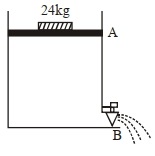
- 7Consider a water tank as shown in the figure. It's cross-sectional area is $0.4\, m ^{2}$. The tank has an opening $B$ near the bottom whose cross-section area is $1\, cm ^{2}$. A load of $24\, kg$ is applied on the water at the top when the height of the water level is $40\, cm$ above the bottom, the velocity of water coming out the opening $B$ is $v\, ms ^{-1}$. The value of $v$, to the nearest integer, is ......$m/s$. [Take value of $g$ to be $10 \,ms ^{-2}$ ]View Solution
- 8If a ball of steel (density $\rho=7.8 \;gcm ^{-3}$) attains a terminal velocity of $10 \;cms ^{-1}$ when falling in a tank of water (coefficient of viscosity $\eta_{\text {water }}=8.5 \times 10^{-4} \;Pa - s$ ) then its terminal velocity in glycerine $\left(\rho=12 gcm ^{-3}, \eta=13.2\right)$ would be nearlyView Solution
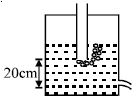
- 9View SolutionA tube is attached as shown in closed vessel containing water. The velocity of water coming out from a small hole is :
- 10Two identical cylindrical vessels with their bases at same level each contains a liquid of density $\rho$. The height of the liquid in one vessel is ${h_1}$ and that in the other vessel is ${h_2}$. The area of either base is $A$. The work done by gravity in equalizing the levels when the two vessels are connected, isView Solution