A ball of relative density $0.8$ falls into water from a height of $2$ $m$. The depth to which the ball will sink is ........ $ m$ (neglect viscous forces) :
Medium
Download our app for free and get started
Buoyancy force $=(d v) g$
$m=d^{\prime} V$
acceleration$=\frac{\text {net force}}{m}=\frac{d V g}{d^{\prime} V}$
$\Rightarrow \frac{d \times g}{d^{\prime}}=\frac{10}{0.8}=12.5 \mathrm{m} / \mathrm{s}^{2}$
depth it gets sinked down$:$
$\Rightarrow(2 g \times 2)=0^{2}+2 \times g \times s$
$s=8 m$

Download our appand get started for free
Experience the future of education. Simply download our apps or reach out to us for more information. Let's shape the future of learning together!No signup needed.*
Similar Questions
- 1Two capillary tubes of the same length but different radii $r_1 $ and $r_2$ are fitted in parallel to the bottom of a vessel. The pressure head is $ P. $ What should be the radius of a single tube that can replace the two tubes so that the rate of flow is same as beforeView Solution
- 2A spherical ball of density $\rho$ and radius $0.003$ $m$ is dropped into a tube containing a viscous fluid filled up to the $0$ $ cm$ mark as shown in the figure. Viscosity of the fluid $=$ $1.260$ $N.m^{-2}$ and its density $\rho_L=\rho/2$ $=$ $1260$ $kg.m^{-3}$. Assume the ball reaches a terminal speed by the $10$ $cm$ mark. The time taken by the ball to traverse the distance between the $10$ $cm$ and $20$ $cm$ mark isView Solution
( $g$ $ =$ acceleration due to gravity $= 10$ $ ms^{^{-2}} )$

- 3A highly viscous liquid of viscosity coefficient $\eta$ flows through a fixed horiwntal cylindrical tube (fixed from outer surface) of internal radius $r$, thickness $t (t << r)$ and length $l$. Volume of liquid flowing per;second is $Q$ and pressure difference across the tube is $P$. Modulus of rigidity of material of tube is $\beta$. Shear strain in the tube will beView Solution
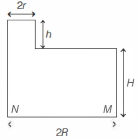
- 4A cylindrical vessel of base radius $R$ and height $H$ has a narrow neck of height $h$ and radius $r$ at one end (see figure). The vessel is filled with water (density $\rho_w$ ) and its neck is filled with immiscible oil (density $\rho_0$ ). Then, the pressure atView Solution
- 5A tank with a square base of area $1.0\; m ^{2}$ is divided by a vertical partition in the middle. The bottom of the partition has a small-hinged door of area $20\; cm ^{2} .$ The tank is filled with water in one compartment, and an acid (of relative density $1.7$) in the other, both to a height of $4.0 \;m$. compute the force (in $N$) necessary to keep the doorView Solution
- 6A body of density $\rho$ is dropped from rest from a height $h$ into a lake of density $\sigma$, where $\sigma > \rho$. Neglecting all dissipative forces, the maximum depth to which the body sinks before returning to float on surface ..........View Solution
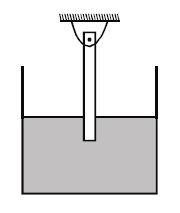
- 7A thin vertical uniform wooden rod is pivoted at the top and immersed in water as shown. The container is slowly raised. At a certain moment, the equilibrium becomes unstable. If density of water is $9/5$ times the density of wood, then ratio of total length of rod to the submerged length of rod, at that moment isView Solution
- 8View SolutionA beaker containing a liquid is kept inside a big closed jar. If the air inside the jar is continuously pumped out, the pressure in the liquid near the bottom of the liquid will
- 9A $0.5\ kg$ mass of lead is submerged in a container filled to the brim with water and a block of wood floats on top. The lead mass is slowly lifted from the container by a thin wire and as it emerges into air the level of the water in the container drops a bit. The lead mass is now placed on the block of wood. As the lead is placed on the wood.View Solution
- 10The value of $g $ at a place decreases by $ 2\%.$ The barometric height of mercuryView Solution