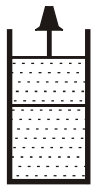
In the figure a container is shown to have a movable (without friction) piston on top. The container and the piston are all made of perfectly insulating material allowing no heat transfer between outside and inside the container. The container is divided into two compartments by a rigid partition made of a thermally conducting material that allows slow transfer of heat. The lower compartment of the container is filled with $2$ moles of an ideal monatomic gas at $700 \ K$ and the upper compartment is filled with $2$ moles of an ideal diatomic gas at $400$
K. The heat capacities per mole of an ideal monatomic gas are $C_v=\frac{3}{2} \ R, C_p=\frac{5}{2} R$, and those for an ideal diatomic gas are $C _{ v }=\frac{5}{2} \ R , C _{ P }=\frac{7}{2} R$.
$1.$ Consider the partition to be rigidly fixed so that it does not move. When equilibrium is achieved, the final temperature of the gases will be :
$(A)$ $550 \ K$ $(B)$ $525 \ K$ $(C)$ $513 \ K$ $(D)$ $490 \ K$
$2.$ Now consider the partition to be free to move without friction so that the pressure of gases in both compartments is the same. Then total work done by the gases till the time they achieve equilibrium will be:
$(A)$ $250 \ R$ $(B)$ $200 \ R$ $(C)$ $100 \ R$ $(D)$ $-100 \ R$
Give the answer question $1$ and $2.$